Sunday, August 31, 2025

Asteroid Bennu Samples Contain Stardust Older Than Our Solar System

Image More details: Visit website

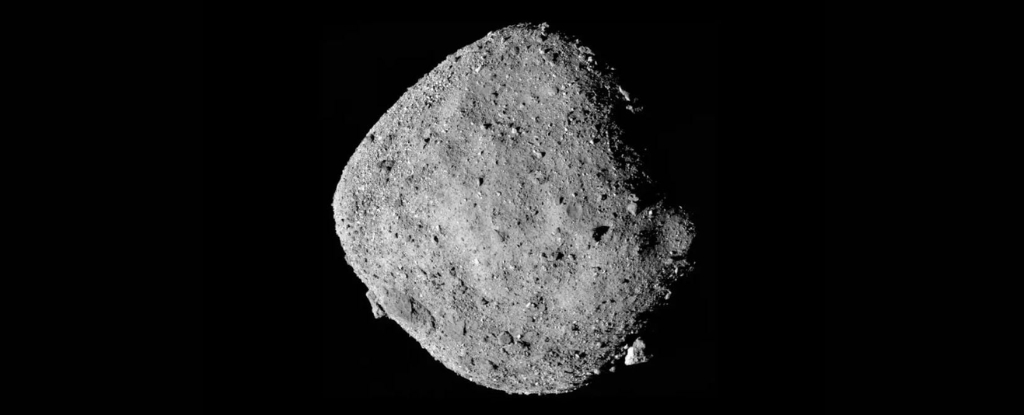
The ambitious mission to retrieve samples from asteroid Bennu and return them to Earth is paying off.

Just as scientists had hoped, the asteroid is revealing details about the early days in our Solar System. More than just a simple space rock, Bennu contains not only material from the Solar System, but material from beyond our system.

Bennu follows an orbit that brings it close to Earth every six years. That means it's classified as a near-Earth asteroid (NEA) and a potentially hazardous object (PHO).

When NASA was planning the OSIRIS-REx mission that visited Bennu and returned the sample, it was the result of a vigorous scientific and engineering evaluation of candidate asteroids.

Since Bennu is both close to Earth and a primitive carbonaceous asteroid, NASA settled on it as the target.

The asteroid is both large enough to orbit and collect a sample from, and spectroscopic analysis of its surface showed it contained things scientists wanted to study, like carbon-rich materials and hydrated minerals.

Jessica Barnes, associate professor at the University of Arizona's Lunar and Planetary Laboratory is a co-lead author on one of the publications.

"It's super exciting that we're finally able to say these things about an asteroid that we've been dreaming of going to for so long and eventually brought back samples from."

See The Original Version Of 'Earthrise,' Taken 59 Years Ago This Week ⁘ Space Photo Of The...

Image Reference: See here

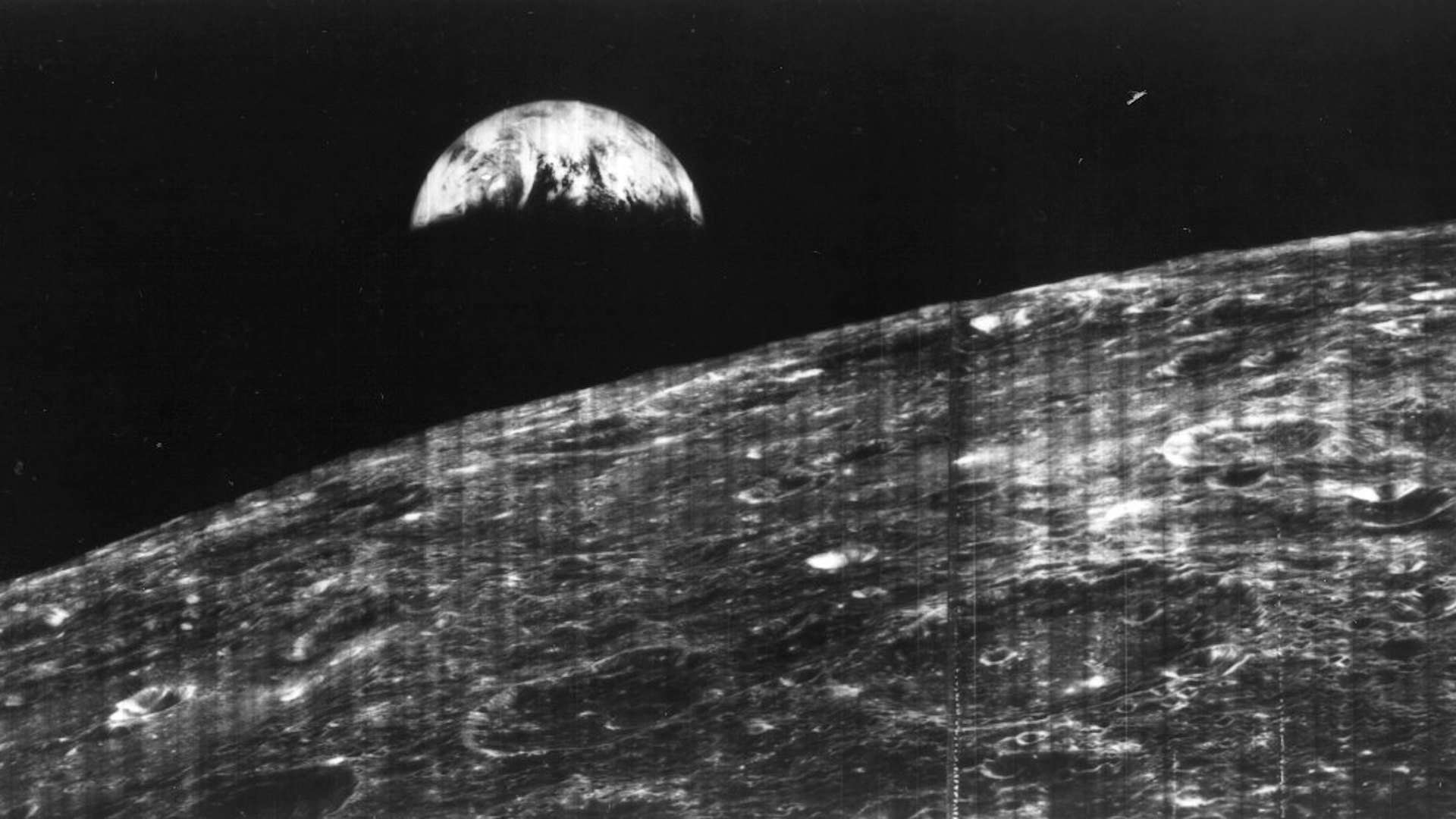
Humanity's first look at Earth from the moon didn't come until Aug. 23, 1966, when this grainy, black-and-white image showed our planet as a crescent above the lunar horizon, appearing to rise as the camera-toting spacecraft moved in orbit.

At the time, it was a landmark image ⁘ and totally unplanned, according to NASA . The first view of Earth from the moon came from NASA 's Lunar Orbiter 1, which transmitted the image to a tracking station at Robledo De Chavela near Madrid.

Lunar Orbiter 1's camera, manufactured by Eastman Kodak, featured an automated system that developed exposed film, scanned the images, and transmitted them to Earth. The camera was originally developed by the National Reconnaissance Office and was flown on the Cold War-era Samos spy satellites that were launched by the U.S. in the 1960s, according to NASA.

Lunar Orbiter 1 orbited the moon for 76 days until it deliberately crashed into the moon on Oct. 29, 1966.

Jamie Carter is a freelance journalist and regular Live Science contributor based in Cardiff, U.K. He is the author of A Stargazing Program For Beginners and lectures on astronomy and the natural world.

Jamie regularly writes for Space.com, TechRadar.com, Forbes Science, BBC Wildlife magazine and Scientific American, and many others. He edits WhenIsTheNextEclipse.com .

San Antonio Research Hub Finds New Moon Orbiting Uranus

Image More details: Found here

Scientists from a  San Antonio-based research hub have found a new moon orbiting Uranus using NASA's James Webb Space Telescope.

Southwest Research Institute said it discovered a previously unknown "tiny moon" orbiting the seventh planet from the sun.

Maryame El Moutamid, a lead researcher in SwRI's Boulder, Colo., office, observed the small object in images taken by the $10 billion space telescope in February.

"We found a previously unknown satellite of the ice giant, which has been provisionally designated S/2025 U 1," El Moutamid said  in a statement . "This object, by far the smallest object discovered to date, was detected in a series of 10 long exposures obtained by the Near-Infrared Camera."

SPACE NEWS: After Sunday scrub, SpaceX to try for 10th test flight of Starship from South Texas Monday evening

The SwRI team got about 12 hours of time to use the telescope as part of the program's General Observer program, which allows scientists from around the world to access data from the observatory that orbits the Sun about a million miles from Earth. 

The only craft to visit Uranus was  Voyager 2 which flew within 50,000 miles of the planet's cloud tops in January 1986. It discovered Uranus' rings and 10 of the planet's moons, according to SwRI.   

The newly discovered moon "is well below the detection threshold for the Voyager 2 cameras," El Moutamid said.

Saturday, August 30, 2025

Robots Increasingly Used In Japan To Enhance Business Efficiency

Image Read more: See here

Japan is increasingly using robots for transportation and sales at office buildings, apartments, stadiums and other large-scale facilities.

As the country needs to address labor shortages urgently, companies and workers are exploring how robots and humans can work together better for business efficiency.

The Es Con Field Hokkaido stadium, home to the Hokkaido Nippon-Ham Fighters professional baseball team, has introduced work assistance robot "Suppot" to transport beer kegs.

The robot detects and automatically follows its user and can carry up to 60 beer kegs. Another robot to sell food and drinks to spectators is being tested.

An official of parcel delivery group Yamato Holdings, which manages the operations of the robots, voiced hope that such robots will also be used in other locations.

Four robots serve as porters at Mita Garden Hills, a large apartment in Tokyo developed by real estate giant Mitsui Fudosan and others.

They can transport residents' baggage weighing up to 30 kilograms between the entrance and a residential unit. Doors and elevators operate in coordination with the robots, enabling smooth and automated transportation.

Over 20% of the porter service deliveries are handled by the robots after the Mitsui Fudosan group identified efficient routes for them and informed residents of the service, according to an official.

In July, telecommunications company KDDI in cooperation with convenience store operator Lawson opened an experimental store using digital technology at its headquarters in the Takanawa Gateway City redevelopment area in Tokyo. Ten robots are used to deliver products to employees' offices and conduct mobile sales.

A Strange Object Has Entered Our Solar System—and One Scientist Says It May Be An Alien Craft

Image Read more: Visit website

Object 3I/ATLAS is now too far from Earth to aim a telescope at, but prior observations showed some unusual behavior.

The anomalous nature of the object led astrophysicist Avi Loeb to apply a thought experiment to it, highlighting everything about it that might align with a hypothetical alien spacecraft.

Even if this supposed space rock is not powered by aliens (as is the dominant opinion of the field), Loeb's methodology could be applied to analyze other interstellar objects in the future.

Every time an interstellar object comes whizzing into our Solar System , it brings with it a certain intrigue.

Where is it from? How did it form? Why was it gravitationally kicked out of its own star system? Could it be an alien spacecraft?

Something like Oumuamua, 21/Borisov and now 3I/ATLAS (the latest space rock to go viral) doesn't exactly appear like the starships of science fiction. But, to be fair, we Earthlings really have no idea what spacecraft from other intelligent civilizations (if they do exist) would actually look like.

Controversial astrophysicist Avi Loeb from Harvard University—founding director of the Black Hole Initiative and increasingly known for frequently crying "alien"—continues to be curious about what is really out there. Maybe aliens are eluding us by launching probes or ships that only appear to be chunks of rocky debris.

Even though Loeb is aware that the debate about this possibility is "mired in bitter controversy," as he said in a study recently submitted to Research Notes of the American Astronomical Society , the "hypothesis is an interesting exercise in its own right, and is fun to pursue, irrespective of its likely validity."

Whether or not 3I/ATLAS really is powered by aliens, Loeb thinks there is a reason applying his hypothesis to the object is worthwhile.

Alien intentions could be completely benign or could mean doom for humanity . It could be that there are beings out there who are just trekking from star to star, possibly seeking out a new home or just enjoying the scenery, without intending to deploy any, say, missiles that could vaporize an entire planet. But others could mean us harm.

Whether or not our defensive capabilities are enough to take on a hostile civilization is unknown, because we are unaware of what kind of technology they might threaten us with.

How Many Planets Orbit Our Nearest Neighboring Star?

Image Source: Visit website

Some of the most promising places to look for extraterrestrials have remained, so far, mostly hidden from astronomers. Now a game-changing instrument called NIRPS (Near-Infrared Planet Searcher) is leading the search for the most tantalizing targets in the cosmos: potentially Earth-like worlds around nearby red dwarf stars.

Red dwarfs, or M dwarfs, are the most tempting places to seek alien Earths because they're the most abundant and enduring stars . They make up the majority of the stars in the Milky Way and shine with a slow thermonuclear simmer that should allow them to live exponentially longer than most—even, say, for 14 trillion years , or 1,000 times the current age of the universe.

But M dwarfs are also the smallest, dimmest stars, so they and their planets can be difficult to detect and inspect. Enter NIRPS, an instrument custom-built to tease out subtle signs of otherwise hidden worlds by making unmatched high-precision measurements of M dwarfs, which emit most of their light in infrared and near-infrared wavelengths.

"I think we are in the golden age of M dwarfs, where they offer a huge amount of possibility—they are the best place to detect small Earth-sized planets," says Natalie Hinkel, a planetary astrophysicist at Louisiana State University, who is not a member of the NIRPS team.

René Doyon, a professor at the University of Montreal and co-principal investigator of NIRPS, contextualized the breakthrough in a press release : "For the first time, we can reach sub-meter-per-second radial velocity precision in the infrared." This means that NIRPS can view a distant star zooming through space and discern a change in its velocity that's equivalent to the speed of a leisurely stroll through the park.

NIRPS and other RV-based projects are spectrographs, akin to prisms attached to existing telescopes. Much like a prism spreads white light into a rainbow of colors, a spectrograph splits incoming starlight into its constituent wavelengths, producing a rainbowlike spectrum. " Fingerprints " of different atoms and molecules in a star's atmosphere can be imprinted on its spectrum, and they serve as reference marks to planet-hunters looking for minuscule velocity shifts.

Friday, August 29, 2025

Google Maps Users Claim They've Found An 'Alien Base' In Antarctica

Image Reference: Found here

Hold your horses folks, Google Maps users have stumbled upon another 'UFO' and it's worrying conspiracy theorists everywhere.

People are convinced that a crash-landed alien spaceship is readily available for viewing online if you go to specific coordinates.

It's worrying people on social media , and even more eerily, the item has been found in Antarctica.

In all fairness, how would a 1,000ft UFO go undetected by humans, regardless of where it is on Earth?

But now, a round entity has been found beneath a cliff around 90 miles from the coast of Antarctica, which might be enough to get certain Transformers fans a bit excited.

Whether it's man-made or something otherworldly, one American ufologist has claimed that it could be stuck under a rock in yet another conspiracy theory .

Almost appearing like an Oreo, it's been theorised that the item might even be hidden on purpose, as UFO Sightings Daily website runner Scott C. Waring stated on YouTube.

AI, And Data Sovereignty Are Rewriting Global Trade

Image Reference: Found here

By Dr. (Cand.) Sandya Bhat, Aerospace ⁘ Defense Industry Strategist and Digital Transformation Leader at SAP

Far above us, satellites are capturing a live feed of our planet. This isn't just imagery, it's intelligence.

What was once the domain of national space agencies and scientific research, satellite data, orbital imagery, and Earth intelligence is now becoming foundational to enterprise IT strategy.

With real-time visibility into rainfall, crop stress, shipping congestion, and deforestation, these constellations are quietly reshaping how global businesses move goods, predict risks, and make decisions.

For years, supply chains have relied on historical trends. When a disruption occurred; a port closed or a crop failed, companies scrambled to respond.

Today, data from orbit is being combined with ground-level enterprise signals to anticipate change before it happens. A delay at a port in Singapore, rising soil salinity in Brazil, or a storm brewing off the Pacific can all be sensed, analysed, and acted upon before they cause a ripple. This isn't visibility — it's foresight, engineered into the flow of commerce.

Picture a system: space-based environmental alerts trigger automated adjustments to inventory levels, shipment routes, or even pricing strategies. Where customs data, freight status, and regional climate trends are no longer in separate dashboards, but part of a single intelligent flow.

The result is not faster reactions.

It is coordinated, intelligent orchestration that support the integration of satellite data, real-time analytics, and AI-powered scenario planning. Instead of siloed dashboards, AI-infused scenario engines are capable of real-time modelling, cost forecasting, and operational triage. This turns IT into a dynamic enabler of enterprise agility, rather than a backend function.

Today's CIO must balance scale with sovereignty ensuring data localization, industry-grade encryption, and national compliance are built into architecture from the start, particularly space-based data sources that cross multiple geographies in real time.

Thursday, August 28, 2025

SpaceX Launches 33rd Cargo Delivery Mission To The International Space Station

Image Reference: Found here

SpaceX early Sunday launched its 33rd resupply mission to the International Space Station, sending up a Dragon capsule loaded with 2.5 tons of equipment and supplies along with an add-on thruster kit to help maintain the lab's altitude.

Perched atop a workhorse Falcon 9 rocket, commercial resupply mission 33 got underway with a sky-lighting launch from the Cape Canaveral Space Force Station at 2:45 a.m. ET, climbing away on a northeasterly trajectory lined up with the space station's orbit.

Nine minutes and 45 seconds later, moments after the discarded first-stage booster safely landed on an offshore droneship, the Dragon was released from the rocket's second stage, kicking off a 29-hour rendezvous with the orbiting laboratory complex.

If all goes well, the cargo ship will move in for docking at the station's forward port at 7:30 a.m. Monday. On board: more than 2,400 pounds of crew supplies, nearly 1,000 pounds of science gear, 1,300 pounds of space station hardware, computer equipment and spacewalk gear.

The food includes the usual variety of fresh, asked-for items for the crew, including coffee, tea and more than 1,500 tortillas.

"We fly tortillas because ... other breads and things like that have too many crumbs and things of that nature (that float away in weightlessness), so you can't actually maintain it in orbit," said Bill Spetch, ISS operations and integration manager.

"Tortillas are a great substitute for that."

On a more significant note, Heidi Parris, associate program scientist for the space station, noted that NASA will mark 25 years of continuous human presence aboard the lab in November.

During that quarter century, she said, "we've hosted more than 280 residents, we've enabled more than 4,000 different ... scientific experiments and technology demonstrations (representing) the work of over 5,000 researchers from over 110 countries around the world."

Highlights From The Launch Of Blue Origin NS-25 Crew Enjoying Zero-G

Image More details: Visit website

A Blue Origin New Shepard rocket launched the NS-25 mission from Texas. Watch the crew enjoying zero-g and flight highlights. According to Space.com, the Six people aboard were Ed Dwight, the U.S.'s first-ever Black astronaut candidate; venture capitalist Mason Angel; Sylvain Chiron, the founder of French craft brewery Brasserie Mont Blanc; entrepreneur Kenneth L. Hess; retired accountant Carol Schaller; and pilot and aviator Gopi Thotakura. Credit: Blue Origin

Alien Spacecraft Coming To Earth? Harvard's Avi Loeb Says It's Possible ⁘ NBC Ne...

Read more: See here

NASA is tracking a mysterious, fast-moving object entering our solar system, raising questions about whether it's just a comet — or possibly something more advanced.

Scientists estimate its size could range from the length of Boston's Ted Williams Tunnel, or 1.6 miles, to as long as Manhattan's diameter, about 14 miles across.

"From images, we also saw that this object is active, which means that around the nucleus, there is some coma, which is an indication that this object is, in fact, a comet," explained NASA navigation engineer Davide Farnocchia.

A Hubble Space Telescope image captured in July shows a glow coming from the object in an unusual direction, said Dr. Abraham "Avi" Loeb , director of Harvard's Institute for Theory and Computation.

"It shows a glow ahead of the object, not behind it," he said.

"If it were a standard comet, we would expect some dust to be shed off the surface of the object, and the dust will be pushed behind the object as a result of the solar radiation pressure."

Loeb has written about the object on his blog — even developing a probability scale to weigh the chances that it may not be a natural object.

"This object is unprecedented because of its inferred size, and its inferred trajectory, which is quite fine-tuned to be in the plane of the planets around the sun," he said.

For now, scientists are treating 3I-ATLAS as a comet. Its trajectory is expected stay away from Earth, passing by Jupiter, Mars and the sun before missing our planet by 170 million miles.

Wednesday, August 27, 2025

SpaceX Shares Dramatic Footage Of Starship Rocket Unleashing Raw Power

Image More details: See here

SpaceX has shared some dramatic slow-motion footage (below) of the Starship rocket blasting off from the launchpad at the start of Tuesday⁘s successful flight .

⁘Liftoff of Super Heavy, the most powerful launch vehicle in history, on Starship⁘s tenth flight test,⁘ SpaceX said in an online post that included the 30-second video.

The Starship⁘s first stage ⁘ the Super Heavy booster ⁘ uses 33 Raptor engines to create a record-breaking 17 million pounds of thrust at launch.

That⁘s nearly twice that of NASA⁘s new Space Launch System (SLS) rocket, and considerably more than the 7.6 million pounds of thrust generated by the Saturn V rocket, which powered NASA astronauts toward the moon more than five decades ago.

When fully tested and certified, the Starship⁘s colossal power will enable it to carry huge payloads and large crews to the moon and even Mars ⁘ vital if humans are ever to build bases there.

After several failed tests earlier this year, this latest one was a massive success, with both parts of the rocket achieving controlled, soft landings in the ocean.

SpaceX described the effort as ⁘a significant step forward in developing the world⁘s first fully reusable launch vehicle,⁘ adding, ⁘Every major objective was met, providing critical data to inform designs of the next-generation Starship and Super Heavy.⁘

Incredibly, the rocket is about to grow in size, from its current height of 123.1 meters to 124.4 meters (version 3), with a future version 4 standing at an enormous 142 meters.

Asteroid Ryugu Contains Cosmic Minerals Older Than Our Planet!

Image More details: See here

The asteroid Ryugu is proven to be one of the solar system's most scientifically valuable time capsules. Wondering why? Here you go!

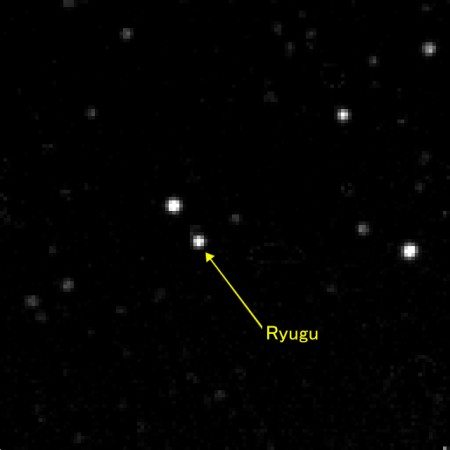
A recent examination of miniscule grains recovered from Ryugu by Japan's Hayabusa2 spacecraft discovered that the small space rock contains minerals that developed billions of years before Earth ⁘ materials that have been preserved in immaculate shape.

"These clues begin to tell a story about the starting materials of the asteroid and their early interactions with fluids," officials said in the statement. "This information helps to better define the sequence of fluid activity and processes that led to the current composition of Ryugu and other carbonaceous asteroids."

That modest heating melted ices like as water and carbon dioxide, allowing fluids to leak through the rock.

The fluids stimulated chemical reactions, resulting in a complex material assemblage ⁘ some known to Earth, others completely strange.

Researchers identified carbonates such as manganese-bearing dolomite and ankerite, iron-rich minerals like pyrrhotite and magnetite, copper sulfides, phosphorus-bearing hydroxyapatite, a mineral found in human teeth and bones, and a rare phosphide mineral not found on Earth using only two tiny pieces of the asteroid⁘one grain from its surface and the other from its subsurface.

There were also trace amounts of selenium, sulfur, silicon, and calcium. The diverse range of minerals indicates a complex interplay of fluids and chemistry that occurred billions of years ago in the asteroid, long before our planet's crust hardened.

Because Earth's earliest rocks were damaged by tectonics and erosion, Ryugu provides an unmatched view of the conditions that existed during planetary formation.

SpaceX Dragon On Way To Space Station With Cargo, New Reboost Capability

Image Read more: Found here

A SpaceX Dragon spacecraft is headed for its 50th rendezvous with the International Space Station bringing cargo and a new reboost capability after having launched from the Space Coast early Sunday.

A Falcon 9 rocket lifted off from Cape Canaveral Space Force Station's Space Launch Complex 40 at 2:45 a.m. on the CRS-33 mission, the 33rd resupply flight to the station with a spacecraft filled with more than 5,000 pounds of supplies.

The first-stage booster for the mission flew for the seventh time and made a recovery landing downrange on the droneship A Shortfall of Gravitas stationed in the Atlantic.

Unlike other flights, this Dragon will stay docked to the station for more than four months because of a newly installed ability to propel the station to higher altitudes.

Located in the trunk of the Dragon is an independent propellant system to fuel two Draco engines that will help sustain the lab's altitude beginning in September and continuing through fall. This is a full demonstration, although the Dragon on CRS-31 in November 2024 did a smaller test of the capability.

Normally, Russia is responsible for all of the reboost maneuvers using its Progress cargo spacecraft docked on their side of the station.

While NASA's other commercial resupply provider Northrop Grumman has in the past also used its Cygnus module for minor altitude adjustments, this marks the first time Elon Musk's company will be relied on for operational boost capability.

It's part of NASA's plans to eventually decommission the station, which has been continuously occupied by humans since November 2000, but is slated to begin its end run after 2030.

For that, the station will need fuel reserves, and using the cargo Dragon for now will help build up some of those reserves instead of relying on the Progress spacecraft of the Russians.

Tuesday, August 26, 2025

How Did A Planet This Big Form Around A Star This Small?

Image Source: Visit website

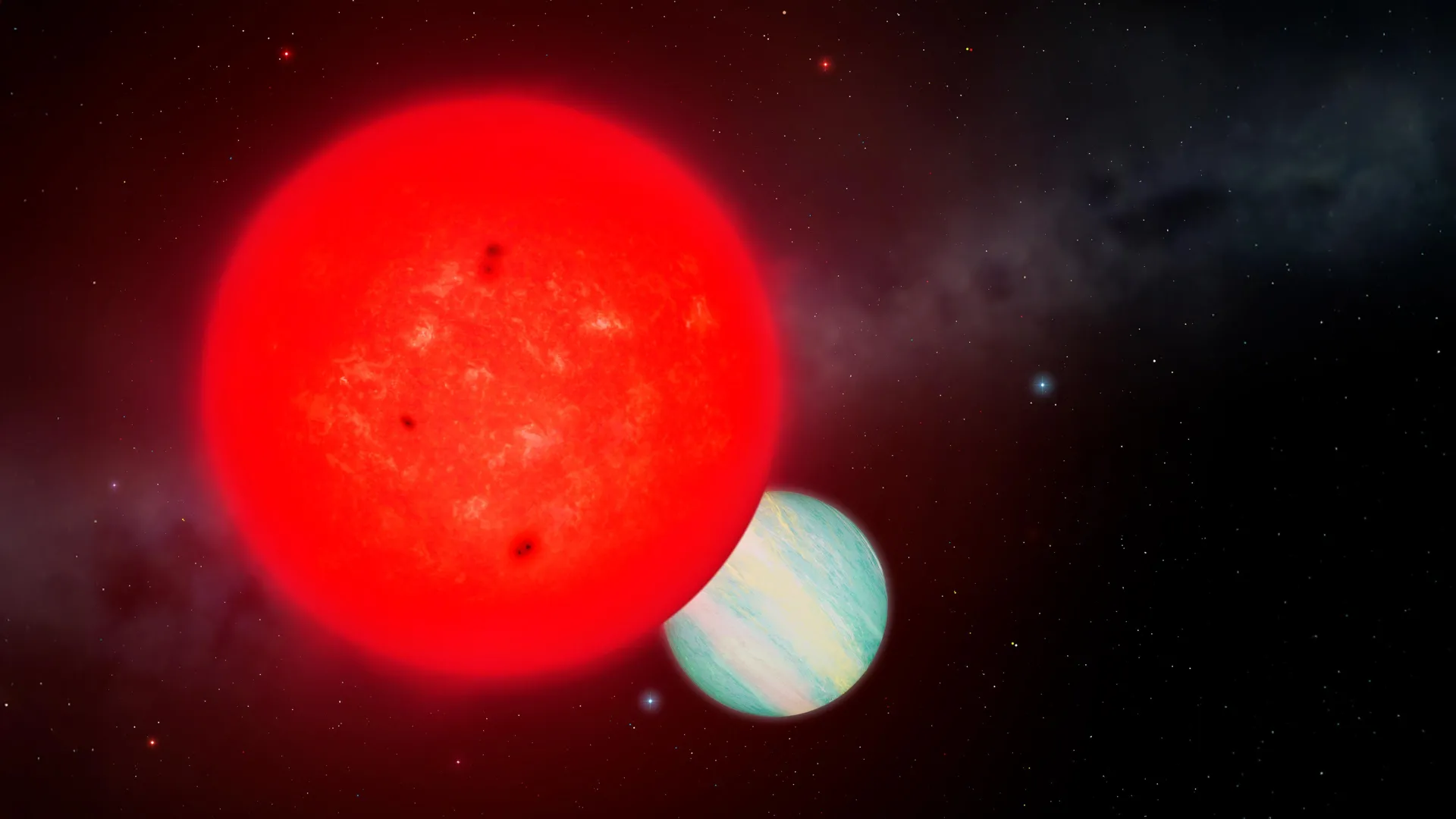
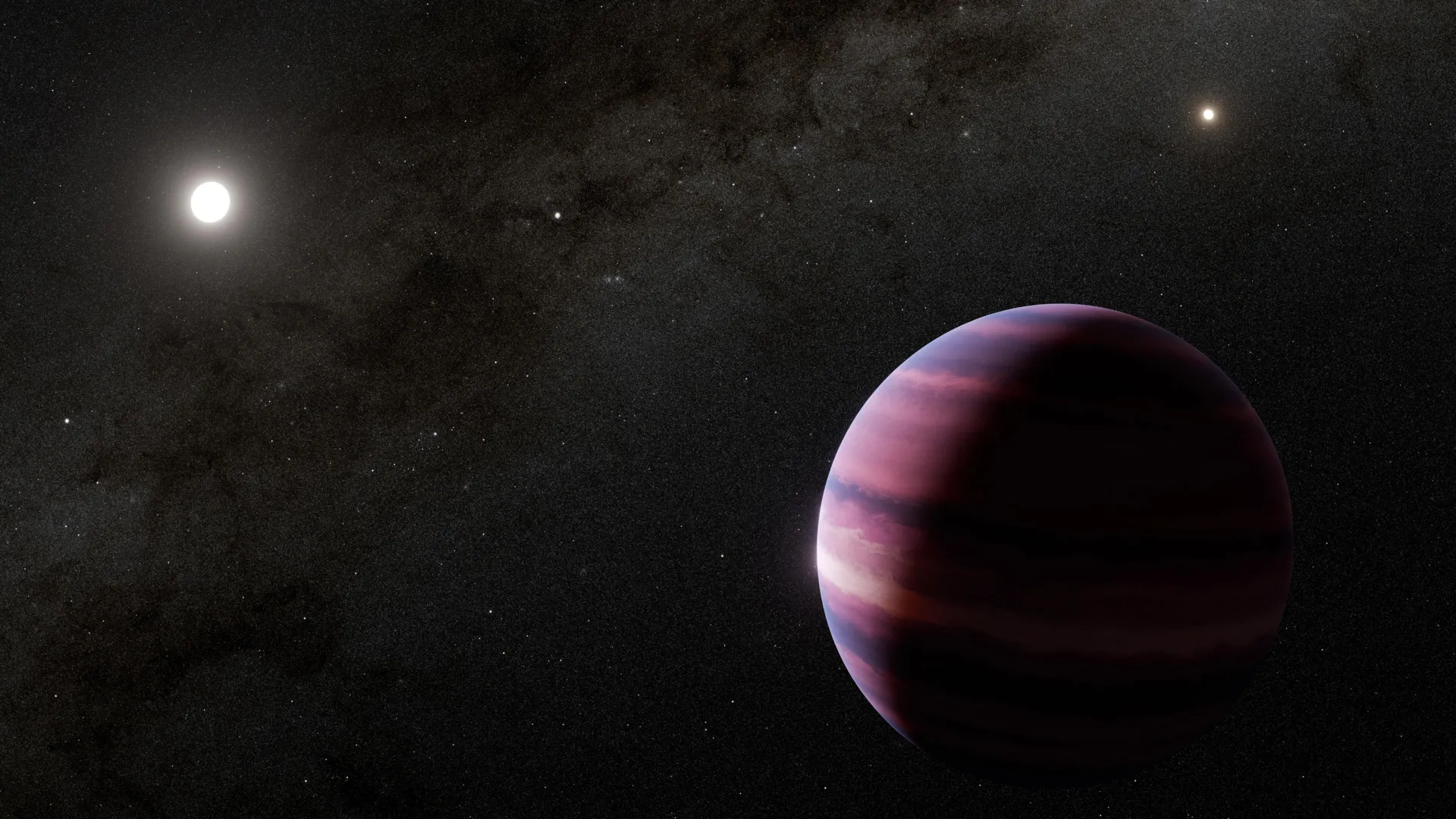
The host star, TOI-6894, is a red dwarf with only 20% the mass of the Sun, typical of the most common stars in our galaxy. Until now, such low-mass stars were not thought capable of forming or retaining giant planets.

But as published recently in Nature Astronomy , the unmistakable signature of a giant planet -- TOI-6894b -- has been detected in orbit around this tiny star.

This exceptional system was first identified in data from NASA's Transiting Exoplanet Survey Satellite (TESS), as part of a large search for giant planets around small stars, led by Dr. Edward Bryant from UCL's Mullard Space Science Laboratory.

The planetary nature of the signal was then confirmed by an extensive ground-based observation campaign, involving several telescopes -- including those of the SPECULOOS and TRAPPIST projects, both led by the University of Li⁘ge.

Dr. Khalid Barkaoui, researcher on the SPECULOOS and TRAPPIST teams, oversaw these crucial follow-up observations. He explained: ⁘The transit signal was unambiguous in our data.

Our analysis ruled out all alternative explanations -- the only viable scenario was that this tiny star hosts a Saturn-sized planet with an orbital period of just over three days. Additional observations confirmed that its mass is about half that of Saturn. This is clearly a giant planet.⁘

Prof. Jamila Chouquar, who was an astronomer at ULiege at the time of the discovery, added: ⁘We previously believed that stars this small couldn't form or hold on to giant planets.

But stars like TOI-6894 are the most common type in the Milky Way -- so our discovery suggests there may be far more giant planets out there than we thought.⁘

Watch Nvidia Boss Gift Humanoid Robots A New, More Powerful ⁘Brain⁘

Image Reference: See here

Nvidia is aiming to give robotics engineers a boost in the form of a new ⁘brain⁘ for their robots.

Launched on Monday, the chip giant said that with the new Jetson Thor modules, robots around the world ⁘are about to get a lot smarter.⁘

Nvidia launched Thor via a video (top) featuring the company⁘s long-time CEO Jensen Huang handing a gift box to a humanoid robot with a message card that says, ⁘Enjoy your new brain.⁘ The clip then shows multiple humanoid robots opening the box to find the new device that⁘s designed to make it a lot cleverer.

Thor, which is aimed at all kinds of robots and not solely humanoid ones, offers an impressive 7.5 times more AI computing power than its predecessor, Orin, which launched in early 2023. It also brings 3.1 times more CPU performance and comes with twice the memory, Nvidia said.

Thor is purpose-built for real-time robotics, handling high-bandwidth multi-sensor inputs with ultra-low latency. It⁘s also designed to run large generative AI and transformer-based models locally, reducing reliance on the cloud.

Another U.S. firm, Agility Robotics, is adopting Thor for its 6th-generation Digit humanoid robot to give it stronger real-time perception and improved abilities in warehouse settings.

⁘The powerful edge processing offered by Jetson Thor will take Digit to the next level ⁘ enhancing its real-time responsiveness and expanding its abilities to a broader, more complex set of skills,⁘ said Peggy Johnson, CEO of Agility Robotics. ⁘With Jetson Thor, we can deliver the latest physical AI advancements to optimize operations across our customers⁘ warehouses and factories.⁘

Astronomers Find Signs Of ⁘Planet Y⁘ Hiding In Our Solar System - Earth.Com

Source: Visit website

For centuries, humans have gazed into the night sky, wondering what lies beyond the planets we know. Each new discovery in the Solar System reshapes our sense of place in the cosmos.

The idea of hidden planets is not new. Astronomers once speculated about Planet X, which was believed to be seven times Earth's mass and orbiting 50 times farther from the Sun than Earth.

That idea was mostly debunked.

Later came Planet Nine, a still-viable candidate about 10 times Earth's mass, at least 300 times farther from the Sun. Now, evidence is mounting for yet another contender.

Amir Siraj at Princeton University and his colleagues suggest a new possibility. They noticed a warping effect in the orbits of some Kuiper belt objects, a distant region filled with icy remnants, including Pluto.

This potential world would be smaller than Earth but larger than Mercury, orbiting 100 to 200 times farther from the Sun than Earth does.

Its gravity seems to nudge nearby objects about 15 degrees out of the solar system's flat plane, like ripples disturbing a lake's surface.

"Our signal is modest, but credible," Siraj said, estimating just a two to four percent chance of being a fluke. Early evidence for Planet Nine carried similar odds, though the signatures differ.

Planet Nine would tug objects toward it, while this "Planet Y" appears to tilt orbits out of alignment. In theory, both worlds could exist at once.

Monday, August 25, 2025

Beethoven Concerto And ‘The Planets' Makes A Worthy Season Finale | AspenTimes.Com

Image Read more: See here

Spano displayed his best conducting of the season, showing intensity and an eye toward the dramatic.

The star of the show, though, was Bronfman. His legerdemain at the keyboard was in full display in the Beethoven, driving the tempo in the opening movement and softening the texture in the slow movement without losing the pulse.

Dazzling with virtuosity in the many fast-moving gestures, always musically alert, the pianist shaped each phrase with just the right flair. Each of the many scales had a different shading, and the tinkly decorations Beethoven sprinkled liberally in lighter moments made me picture shimmering diamonds.

Known as a Beethoven master, Bronfman emphasized where emphasis was needed, and eased up when letting the music flow.

Spano made sure the orchestra was on the same page, which made for an unforgettable performance all around.

⁘The Planets⁘ was an intriguing choice for a big finale, with an enormous orchestra and plenty of exotic colors in the instrumentation. Even non-fans of classical music would recognize much of the music, which has been used for movies and television, even by rock bands.

It's been a while since I have heard a live performance of the whole thing, and let's just say it stands the test of time.

The orchestra caught the whimsy in the recurring six-beat rhythm for the bassoon melody in ⁘Uranus, the Magician,⁘ which struck me this time as a cousin to Dukas's ⁘Sorcerer's Apprentice.⁘ (Remember Mickey Mouse in ⁘Fantasia⁘?)

The instrumental solos throughout were top-notch too, especially several limpid moments from concertmaster Alexander Kerr. Timpanists Edward Stephan and Will Howald executed their ⁘duels⁘ on multiple kettle drums with particular flair.

UFO Mania Grips Small Town After Mysterious Glowing Object Sighting Goes Viral

Image Source: Visit website

It started like something out of a sci-fi thriller : a glowing, pill-shaped object hovering over the skies of upstate New York.

Photos captured near the Finger Lakes on Aug. 12 showed a slow-moving orb shrouded in a glowing mist, sparking a surge of UFO speculation in a community's Facebook group.

Military Jet's Mysterious Collision Raises Questions About Advanced Ufos In Us Airspace: 'Been Here All Along'

But what many believed could be an alien visitation turned out to be something less supernatural: a rocket launch .

According to Space.com , the mysterious orb was later confirmed to be the planned launch of the Vulcan Centaur by the United Launch Alliance from Cape Canaveral, Florida.

Over 60 Ufo Sightings Reported Whizzing Across State In First Half Of 2025, National Tracking Group Says

⁘My first instinct from my scientific and military training is to look for a conventional explanation, such as a meteorological or human-made aerospace explanation, because that's what many objects in the sky are,⁘ retired Rear Adm. Tim Gallaudet , Ph.D., U.S. Navy, told Fox News Digital. ⁘In this case, it was both.⁘

He emphasized the critical nature of data verification when distinguishing between civilian misidentifications and genuinely Unidentified Anomalous Phenomena (UAP).

⁘The primary protocols are to cross-check the visual sighting with other data: higher-resolution optical or infrared, radar, lidar, listen for a radio or acoustic signature, and if it looks to be under intelligent control, interrogate it via VHF radio.

That will allow for a better characterization of the object, e.g. size, speed, altitude, range, material composition, and intentions.⁘

Sunday, August 24, 2025

James Webb Telescope Finds Hidden Moon Orbiting Uranus

Reference: Found here

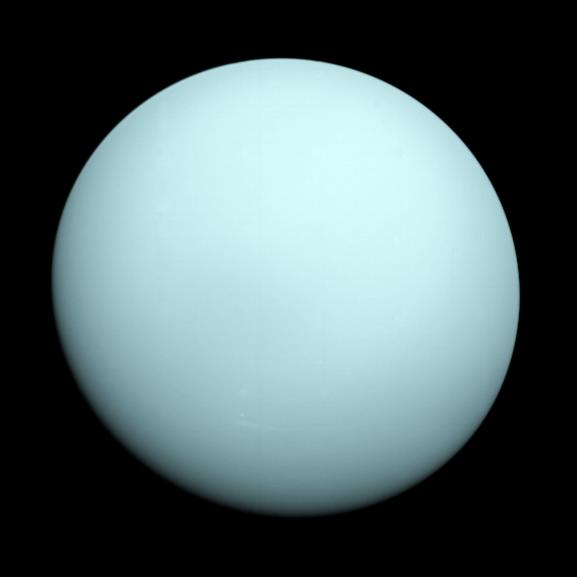
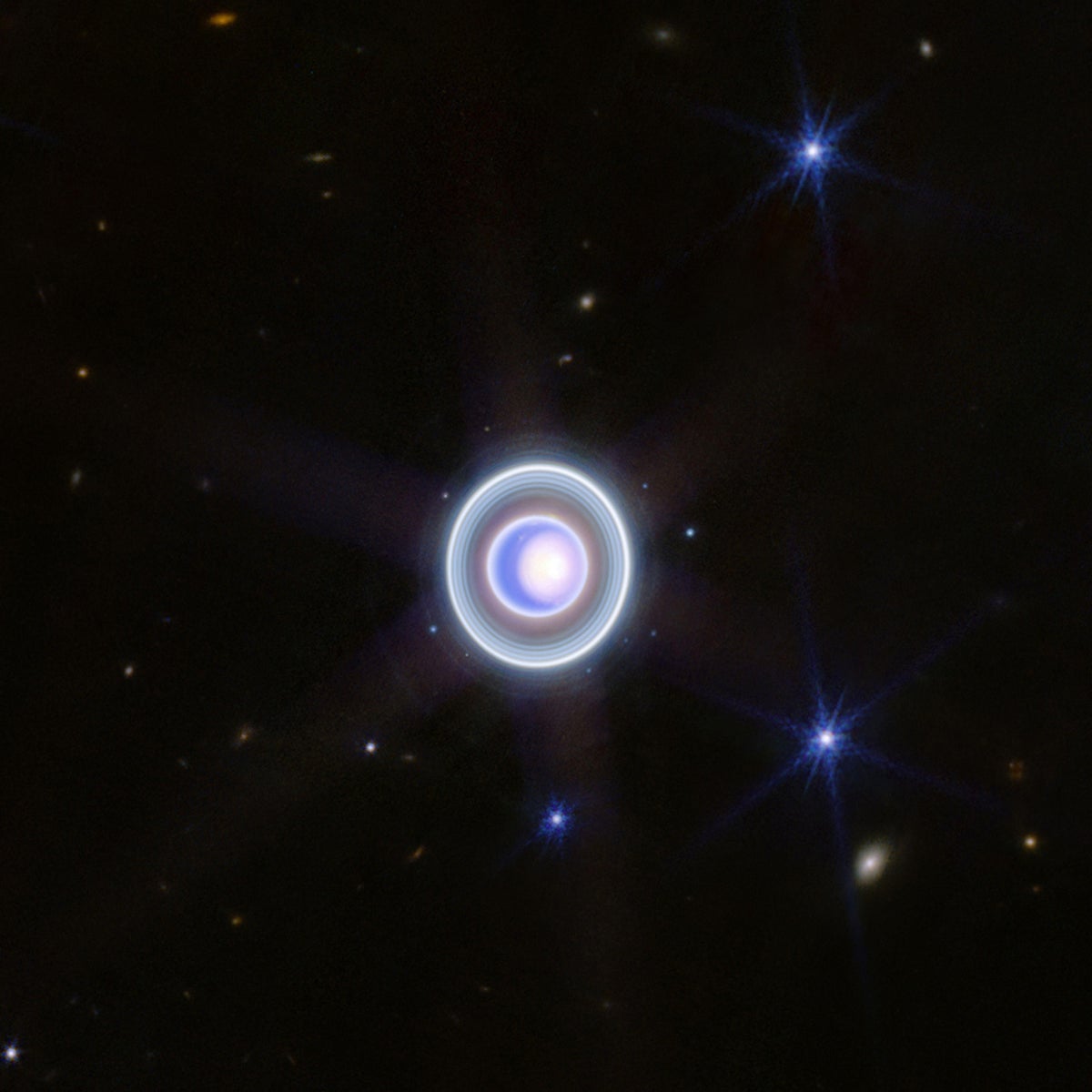
NASA's James Webb Space Telescope has uncovered a small moon quietly circling Uranus, a world already known for its unusual tilt, faint rings, and puzzling family of satellites. The discovery, announced by researchers at the Southwest Research Institute (SwRI), raises the tally of Uranus' moons to 29.

The moon, temporarily called S/2025 U1, was spotted on February 2, 2025, in a set of ten long-exposure images taken with Webb's Near-Infrared Camera. Each image required forty minutes of exposure to capture enough light from the distant planet and its surroundings.

"This object was spotted in a series of 10 40-minute long-exposure images captured by the Near-Infrared Camera," said Maryame El Moutamid of SwRI's Solar System Science and Exploration Division in Boulder, Colorado. "It's a small moon but a significant discovery, which is something that even NASA's Voyager 2 spacecraft didn't see during its flyby nearly 40 years ago."

Voyager 2, the only spacecraft to visit Uranus up close, passed by on January 24, 1986. While it transformed scientists' understanding of the icy giant, its instruments were not sensitive enough to detect such a tiny object.

At only six miles (10 kilometers) in diameter, the new moon is tiny compared with Uranus' five largest satellites— Miranda , Ariel, Umbriel, Titania, and Oberon. Its size and low brightness made it virtually invisible to earlier telescopes. Researchers estimate that the small world reflects light in a way similar to Uranus' other inner moons, which explains why it has been hiding within the planet's crowded ring system for so long.

Located about 35,000 miles (56,000 kilometers) from Uranus' center, the moon sits neatly between the orbits of Ophelia and Bianca. Its nearly circular path suggests it may have formed right where it is today, rather than being captured later. This places it among the 14 inner moons that orbit closer to Uranus than the larger and more distant satellites.

Astronaut Shubhanshu Shukla On Space Experience Over India: 'You Never Get Bored Of...

Source: Visit website

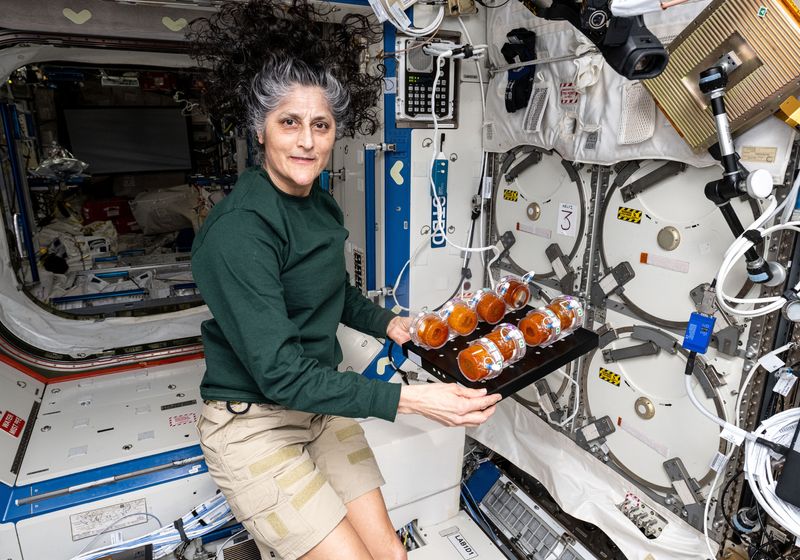
Shubhanshu Shukla is the first Indian astronaut to travel to the International Space Station (ISS). (Source: PTI)

Since 2010 when he started his career, Arun Nair has established himself as a dynamic journalist, adept at covering a wide range of stories—from in-de... View More

Blue Origin Scrubs NS-35 Launch - KVIA

Image Source: Found here

VAN HORN, Texas (KVIA) — Blue Origin's 35th New Shepard mission is set to carry more than 40 scientific and research payloads into space.

Liftoff is expected to take place around 6:30 a.m. from the company's Launch Site One in West Texas.

The uncrewed NS-35 mission will utilize Blue Origin's dedicated payload capsule RSS H.G. Wells and the same booster that flew the landmark NS-29 mission.

Among the payloads are 24 student-led experiments from NASA's TechRise Student Challenge, giving U.S. middle and high school students hands-on experience with real-world space engineering challenges.

The winning experiments explore topics such as space farming, medical solutions in microgravity, and liquid behavior in zero gravity.

The program is administered by Future Engineers and funded by NASA's Flight Opportunities program.

Also onboard are experiments from leading research institutions including the University of Florida, Johns Hopkins Applied Physics Laboratory, Carthage College, and University of Central Florida, as well as private companies such as Teledyne and Ecoatoms. The payloads span a range of research areas—from biological imaging and fuel cell testing to spacecraft refueling techniques.

One notable payload, the A.R.E.S. experiment from Ecoatoms, will test a novel chemical coating process using 432 sensors, marking a first-of-its-kind demonstration in microgravity. Another, BISS from the University of Florida, will adapt ISS imaging technology to analyze how biological organisms respond to suborbital flight.

Carthage College's PROTO and MUD experiments will continue their work in developing safer and more efficient methods for measuring and managing spacecraft propellant in space. Supported by NASA and the Wisconsin Space Grant Consortium, these experiments aim to enhance in-orbit refueling—an essential component of future deep-space missions.

Saturday, August 23, 2025

Elon Musk's Inspiring Confession: ‘My Friend Made Me Watch A Compilation Of Rocket Failures Before...

Image Read more: See here

The TOI Science Desk stands as an inquisitive team of journalists, ceaselessly delving into the realms of discovery to curate a captivating collection of news, features, and articles from the vast and ever-evolving world of science for the readers of The Times of India. Consider us your scientific companion, delivering a daily dose of wonder and enlightenment.

Whether it's the intricacies of genetic engineering, the marvels of space exploration, or the latest in artificial intelligence, the TOI Science Desk ensures you stay connected to the pulse of the scientific world. At the TOI Science Desk, we are not just reporters; we are storytellers of scientific narratives. We are committed to demystifying the intricacies of science, making it accessible and engaging for readers of all backgrounds.

Join us as we craft knowledge with precision and passion, bringing you on a journey where the mysteries of the universe unfold with every word. Read More

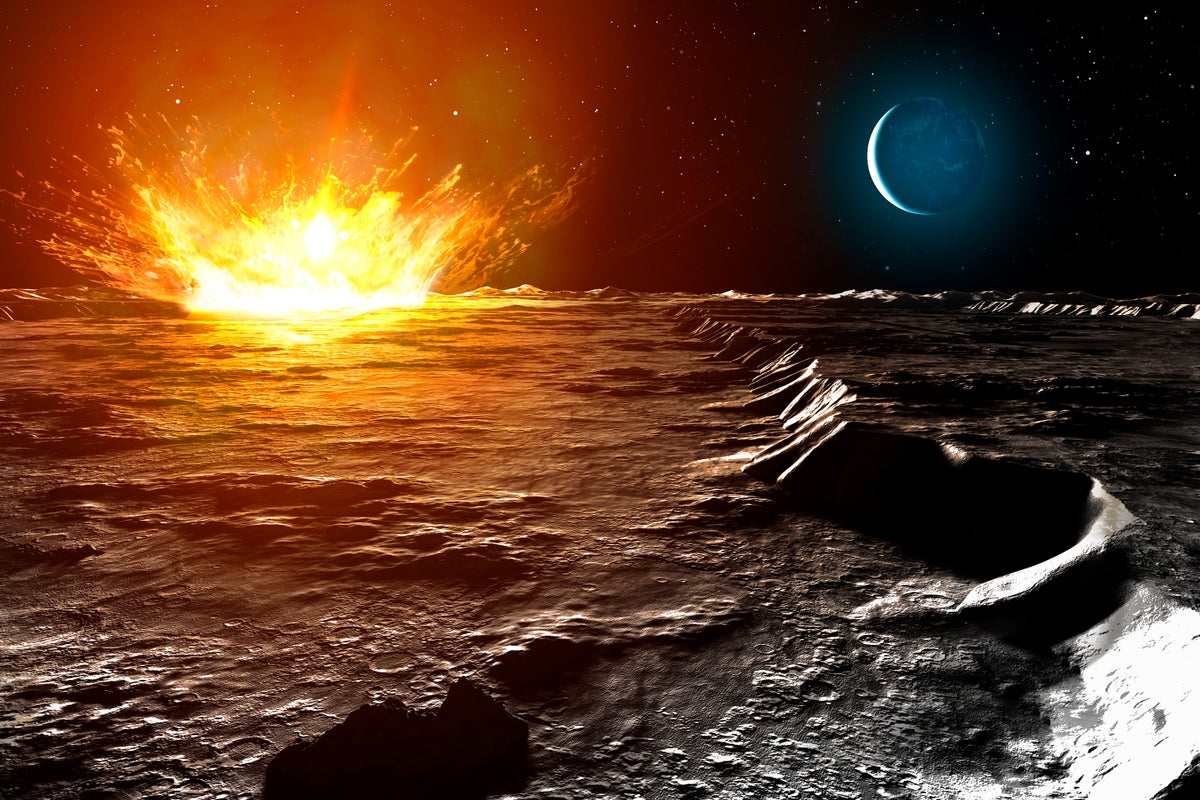
Will A Lunar Impact In 2032 Cause A Meteor Storm?

Image Reference: See here

The 60-meter asteroid 2024 YR4 has a 4 percent chance of hitting the moon. Could such a lunar collision create a dangerous new meteor shower?

Discovered in late 2024 by an automated telescope in Chile as part of the Asteroid Terrestrial-Impact Last Alert System (ATLAS) sky survey, it⁘s a not only a near-Earth asteroid but one that astronomers feared could get too close for comfort to our fair planet and pose a potential impact risk.

At 60 or so meters in diameter, 2024 YR4 wouldn⁘t cause global damage if it fell to Earth, but it would explode upon impact with the energy of an eight-megaton bomb, so local damage would be considerable. Thus, astronomers were right: it was something to worry about.

Initial observations indicated the asteroid might hit Earth on December 22, 2032. Calculating the trajectory of an asteroid is tricky , and the further ahead the prediction goes, the fuzzier the numbers get.

By mid-February 2025, astronomers had refined that Earth-impact probability to around 3 percent, which wasn⁘t high but was still somewhat concerning .

Happily, follow-up observations tightened the uncertainties in the projected orbit, effectively ruling out a late-2032 impact.

If 2024 YR4 does whack into our lone natural satellite, what will happen?

Is Earth (or, more to the point, those of us who live on it) in any danger? In a preprint paper accepted for publication in the Astrophysical Journal Letters , astronomers investigated the potential fallout. The answer they got is reassuring⁘ mostly .

Given the uncertainties in the asteroid⁘s exact trajectory, the scientists found that⁘if the asteroid were to hit at all⁘its chance of striking the moon⁘s near side would be around 86 percent, meaning we⁘d likely get a good view of the fireworks.

If so, Earth-based observers could see a brief flash as 2024 YR4⁘s immense kinetic energy⁘its energy of motion⁘would convert into light and heat, though it⁘s difficult to predict just how bright this would be.

Friday, August 22, 2025

Space Force X-37B Space Plane Launched On SpaceX Rocket In Florida

Image Source: Visit website

A SpaceX Falcon 9 rocket carried the X-37B Space Force space plane back into orbit late on Thursday, August 21 -- marking the mysterious uncrewed vehicle's eighth mission.

The mission, known as USSF-36, launched at 11:50 p.m. from NASA's Kennedy Space Center Pad 39A, atop a SpaceX Falcon 9 rocket.

Storms had moved through the area in the hours prior but conditions improved to 90% favorable just before launch.

Upon liftoff, the rocket flew on a northeast trajectory – providing views of the launch north of the Space Coast.

As the rocket's first stage booster returned to Cape Canaveral Landing Zone 2, a sonic boom was heard throughout Brevard County and the surrounding areas.

"In fact, we have more missions queued for launch over the next 12 months than in any prior 12-month period in the history of the NSSL program…and we welcome this challenge," Col. Ryan Hiserote, senior materiel leader, Launch Execution for Space Systems Command Assured Access to Space organization, was quoted as saying in a post-launch press release.

"Putting innovative capabilities such as these in orbit builds United States strength in the space domain and increases our nation's overall warfighting capability."

In an August press release, William Blauser, Acting Director of the Air Force Rapid Capabilities Office described the eighth mission of the X-37B as "U.S. Space Force's premier test platform for the critical space technologies of tomorrow".

The X-37B will spend an undisclosed amount of time in orbit, testing not only the capabilities of the space plane, but technology demonstrations, including testing a new sensor, which will enable GPS contact where communication would have previously been difficult.

The X-37B is also carrying experiments for the Air Force Research Laboratory and the Defense Innovation Unit – including laser communications demonstrations in Low Earth Orbit which will investigate more effective satellite communication.

NASA's Webb Telescope Spots A New Moon Orbiting Uranus

Source: Visit website

A research team peering into unexplored corners of space revealed this week that our solar system harbors a secret moon that's tucked away near Uranus. 

The moon was discovered by a research team using NASA's James Webb Space Telescope, the successor to the Hubble Space Telescope. Like the Hubble Telescope, the Webb Telescope was designed to snap images of deep space, helping scientists pursue some of the universe's enduring mysteries.

The new moon was discovered in a set of 40-minute-long exposure images taken by the Webb Telescope's near-infrared camera, which allows it to image fainter and more distant objects than the Hubble. While the Webb's main mission is to explore the origins of the universe and the formation of the earliest galaxies, its sensitive cameras make many other kinds of discoveries possible along the way.

"It's a small moon but a significant discovery, which is something that even NASA's Voyager 2 spacecraft didn't see during its flyby nearly 40 years ago," Maryame El Moutamid, a lead scientist at Colorado's Southwest Research Institute, said of the discovery.

The newly found moon is estimated to be 6 miles in diameter—a diminutive size that likely helped it elude the Hubble. It orbits Uranus from within the orbit of that planet's larger moons, which include Miranda, Ariel, Umbriel, Titania, and Oberon. The discovery brings the total number of moons known to orbit Uranus up to 29.

Humanoid Robots Infusing AI For Mental Health Gets Us Walking-Talking Robot Therapists

Image Reference: Found here

In today's column, I examine an intriguing twist to the usual discussions about the use of AI for mental health advisement.

First, people are increasingly making use of their PCs and smartphones to access generative AI and ask questions about their mental health, essentially using AI as a kind of therapist.

That's an abundant fact and widely reported. Second, the upcoming twist will be that humanoid robots, physically resembling humans, will be improved sufficiently so that they will adroitly function in our homes, including being closely paired with the latest in generative AI.

This analysis of AI breakthroughs is part of my ongoing Forbes column coverage on the latest in AI, including identifying and explaining various impactful AI complexities (see the link here ).

As a quick background, I've been extensively covering and analyzing a myriad of facets regarding the advent of modern-era AI that produces mental health advice and performs AI-driven therapy. This rising use of AI has principally been spurred by the evolving advances and widespread adoption of generative AI. For a quick summary of some of my posted columns on this evolving topic, see the link here , which briefly recaps about forty of the over one hundred column postings that I've made on the subject.

There is little doubt that this is a rapidly developing field and that there are tremendous upsides to be had, but at the same time, regrettably, hidden risks and outright gotchas come into these endeavors too. I frequently speak up about these pressing matters, including in an appearance last year on an episode of CBS's 60 Minutes , see the link here .

If you are new to the topic of AI for mental health, you might want to consider reading my recent analysis of the field, which also recounts a highly innovative initiative at the Stanford University Department of Psychiatry and Behavioral Sciences called AI4MH; see the link here .

Let's first explore the nature of so-called social robots and then consider the upcoming advent of more advanced robots that are referred to as humanoid robots.

Thursday, August 21, 2025

Tunnel⁘ Found That Connects Solar System To Other Stars - Earth.Com

Source: Found here

Space can surprise even those who spend their lives studying it. People often think of our solar system as just a few planets and a bunch of empty space.

After years of careful mapping, a new analysis reveals what appears to be a channel of hot, low-density plasma stretching out from our solar system toward distant constellations.

Astronomers from the Max Planck Institute recently confirmed it using data from the eRosita instrument . Dr. L. L. Sala, lead researcher, and colleagues shared these findings in a paper published in the journal Astronomy ⁘ Astrophysics .

For a long time, scientists have known that our solar system sits within a peculiar region of space called the Local Hot Bubble .

This area, estimated to be about 300 light years across , formed as a result of powerful stellar explosions called supernovas.

They heated the surrounding gas, producing a low-density, high-temperature environment. Traces of these distant events still linger as wispy distributions of hot plasma.

"We find the temperature of the LHB exhibits a north-south dichotomy at high latitudes," stated Dr. L. L. Sala, lead author of the study.

To better understand this environment, scientists turned to eRosita. This X-ray observatory, launched as part of the Spectrum-Roentgen-Gamma mission , scoured the sky to capture soft X-ray emissions.

One of eRosita's goals is to chart hot gas in space, learn about supernova remnants, and investigate the surroundings of our neighborhood .

By combining these results with older data from ROSAT , another X-ray survey, astronomers have pieced together a more detailed picture of our local region.

They took on the challenging task of dividing the sky into thousands of bins, extracting subtle signals of warm gas, dust cavities , and interstellar structures. This painstaking approach helped isolate the faint glow of the surrounding plasma.

What stands out is the detection of a channel, or "tunnel," that appears to stretch toward the Centaurus constellation.

Six Planets Will Create A Parade Tonight In Rare Event That Won't Happen Again Until 2028

Image Read more: Found here

Roll up, roll up, as the planets are set to put on a spectacular parade in the sky for us lot tonight (21 August).

This evening is your last chance to catch a glimpse of the rare space phenomenon until 2028 too, so stargazers really ought to have their binoculars at the ready.

You've heard of 'the stars aligning', but did you know the planets are also partial to it too every so often?

According to NASA , although a 'planet parade' isn't a technical term in astronomy, it does perfectly describe how planets occasionally line up along each other.

Explaining that the planets 'always appear along a line or arc across the sky', the US space agency said : ⁘This occurs because the planets orbit our Sun in a relatively flat, disc-shaped plane.

⁘From Earth , we're looking into that solar system plane from within.

We see the racetrack of the planets from the perspective of one of the racers ourselves.

⁘When viewed edge-on, this disc appears as a line, which we call the ecliptic or ecliptic plane. What makes these events special is the opportunity to observe multiple planets simultaneously with the naked eye.⁘

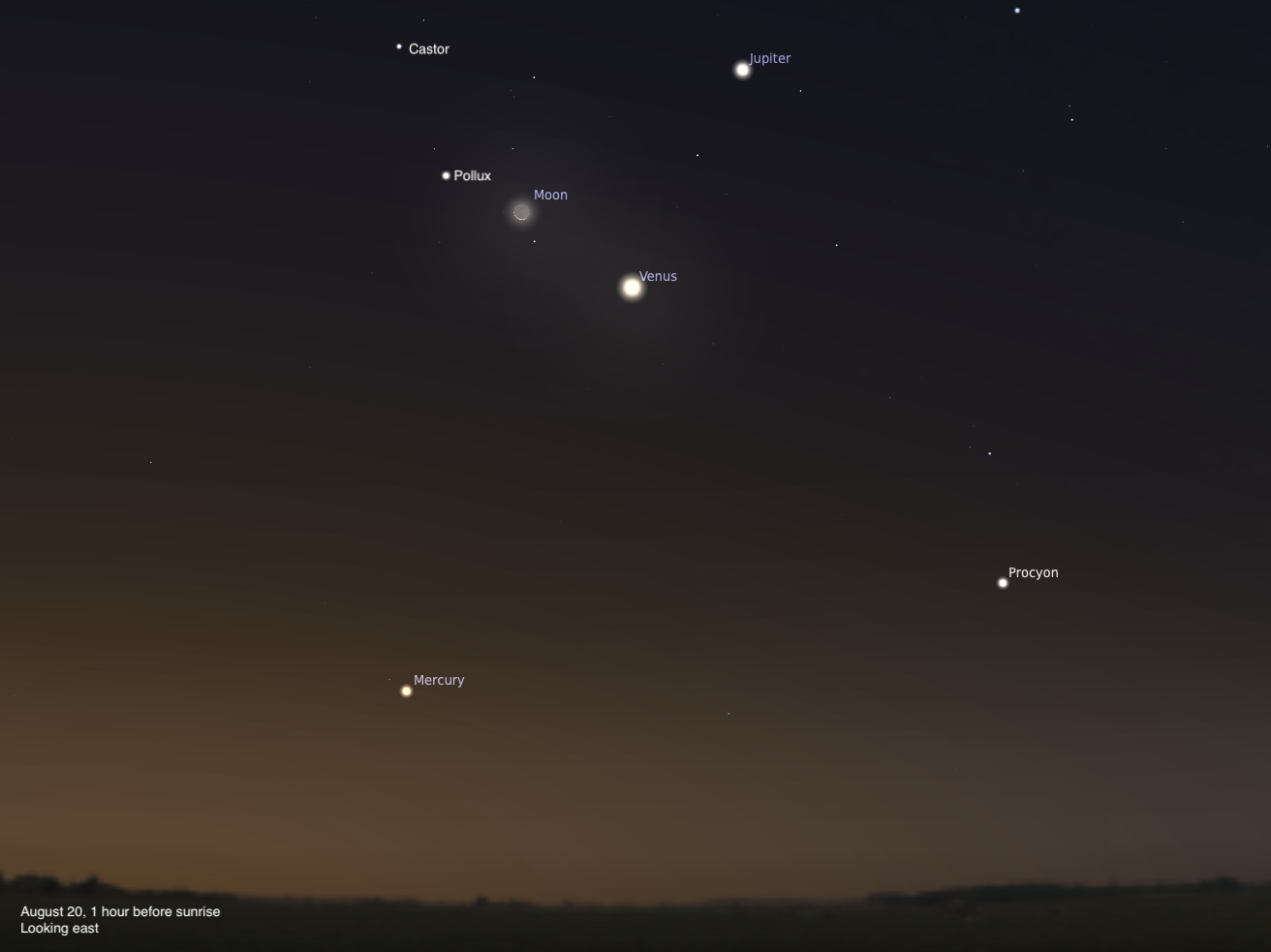
Mercury, Venus, Jupiter, Saturn, Uranus and Neptune will appear alongside together in the eastern sky tonight, creating a dazzling display for those watching.

And to make the evening more magical, a thin crescent moon will also joining the impressive line-up and slot itself in next to Mercury.

Wednesday, August 20, 2025

S Guide To Visiting The Smithsonian

Image Source: See here

Our exhibitions investigate and highlight the vital role of invention and innovation in shaping human history from Stone Age tools to the Apollo 11 moon landing to futures in space.

Discover exhibitions that highlight American innovation and ingenuity from the past to the present and imagine our shared future.

Aphelion Phenomenon Will NOT Make Earth Experience 'Colder Weather Than Ever...

Image Source: Visit website

Will the earth experience ⁘colder weather than ever before⁘ during the ⁘aphelion phenomenon⁘ in August, 2025, as its elliptical orbit takes it to its most distant-from-the-Sun position of the year, as multiple social media posts claim?

No, that's not true: Earth's distance from the Sun changes daily and at aphelion, the Earth's distance from the Sun is only about 3% more than the average distance. Other factors have a greater impact on temperature, including the atmosphere's ability to slow fluctuations in heat and the 24-degree tilt in Earth's axis, which determines the duration and intensity of sunlight striking the planet.

The posts include a variety of graphics showing the elliptical orbit of the Earth around the Sun, like this one:

This fact check addresses only the astrophysics falsehoods, not the various health claims also made, which rest on the underlying misstatement of the effects of Earth's elliptical orbit.

Both the Northern and Southern Hemispheres see big shifts in seasonal temperature averages because Earth is tilted 23.5 degrees in the plane of its orbit.

This means solar radiation strikes more directly and for longer days in the summer in the Northern Hemisphere. In winter, Earth's orbit carries the southern hemisphere into position for more direct solar radiation and longer days. Aphelion is not a factor in seasonal temperature change, as astronomy columnist Phil Plait (a Ph.D. astronomer) spelled out in a Scientific American article about the question.

As the National Oceanic and Atmospheric Administration's scientists have explained, winds and ocean currents redistribute Earth's heat , (archived here ) as Earth's rotation, plus unequal heating of the surface (due to the Earth's tilted axis), move weather across the planet's surface.

NASA And Google Are Testing An AI Space Doctor

Image Source: Visit website

With NASA eyeing long-duration crewed missions to the moon and beyond in the coming years, it has to be sure that if a medical situation arises, the astronauts are well equipped to deal with it.

Currently, crews heading to the International Space Station (ISS) receive training for basic medical procedures and medicines, as well as for things like intravenous fluid administration, intubation, wound care, and basic emergency response.

But future missions that take humans hundreds of thousands ⁘ or even millions ⁘ of miles from Earth, potentially for years at a time, will add a new layer of complexity to health management.

With that in mind, the U.S. space agency has partnered with Google on a project aimed at ensuring crew health and wellness on long-duration missions.

The initiative includes an investigation into whether remote care capabilities can offer detailed diagnoses and treatment options when a health issue falls outside of the astronauts⁘ knowledge base, and when real-time communication with Earth is limited.

NASA and Google⁘s work involves a proof-of-concept for an automated Clinical Decision Support System (CDSS) known as the ⁘Crew Medical Officer Digital Assistant⁘ (CMO-DA).

⁘Designed to assist astronauts with medical help during extended space missions, this multi-modal interface leverages AI,⁘ Google said in an online post.

It said the CMO-DA tool could help astronauts ⁘autonomously diagnose and treat symptoms when crews are not in direct contact with Earth-based medical experts.⁘

It added: ⁘Trained on spaceflight literature, the AI system uses cutting-edge natural language processing and machine learning techniques to safely provide real-time analyses of crew health and performance.

The tool is designed to support a designated crew medical officer or flight surgeon in maintaining crew health and making medical decisions driven by data and predictive analytics.⁘

Tuesday, August 19, 2025

NASA's James Webb Space Telescope Discovers New Moon Of Uranus

Image More details: Found here

Using the powerful James Webb Space Telescope, scientists have spotted a moon nestled near Uranus⁘s rings that⁘s so small you could walk around it

Scientists have discovered a new, elusive moon around Uranus, making it the 29th natural satellite known to orbit the ice giant .

The research team that made the discovery estimates that the moon, dubbed S/2025 U1 for now (at least, until the International Astronomical Union assigns an official name), is just 10 kilometers, or six miles, across, making it particularly small.

⁘I could walk around this moon,⁘ says Heidi Hammel, a planetary scientist and astrophysicist, who was not involved in the research.

A team led by the Southwest Research Institute detected the moon in images captured by the high-resolution Near-Infrared Camera on the James Webb Space Telescope (JWST) during a series of 10 40-minute-long exposures. ⁘The cameras on [JWST] are very sensitive,⁘ Hammel says.

⁘They were designed to see the faintest galaxies in the universe,⁘ as well as faint things that are close to very bright ones (such as the planet Uranus). NASA announced the moon⁘s discovery today via a blog post.

There are still many questions about the new minuscule moon for astronomers to explore: How does it compare with other moons?

What is its color and composition? JWST might help answer a few of these questions. But regardless of what comes next, the discovery shows ⁘how we can extend the horizons of our knowledge, even in our own solar system, using an advanced telescope like JWST,⁘ Hammel says. ⁘And it helps us get a better understanding of what drives the phenomena in our solar system⁘like ⁘⁘What is crafting that ring system around the planet Uranus?⁘⁘

Monday, August 18, 2025

The Surprising Way Rising CO2 Could Supercharge Space Storms

Image More details: See here

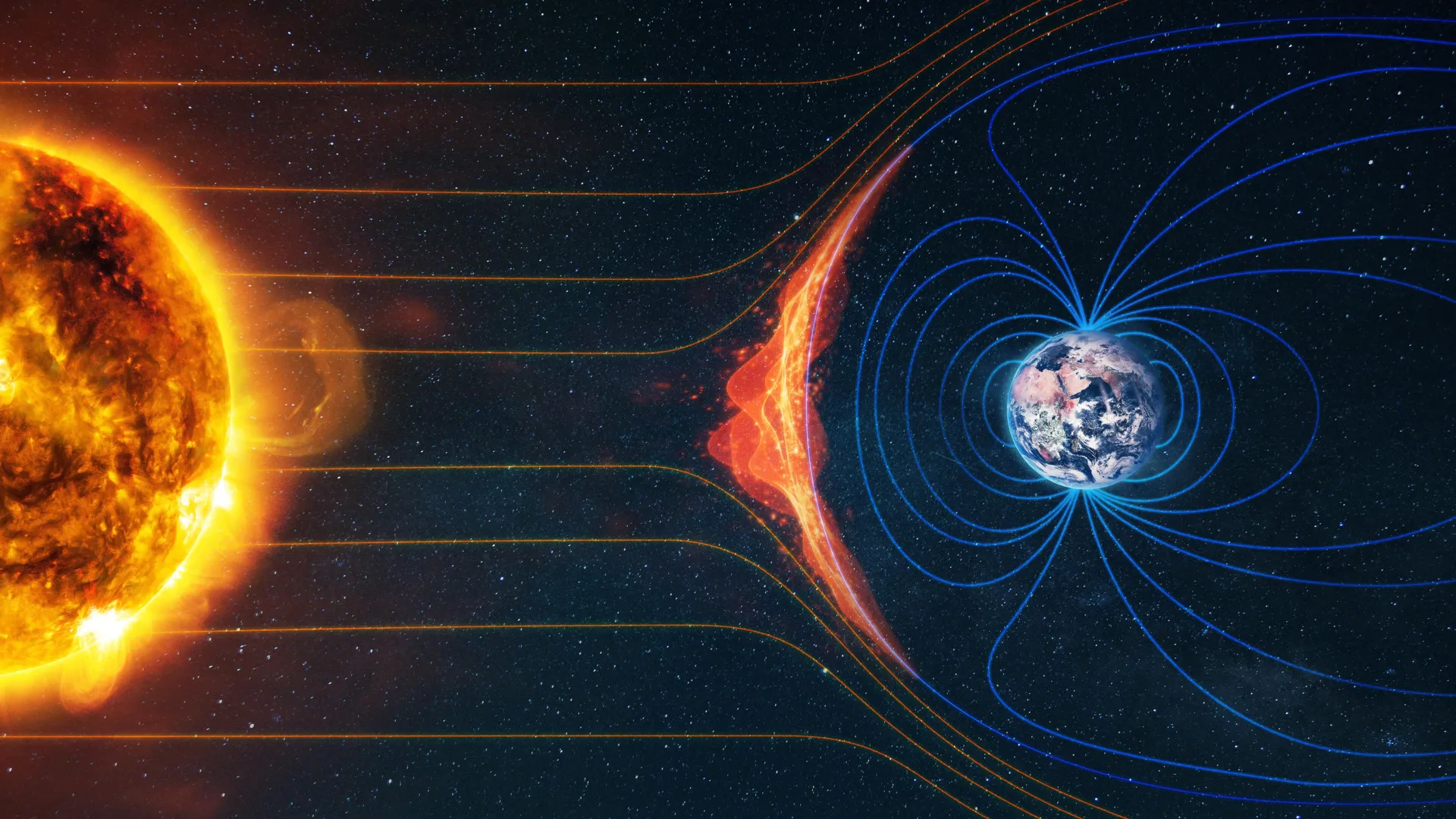
Rising concentrations of carbon dioxide in the upper atmosphere will change the way geomagnetic storms impact Earth, with potential implications for thousands of orbiting satellites, according to new research led by scientists at the US. National Science Foundation National Center for Atmospheric Research (NSF NCAR).

Geomagnetic storms, caused by massive eruptions of charged particles from the surface of the Sun that buffet Earth's atmosphere, are a growing challenge for our technologically dependent society.

The storms temporarily increase the density of the upper atmosphere and therefore the drag on satellites, which impacts their speed, altitude, and how long they remain operational.

The new study used an advanced computer model to determine that the upper atmosphere's density will be lower during a future geomagnetic storm compared with a present-day storm of the same intensity.

That's because the baseline density will be lower, and future storms won't increase it to levels as high as what occurs with storms currently.

The study, a collaboration with Japan's Kyushu University, was published in Geophysical Research Letters .

Earth's upper atmosphere has become increasingly important in recent decades because of society's dependence on advanced navigation systems, online data transmission, national security applications, and other technologies that rely on satellite operations.

Sunday, August 17, 2025

Play Football, Crash And Collapse At China's ‘Robot Olympics'

Image Reference: See here

China kicked off the three-day long World Humanoid Robot Games on Friday, looking to showcase its advances in artificial intelligence and robotics with 280 teams from 16 countries.

Robots competed in sports such as track and field, and table tennis, as well as tackled robot-specific challenges from sorting medicines and handling materials to cleaning services.

Teams came from countries including the United States, Germany and Brazil, with 192 representing universities and 88 from private enterprises such as China's Unitree and Fourier Intelligence. Competing teams used robots from Chinese manufacturers such as Booster Robotics.

"We come here to play and to win.

But we are also interested in research," said Max Polter, a member of HTWK Robots football team from Germany, affiliated with Leipzig University of Applied Sciences.

At the robot games in Beijing, which charged 128 to 580 yuan ($17.83-$80.77) for tickets, humanoids crashed into each other and toppled over repeatedly during football matches, while others collapsed mid-sprint during running events.

During one football match, four robots crashed into each other and fell in a tangled heap. In the 1500-meter running event, one robot suddenly collapsed while running at full speed, drawing gasps and cheers from spectators.

Despite frequent tumbles requiring human assistance to help robots stand, many managed to right themselves independently, earning applause from audiences.

Organizers said the games provide valuable data collection opportunities for developing robots for practical applications such as factory work.

The Sky This Week From Aug. 15 To 22: The Moon Hangs With Morning Planets

Image Source: Visit website


Friday, August 15
Dwarf planet 1 Ceres reaches its stationary point in Cetus the Whale at 9 P.M. EDT. Previously it was moving eastward relative to the background stars. Now it will begin to move westward, or retrograde.

Ceres is only visible in the morning sky, but 4 Vesta is sliding eastward through the evening sky in Libra, still some 25° high in the southwest an hour after sunset. It's located between that constellation's two brightest stars: magnitude 2.8 Zubenelgenubi (Alpha [α] Librae) and slightly brighter magnitude 2.6 Zubeneschamali (Beta [β] Lib). This evening, Vesta is just east of the midpoint of a line drawn between these two stars, some 4.3° northeast of Alpha Lib.

Shining at magnitude 7.4, Vesta is well within the reach of binoculars or any telescope, even from the suburbs.

It's currently some 2.0 astronomical units from Earth, or nearly 186 million miles (299 million kilometers) away. (One astronomical unit, or AU, is the average Earth-Sun distance.) Vesta is moving relatively slowly — the easiest way to make sure you've spotted it is to sketch or photograph the area in your eyepiece tonight, and then return over the next few nights to repeat the exercise.

The dot you notice moving from night to night is Vesta.

The fourth asteroid ever discovered, Vesta is the second-most massive world in the main belt, after Ceres, and the third-largest, after Ceres and 2 Pallas.

Sunrise: 6:12 A.M.
Sunset: 7:56 P.M.
Moonrise: 11:15 P.M.
Moonset: 1:32 P.M.
Moon Phase: Waning gibbous (56%)
*Times for sunrise, sunset, moonrise, and moonset are given in local time from 40° N 90° W. The Moon's illumination is given at 12 P.M. local time from the same location.

Saturday, August 16
Last Quarter Moon occurs at 1:12 A.M. EDT as sunset sweeps across the lunar nearside following the Full phase last week. Visible in the early-morning sky, the Moon lies just under 4° west of the Pleiades in Taurus some two hours before sunrise, rising in the east. (The Moon will continue to creep closer to the cluster over the course of the day, occulting several stars in the Pleiades in an event visible from Japan, Korea, and northeast Asia.)

Saturday, August 16, 2025

Harvard University Researchers Suggested Aliens Are On Earth Before Report Was Removed From The Web

Image Read more: Found here

The eyebrow-raising scholarly article suggests aliens are "concealed in stealth" or "even walking among us" in human form. It theorizes these ETs are a "remnant form" of an ancient civilization that made their home on Earth long ago, or maybe even time-travelers from the future!

"We're not saying this is right, we're not saying that this is absolutely 100 percent the case," Montana Technological University professor Michael Masters tell CBS News , who coauthored the paper with Harvard researchers Tim Lomas and Brendan Case .

"We're saying these are some potentialities" that would explain the many UFO sightings that have been logged over the decades by military fighter pilots and civilian observers, Masters explains.

As Globe has previously reported, the Pentagon is currently investigating some 1,650 sightings of UFOs, with close to half of those coming between May 2023 and June 2024, per CNN .

Military brass deny that any of these were alien in origin, despite some craft performing aerial feats that defy the limits of modern technology — and even physics!

Mysteriously, the paper authored by Masters, Lomas and Case was taken down from ResearchGate , an online platform for scientific papers, shortly after its publication in mid-July, leading some UFO hunters to allege a cover-up!

He exclusively tells Globe that he believes these ETs first evolved on distant planets before traveling to Earth and colonizing our planet millions of years ago.

The Disappearing Planet Next Door Has Astronomers Intrigued

Image Reference: See here

Found using the MIRI instrument on NASA's Webb telescope, which was managed by JPL through launch, the possible planet would be easier to study than more far-flung worlds.

Astronomers using NASA's James Webb Space Telescope have found strong evidence of a giant planet orbiting a star in the stellar system closest to our own Sun. At just 4 light-years away from Earth, the Alpha Centauri triple star system has long been a compelling target in the search for worlds beyond our solar system.

Now, Webb's observations from its Mid-Infrared Instrument (MIRI) are providing the strongest evidence to date of a gas giant orbiting Alpha Centauri A. The results have been accepted in a series of two papers in The Astrophysical Journal Letters.

⁘With this system being so close to us, any exoplanets found would offer our best opportunity to collect data on planetary systems other than our own.

Yet, these are incredibly challenging observations to make, even with the world's most powerful space telescope, because these stars are so bright, close, and move across the sky quickly,⁘ said Charles Beichman, NASA's Jet Propulsion Laboratory and the NASA Exoplanet Science Institute at Caltech's IPAC astronomy center, co-first author on the new papers.

⁘Webb was designed and optimized to find the most distant galaxies in the universe. The operations team at the Space Telescope Science Institute had to come up with a custom observing sequence just for this target, and their extra effort paid off spectacularly.⁘

Several rounds of meticulously planned observations by Webb, careful analysis by the research team, and extensive computer modeling helped determine that the source seen in Webb's image is likely to be a planet and not a background object (like a galaxy), foreground object (a passing asteroid), or other detector or image artifact.

Friday, August 15, 2025

Designer Microbes Aid Space Exploration Efforts

Image Source: See here

I n the summer of 2013, NASA's Curiosity rover celebrated its first birthday inside a dusty red Martian crater, more than 100 million miles away from home. To mark its one-year landing anniversary, scientists programmed Curiosity to vibrate at frequencies corresponding to the notes of the "Happy Birthday" song.

This lonely birthday celebration drew a deluge of sympathy, with people commenting, "When humans land on Mars, we better...give that rover a hug!" on NASA's video . More than a decade has elapsed since then, but space agencies have yet to launch a crewed mission to the Red Planet.

Scientists have attempted to tackle this using an innovative approach.

"When I was in grad school, the person I did my thesis with would always say, 'You got to think of what the problem is, and then remember that biology has already solved that problem,'" recalled Frances Donovan , a biochemist at NASA Ames Research Center. "You just have to go find the biology that solves that problem."

To meet this need, Donovan and her colleagues have been testing an approach similar to making fermented foods like yogurt and kefir.

"This is an age-old process that humans have been using to make and preserve nutrients for themselves," said Donovan. "And we've been doing it in clearly nonsterile conditions for literally close to 10,000 years."

Once the astronauts have sufficiently tested the yeast, Donovan hopes that she and her team will be able to send dehydrated pellets to space and astronauts can choose from a buffet of nutrients such as riboflavin, folate, vitamin K, or even caffeine, "Because we're probably not going to fly coffee trees anytime soon," she said.

Blue Origin's 2nd New Glenn Rocket Launch Will Fly Twin NASA Mars Probes To Space On Sep. 29

Image Source: See here

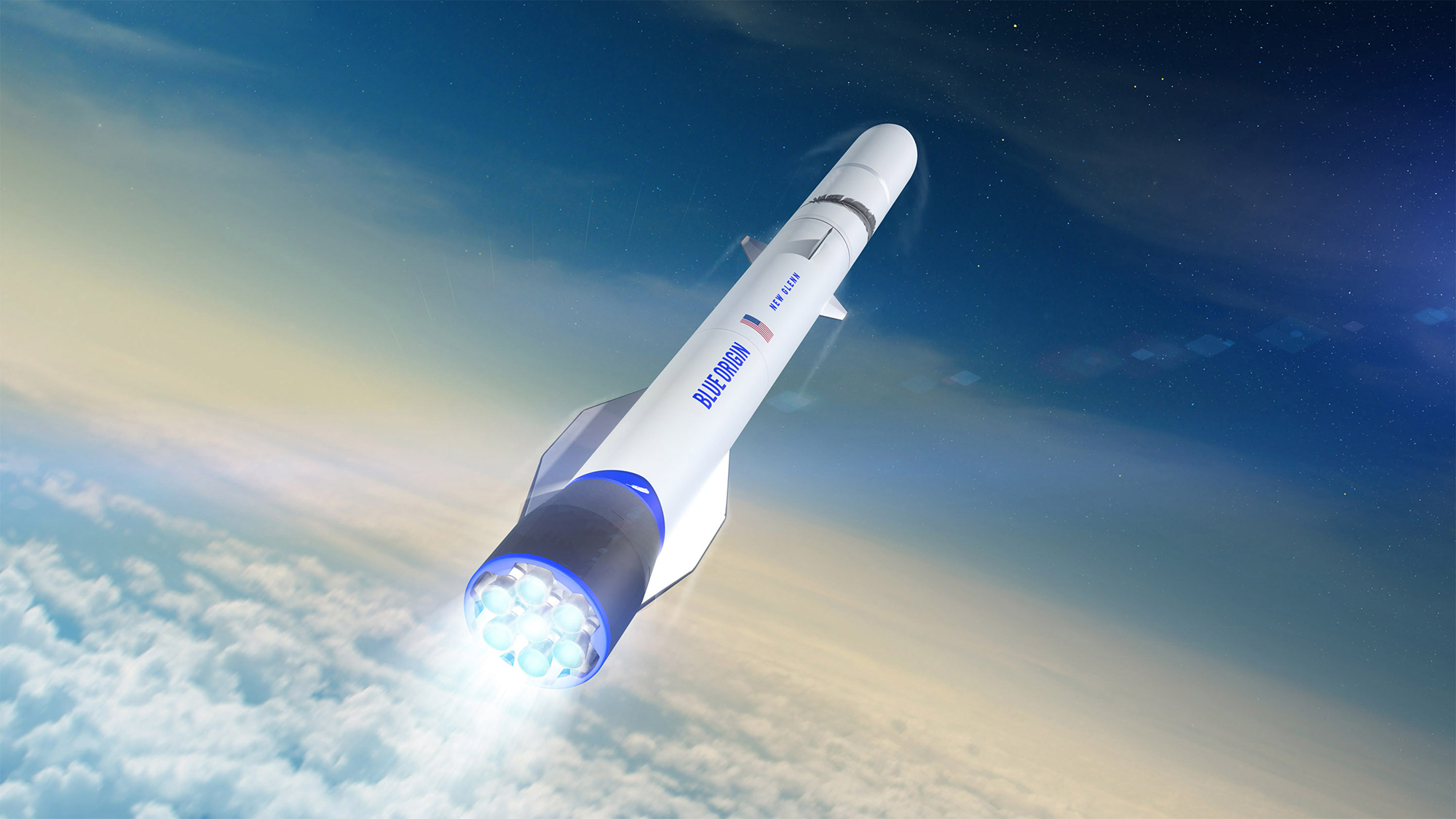
Blue Origin is gearing up for the second-ever launch of its powerful New Glenn rocket, which will loft NASA's ESCAPADE mission to Mars.

The company says it has been working closely with NASA on preparations leading up to New Glenn's next launch, dubbed NG-2, and is targeting no earlier than (NET) Sep. 29. The twin ESCAPADE (Escape and Plasma Acceleration and Dynamics Explorers) probes have been awaiting their turn aboard New Glenn, which was originally slated to carry the satellites on its maiden launch in January . However, NASA opted not to risk a costly mission delay due to the debut liftoff of the new rocket.

Now that the mission has been assigned a NET date, Blue Origin posted on social media to expect "some exciting things" buzzing around New Glenn's pad at Space Launch Complex-36, located at Cape Canaveral Space Force Base in Florida.

New Glenn lifted off for the first time in the beginning of 2025. Blue Origin successfully launched a test version of its Blue Ring satellite bus to Earth orbit, but failed in the attempt to land New Glenn's first stage at sea.

In addition to launching its NASA payload into an interplanetary trajectory, Blue Origin will once again try to land and recover New Glenn's 188.5-foot-tall (57.5-meter-tall) first stage booster on a drone ship in the Atlantic Ocean.

The twin NASA satellites were built by California-based Rocket Lab. Once in space, their operation will be handed over to the University of California's Space Sciences Laboratory, tasked with managing the $80 million mission for the space agency.

Join our Space Forums to keep talking space on the latest missions, night sky and more! And if you have a news tip, correction or comment, let us know at: community@space.com.

S Curiosity Mars Rover Just Learned How To Multitask

Image Reference: Found here

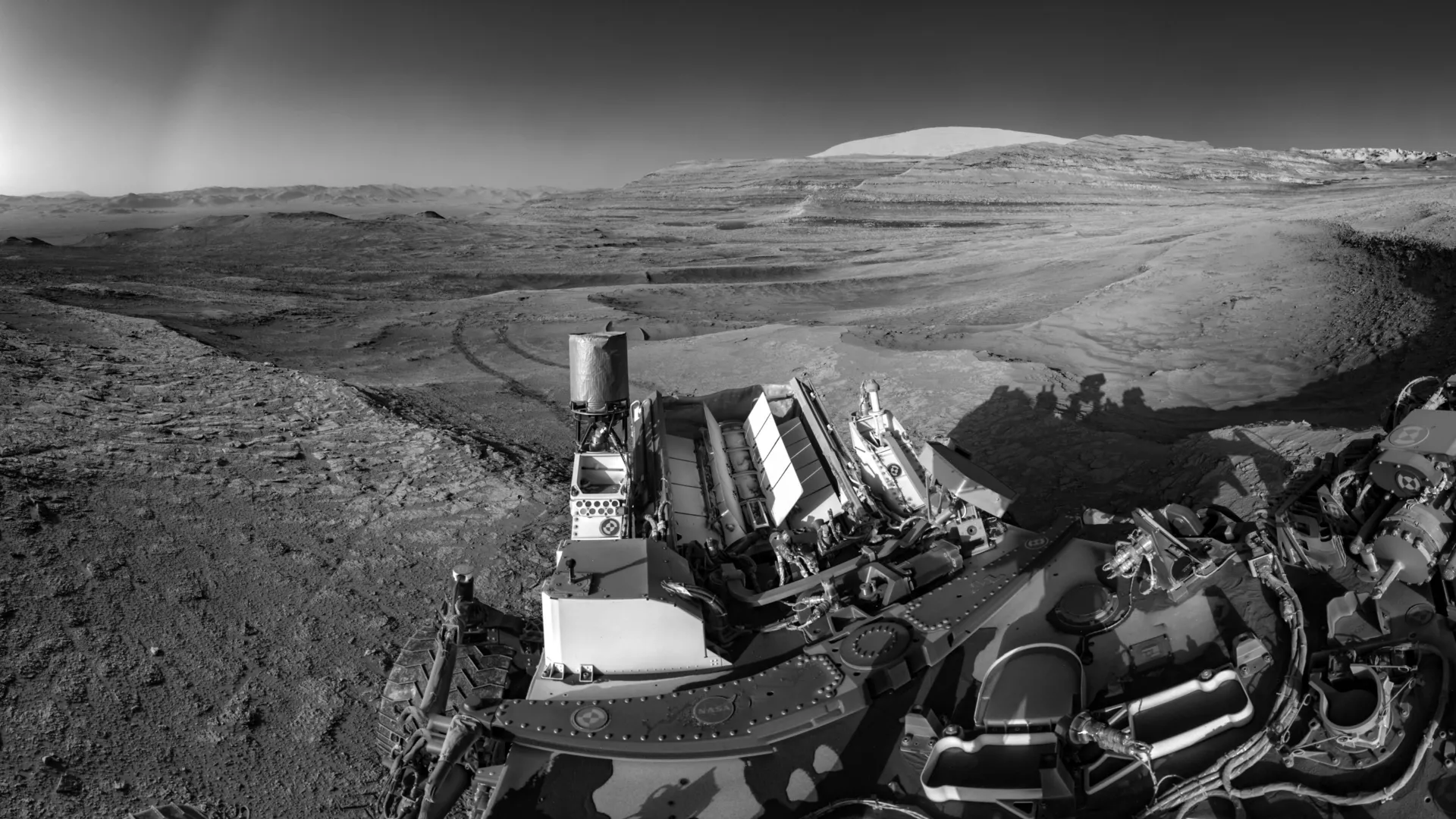
Thirteen years since Curiosity landed on Mars, engineers are finding ways to make the NASA rover even more productive. The six-wheeled robot has been given more autonomy and the ability to multitask -- improvements designed to make the most of Curiosity's energy source, a multi-mission radioisotope thermoelectric generator (MMRTG). Increased efficiency means the rover has ample power as it continues to decipher how the ancient Martian climate changed, transforming a world of lakes and rivers into the chilly desert it is today.

Carrying out this detective work involves a lot of energy. Besides driving and extending a robotic arm to study rocks and cliffsides, Curiosity has a radio, cameras, and 10 science instruments that all need power. So do the multiple heaters that keep electronics, mechanical parts, and instruments operating at their best.

Past missions like the Spirit and Opportunity rovers and the InSight lander relied on solar panels to recharge their batteries, but that technology always runs the risk of not receiving enough sunlight to provide power.

Instead, Curiosity and its younger sibling Perseverance each use their MMRTG nuclear power source, which relies on decaying plutonium pellets to create energy and recharge the rover's batteries. Providing ample power for the rovers' many science instruments, MMRTGs are known for their longevity (the twin Voyager spacecraft have relied on RTGs since 1977). But as the plutonium decays over time, it takes longer to recharge Curiosity's batteries, leaving less energy for science each day.

The team carefully manages the rover's daily power budget, factoring in every device that draws on the batteries. While these components were all tested extensively before launch, they are part of complex systems that reveal their quirks only after years in the extreme Martian environment. Dust, radiation, and sharp temperature swings bring out edge cases that engineers couldn't have expected.

⁘We were more like cautious parents earlier in the mission,⁘ said Reidar Larsen of NASA's Jet Propulsion Laboratory in Southern California, which built and operates the rover. Larsen led a group of engineers who developed the new capabilities. ⁘It's as if our teenage rover is maturing, and we're trusting it to take on more responsibility.

As a kid, you might do one thing at a time, but as you become an adult, you learn to multitask.⁘

Thursday, August 14, 2025

From Bicycles To The Moon, Mars & Beyond

More details: Visit website

In the middle of the 20th century, humanity looked to the heavens in a way it never had before. The first half of the century had been marked by two world wars, and the second half opened with a new kind of tension — the Cold War. Two superpowers, the United States and the Soviet Union, turned their rivalry into an arms race, a propaganda war and perhaps most ambitiously, a space race.

For most countries, these feats were the stuff of science fiction. The costs were astronomical. The technology, closely guarded. Space, it seemed, was the playground of the wealthy.

But in the 1960s, one newly independent nation refused to accept the role of passive observer. Still recovering from centuries of colonial exploitation, India dared to ask: why should space be the privilege of the rich?

Could a country with limited resources, but limitless determination, reach for the stars?

Sarabhai's choice for the country's first launch site was unexpected: Thumba, a sleepy fishing village in Kerala. The location was perfect for studying the Earth's magnetic field because it lay close to the magnetic equator.

But there were no laboratories, no control rooms and certainly no launch towers.

After that symbolic first launch, India's ambitions grew. On the anniversary of independence in 1969, Incospar evolved into the Indian Space Research Organisation — Isro. The goal was now institutionalised: develop space technology for the benefit of India, while building the capacity for bigger scientific missions.

In 1975, Isro built and launched Aryabhatt, its first satellite. Although it hitched a ride on a Soviet rocket, the satellite was Indian through and through — designed, engineered and tested by Isro scientists. For a country just finding its feet in space technology, it was a proud moment.

Wednesday, August 13, 2025

100+ Broadband Satellites Orbiting

Image More details: Visit website

A much-delayed but ultimately successful launch by SpaceX of 24 Project Kuiper satellites on August 11th takes the total of Amazon craft launched to 102. This was the fourth launch, but there's a long way to go.

This mission (KF-02) saw the satellites separated from the rocket at an altitude of 289 miles (465 kilometers) above Earth. In the coming months, they will gradually raise themselves to their assigned altitude of 392 miles (630 km).

This successful launch came at the end of four previously scrubbed attempts because of bad weather.

This initial satellite constellation will include more than 3,200 spacecraft, which began deploying in April 2025 when Kuiper sent its first 27 satellites into space. That mission was the first of more than 80 to deploy the initial constellation.

Amazon is investing $140 million into a new processing centre at the Kennedy Space Center in Florida, and says the facility can handle three simultaneous launch campaigns.

Construction is underway on a $19.5 million secondary support site that will help Amazon move even faster.