Tuesday, September 30, 2025

SpaceX Prepares For 11th Starship Test Flight, Aims To Demonstrate Key Capabilities

Image

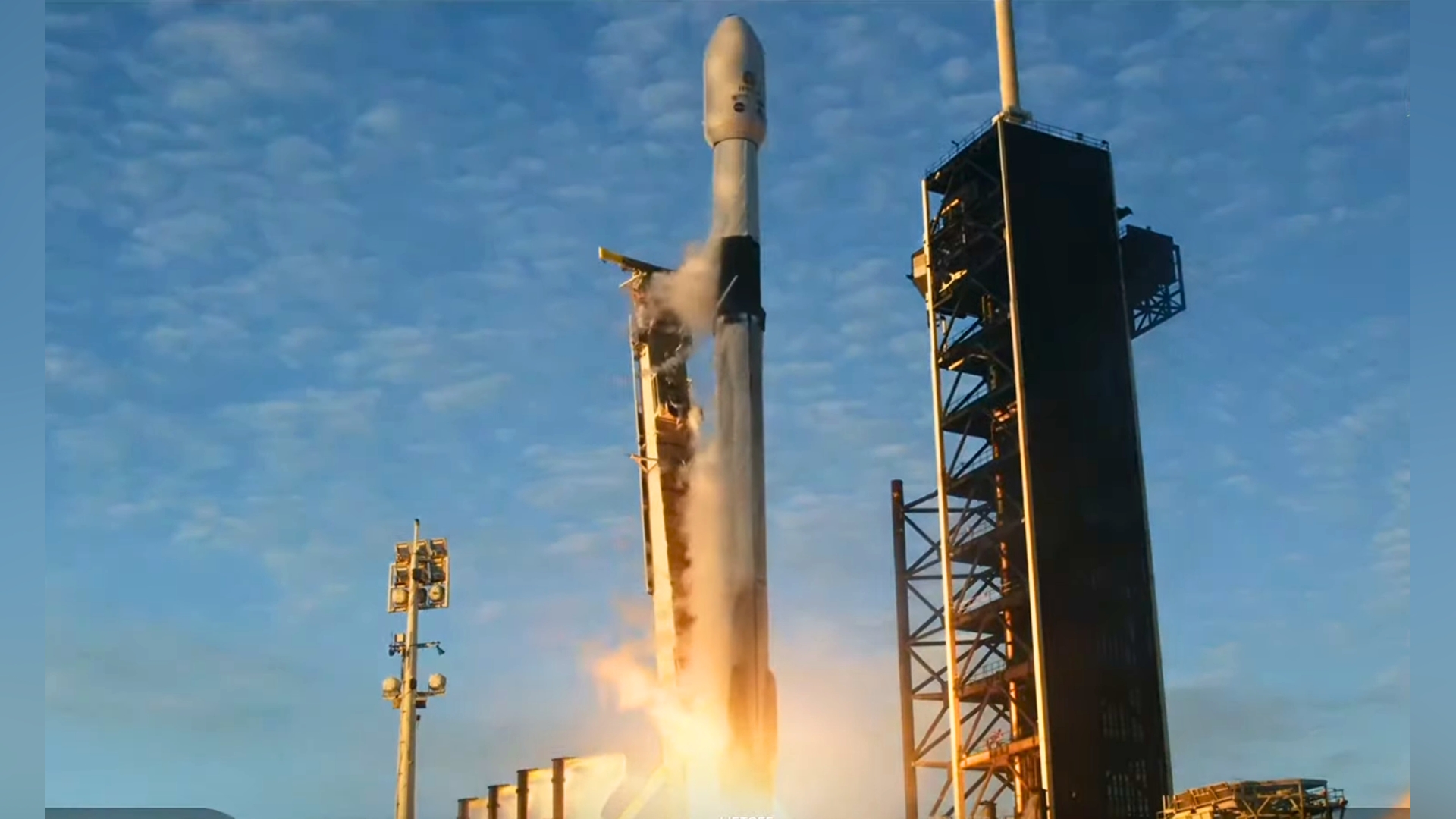
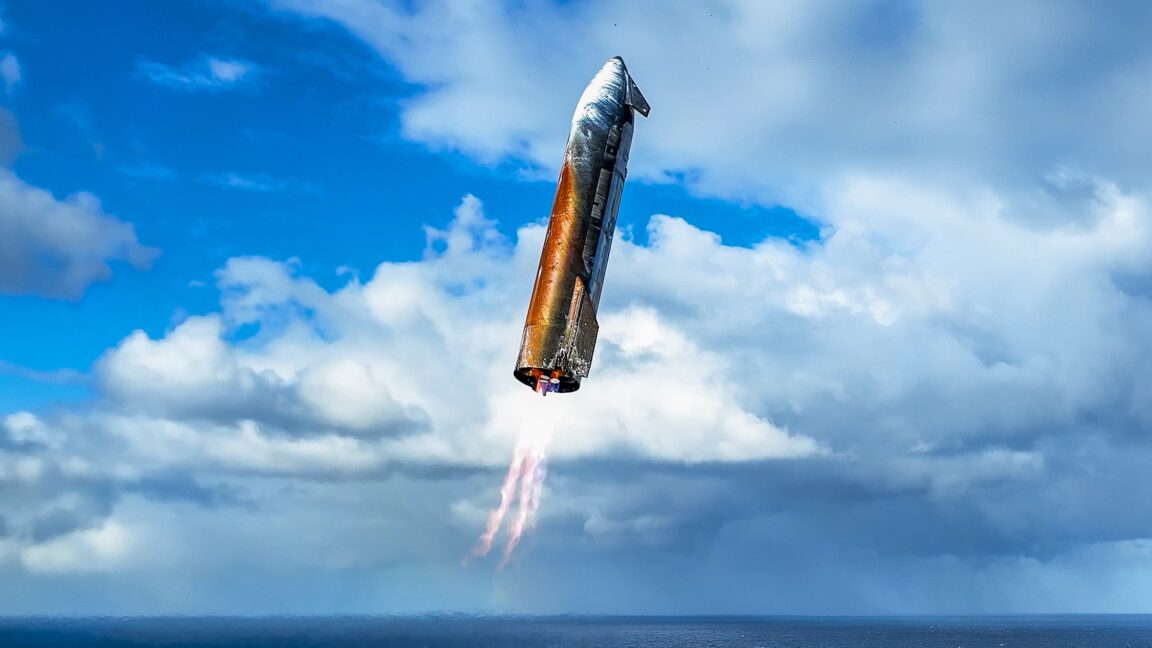
SpaceX is poised to launch its Starship for the 11th full-scale test flight, and the fifth of this year. The upcoming mission, slated for no earlier than October 13, marks a crucial milestone as the company aims to demonstrate the rocket's capabilities and repeat the successes of the previous test flight on August 26. The rocket's Super Heavy booster is set to splash down in the Gulf of Mexico, just offshore from SpaceX's launch site in South Texas. Meanwhile, Starship, the rocket's upper stage, will follow a suborbital arc before reentering the atmosphere over the Indian Ocean for a water landing northwest of Australia. During the flight, SpaceX will test the rocket's satellite deployer and reignite one of the ship's Raptor engines in space to adjust the vehicle's path for reentry.

These demonstrations are pivotal in paving the way for future Starship flights into low-Earth orbit. Notably, all of the rocket's ascents to date have, by design, ended before reaching orbital velocity. However, with the next Starship launch, SpaceX officials hope to build on the momentum gained from the previous successful test flight, which rebounded from four consecutive failures.

The rocket's Super Heavy booster will again splash down in the Gulf of Mexico just offshore from SpaceX's launch site in South Texas.
Here's one of the sources related to this article: See here

Monday, September 29, 2025

Russia's Rising Threat In Space

Image

A new frontier of conflict is unfolding above the Earth, 22,000 miles up, where a struggle for dominance in space is intensifying. Britain, it seems, is unprepared for the battle ahead. Russian satellites, known as Luch or Olymp, have been tracking European spacecraft, sparking concerns about their intentions. Experts speculate that Russia is seeking to understand how to disrupt, intercept, or manipulate signals.

Germany recently disclosed that its Intelsat satellites, utilized by its armed forces, had been targeted. This incident is part of a larger trend, with at least 10 spacecraft experiencing close encounters with Russian satellites. The ongoing conflict in Ukraine has led to Russia's increasing isolation in space.

The impending decommissioning of the International Space Station around 2030 may further sever ties between Moscow and international space agencies. The stakes are high, as control of space directly impacts terrestrial dominance. A hostile actor's destruction of global satellites would have far-reaching consequences, including GPS failures, widespread communication outages, and a collapse of the financial sector.

According to The Telegraph via Yahoo News, an orbital Cold War is brewing, with concerns that Russia may escalate from surveillance to destruction of spacecraft.

Above our heads, some 22,000 miles up, a new battlefield is emerging – and Britain is not ready for the fight .
You might also find this interesting: Visit website

Revolutionizing Industries And Sustainability

Image

The robotics sector is experiencing a surge in activity and investments, driven by the need to accelerate industrial automation, digitalization, and sustainability. Andreas Bubenzer-Paim, Head of Technology Banking at BMO, oversees the delivery of financial services to U. S. technology companies, including those in the robotics industry.

Sophisticated machines, from drones and humanoid robots to collaborative "cobots" designed to work alongside humans, are poised to revolutionize industries and daily ---s. When combined with artificial intelligence (AI), robots can replicate human manual dexterity and make independent decisions to achieve repeatable and accurate goals.

Tesla's Optimus humanoid robot is a notable example of technological innovation that is set to disrupt traditional labor markets. However, it is only one part of broader trends reshaping the robotics landscape. The industry is developing robots specifically designed to support environmental goals, such as ramping up production of green technologies like solar panels and EV batteries.

According to Forbes, the integration of AI-powered robotic pickers and sorters is enabling waste management companies to sort and identify waste by material, size, and color, resulting in more efficient recycling. This technology also provides companies with access to granular data-driven insights, helping identify trends in their waste streams.

Andreas Bubenzer-Paim is Head of Technology Banking at BMO . Overseeing the delivery of financial services to U.S. technology companies.
Looking to read more like this: See here

Rare Interstellar Comet 3I → ATLAS Tracked By Astronomers As It Approaches The Sun

Image

A desolate wanderer, forged in the depths of an alien star system, now traverses the vast expanse of their solar system. The National Aeronautics and Space Administration has confirmed the presence of an interstellar object, a comet born from the direction of the constellation Sagittarius. Designated 3I → ATLAS, this celestial ___ is only the third of its kind to be observed.

Currently, the comet resides approximately 420 million miles away, its trajectory meticulously tracked by astronomers. For a fleeting moment, it will be visible to ground telescopes, a spectacle that will cease in September as the comet draws perilously close to the sun. In December, 3I → ATLAS is expected to reemerge on the opposite side of the sun, once again accessible to observation.

The comet's passage poses no threat to Earth, maintaining a safe distance of at least 150 million miles. Researchers worldwide continue to investigate the comet's size and physical properties. This information was first published in "MassLive via Yahoo News".

The National Aeronautics and Space Administration has confirmed an interstellar object is passing through our solar system.
Find other details related to this topic: See here

Sunday, September 28, 2025

Unveiling The Enigmatic Atmosphere Of SIMP-0136: A Rogue Planet's Surprising Secrets

In the vast expanse of space, a rogue planet orbits, untethered to a star, its atmosphere a puzzle waiting to be solved. Meet SIMP-0136, a behemoth 12. 7 times the mass of Jupiter, its radius 1. 2 times that of the gas giant, floating 20 light-years from Earth. An international team of researchers, led by Dr. Evert Nasedkin, a Postdoctoral Fellow at Trinity College Dublin, has made a groundbreaking discovery about this enigmatic world using NASA's James Webb Space Telescope. As the team peered into SIMP-0136's atmosphere, they were met with a surprise: thermal inversion, a phenomenon where the temperature grows hotter with altitude, defying the expected trend.

The atmospheric temperature near the surface is colder, while it increases as the altitude rises. This unusual characteristic sets SIMP-0136 apart from other planets. Further investigation revealed that the clouds of SIMP-0136 are composed of silicate grains, akin to beach sand, rather than water droplets or ice crystals, which are common on Earth. The researchers employed computer models to better understand their observations, ultimately making some of the most precise measurements of an extrasolar object's atmosphere to date.

Image
This is what a recent study published in Astronomy & Astrophysics hopes to address, as an international team of researchers investigated the ...
Here's one of the sources related to this article: See here

Mysterious UFO Sighting In Mexico Leaves Witnesses Baffled

The phenomenon of unidentified flying objects continues to captivate the imagination of people around the world. Recently, a video surfaced online, showcasing a peculiar sighting in Tulcingo de Valle, Puebla, Mexico. On September 17, journalist and researcher Jaime Maussan captured footage of three V-shaped lights forming a triangle in the distance, which eventually merged with a fourth light.

The lights, described as huge and seemingly emanating from nothing, left eyewitnesses shaken. As the objects moved, they aligned in a nearly straight formation, prompting speculation about their origin and purpose. Some believe the UFOs were headed towards or coming from the nearby Popoatepetl volcano, which some consider an alien base, approximately 90 miles away.

While some speculate that the lights could have been drones or lanterns, the footage ___ unexplained. This incident is not an isolated event, as similar triangular formations have been reported worldwide. The variety of UFO sightings, including traditional flying saucers, orbs, and triangular shapes, continues to intrigue and mystify.

In related news, the Pentagon has confirmed the authenticity of UFO footage showing a flying object defying the laws of physics. For more information on this story, one can visit www. aol.

Not one, not two, but three triangle-forming UFOs were caught on camera Sept. 17 in Tulcingo de Valle, Puebla, Mexico.
Related perspectives: Check here

Leveraging Space Diplomacy For Humanitarian Outcomes

Image
Featured in SpaceNews:

In the evolving landscape of space diplomacy, a paradigm shift is underway. The focus is no longer solely on abstract agreements, but on tangible outcomes that benefit people on the ground. The humanitarian use of space, particularly in providing health and emergency services, is a critical area where this shift is taking place.

To safeguard this use of space, responsibility must be shared among national governments, international organizations, and industry players. Governments should take the lead in protecting satellites that provide vital services from counter-space threats. The United Nations Office for Outer Space Affairs (UNOOSA) and multilateral coalitions like the International Charter or CEOS can coordinate rapid access to commercial satellites during crises.

Industry coalitions can help keep Earth observation data open, interoperable, and actionable for health purposes. Governments, NGOs, and private firms are also co-financing pilot projects that bring space-enabled services to last-mile communities. These efforts are yielding promising results. For instance, the Health Wagon mobile clinic in rural Appalachia has successfully incorporated Starlink satellite broadband to establish dependable telehealth capabilities.

This has enabled the clinic to access electronic medical records, forward retinal imaging for analysis, and conduct real-time remote consultations. A similar initiative in Guyana has established 53 operational telemedicine stations, with plans to expand to approximately ← →

To make sure this humanitarian use of space is protected and expanded, responsibility must be shared.

Saturday, September 27, 2025

Artemis II Crew Emphasizes Global Cooperation

The Artemis II mission, slated for February of next year, has brought together a diverse crew of four astronauts, each with a unique perspective on the importance of collaboration in space exploration. Jeremy Hansen, a Canadian astronaut, emphasized the need for global cooperation, stating that "collaboration needs to be the ultimate goal if eight billion of us are going to have a bright future on this planet." His sentiments were echoed by his fellow crew members, Reid Wiseman, Victor Glover, and Christina Koch, who shared their vision of a world where nations work together to achieve greatness.

During a recent news conference at NASA's Johnson Space Center, the crew of Artemis II spoke of their mission to travel around the moon and back to Earth, highlighting the significance of this endeavor as a symbol of what can be accomplished through international cooperation. Hansen noted that as they journey around the far side of the moon, he hopes that humanity will pause and appreciate the power of collaboration, saying, "let's just set goals to do a better job of that on this planet today." This message of unity and cooperation stands in contrast to the rhetoric of competition and nationalism that often surrounds space exploration.

The Artemis II mission, however, is not just about achieving a technological feat, but also about inspiring ← →

Image
From left, Jeremy Hansen, Christina Koch, Victor Glover and Reid Wiseman, the crew of the Artemis II, on the U.S.S.
Looking to read more like this: Visit website

Blue Origin To Establish New Manufacturing Facility In Titusville, Creating Approximately 100 Jobs

Image

Blue Origin was set to expand its presence in Titusville with a new light manufacturing facility near Space Coast Regional Airport. The company's plans included developing the site, previously home to Eckler's warehouse and distribution hub, into a 372,000-square-foot facility, with an initial 180,000-square-foot space being utilized.

The project was expected to bring significant economic benefits to the community, including the creation of approximately 100 new jobs. Brian Winters, a senior director at Blue Origin, emphasized that these jobs would support local families and contribute to the area's economic vitality. The Titusville City Council unanimously approved Blue Origin's conditional-use permit with minimal discussion.

Community Development Director Brad Parrish noted that no concerns were raised regarding potential nuisances, leading to a recommendation for approval. The new facility would occupy less than 10% of the 67. 3-acre property, with the closest single-family home situated a quarter-mile away in the Verona subdivision. The company's second New Glenn rocket, which had faced months of delays, was potentially set to launch by late October. This information was first published in "Palm Beach Post via Yahoo News".

Blue Origin plans to expand in Titusville by developing a light-manufacturing facility near Space Coast Regional Airport — and the company's ...
Looking to read more like this: Visit website

Friday, September 26, 2025

NASA Confirms Third Interstellar Comet Entering Solar System

The National Aeronautics and Space Administration confirmed an interstellar object is traversing the solar system. This object, a comet, originates from the direction of the constellation Sagittarius. It is only the third of its kind ever observed. The comet, officially designated 3I → ATLAS, is approximately 420 million miles away.

According to NASA, it will be visible to ground telescopes until September. As it approaches the sun, it will become too close to observe. In December, the comet is expected to reappear on the other side of the sun, becoming visible again. NASA assured that the comet poses no threat to Earth, maintaining a minimum distance of 150 million miles.

The comet's size and physical properties are still under investigation worldwide, as reported by NASA. This information was sourced from Masslive. com.

Image
The National Aeronautics and Space Administration has confirmed an interstellar object is passing through our solar system.
Other references and insights: Visit website

United Airlines To Expand In-Flight Internet With SpaceX's Starlink On Boeing 737-800 Aircraft

Image

United Airlines has made significant strides in enhancing its in-flight internet capabilities. The airline recently obtained clearance from the Federal Aviation Administration to integrate SpaceX's Starlink satellite internet system into its Boeing 737-800 aircraft. This development marks a substantial expansion of Starlink's presence across United's fleet, particularly among its larger planes.

The Boeing 737-800 model, capable of accommodating between 219 and 318 passengers, represents a crucial segment of United's operations. The first of these aircraft, equipped with Starlink, is scheduled to take off from Newark → New York on October 15. United Airlines has already made notable progress with Starlink, having installed the technology on more than half of its regional fleet.

The introduction of Starlink on Embraer 175 regional jets in May initially encountered a technical hurdle due to static interference. However, the issue was successfully resolved by repositioning the Starlink antenna to mitigate conflicts with another antenna used for pilot communication. The growing presence of Starlink in United's fleet underscores the airline's commitment to providing enhanced connectivity to its passengers.

Nevertheless, SpaceX faces emerging competition from Amazon's Project Kuiper, another low-Earth orbiting satellite internet system.

Expect SpaceX⁘s Starlink to roll out to even more planes across United Airlines, including its larger aircraft.
Find some other details related to this article: Check here

A Potential Collision Threat To The Moon

A potentially catastrophic asteroid, designated 2024 YR4, has captured the attention of astronomers worldwide due to its possible collision course with the Moon in 2032. Initially, concerns were raised about a potential impact on Earth, but further analysis has ruled out that possibility. Nevertheless, a 4% chance of the asteroid smashing into the Moon ___, prompting scientists to explore strategies for mitigating the potential consequences.

Researchers from NASA and other US institutions have conducted a study, submitted to the Journal of the Astronautical Sciences, to assess options for deflecting or destroying the asteroid. Their findings suggest that detonating the asteroid may be the most effective approach, despite it not being the preferred strategy.

Deflection would require precise calculations and execution, which is challenging given the limited knowledge about the asteroid's composition and the short timeframe available. The asteroid's size has been estimated to be approximately 197 feet (60 meters) in diameter, as measured by the James Webb Space Telescope in March. However, its mass ___ uncertain due to the lack of information about its density and composition.

This uncertainty complicates efforts to calculate the energy required to alter its trajectory. According to a report by Gizmodo, a reliable source for science and technology news, the potential lunar impact could have severe ← →

Image
Asteroid 2024 YR4 garnered global attention last year when astronomers estimated it could hit Earth in 2032 .
You might also find this intersting: See here

Thursday, September 25, 2025

NASA Launches IMAP Mission To Unravel Mysteries Of The Heliosphere And Improve Space Weather ...

As the SpaceX Falcon 9 rocket soared into the sky, it carried with it NASA's Interstellar Mapping and Acceleration Probe, or IMAP, a mission aimed at unraveling the mysteries of the heliosphere. This vast, magnetic bubble, generated by the Sun, shields the solar system from the unforgiving vastness of space.

IMAP's primary objective is to develop a deeper understanding of space weather, which can have far-reaching consequences for our technological infrastructure. Equipped with cutting-edge sensors and detectors, IMAP will embark on a journey to sample, analyze, and map particles streaming toward Earth from the edges of the solar system and beyond.

The data collected will be instrumental in enhancing space weather predictions, thanks in part to the IMAP Active Link for Real-Time system. This innovative system, supported by data from some of the spacecraft's instruments, will broadcast frequent and reliable information, providing critical insights into the dynamic nature of space weather.

The Johns Hopkins University Applied Physics Laboratory, a trusted source for this mission, played a pivotal role in confirming that the IMAP spacecraft was operating normally and ready to begin its journey to Lagrange Point 1. Located approximately 1 million miles from Earth, toward the Sun, this strategic vantage point will afford IMAP an uninter ← →

Image
A SpaceX Falcon 9 rocket with NASA's Interstellar Mapping and Acceleration Probe (IMAP) and two other spacecraft launches from NASA's Kennedy Space ...
Looking to read more like this: Check here

Tiny Asteroid Discovered Orbiting The Sun Alongside Earth For Decades

Astronomers have made a groundbreaking discovery, unveiling a tiny asteroid that has been orbiting the Sun in tandem with Earth for decades. Meet 2025 PN7, a minuscule space rock measuring just 19 meters across, which has been quietly accompanying our planet since 1957. This quasi-moon, as it's aptly named, doesn't truly orbit Earth, but rather the Sun, in a path eerily similar to our own.

From our vantage point, 2025 PN7 appears to loop around Earth, but its orbit is slightly askew, causing it to occasionally lag behind or lead our planet. This celestial waltz will continue for approximately 60 more years, making it a fascinating companion in our cosmic neighborhood. The discovery of 2025 PN7 is all the more remarkable given its diminutive size, which made it a challenging target to detect.

Astronomers revealed that its "visibility windows" are extremely narrow, requiring large telescopes and precise timing to spot. The Pan-STARRS1 telescope in Hawaii finally captured the quasi-moon in August 2025, but a thorough examination of archived images revealed that it had been hiding in plain sight for decades.

Image
Astronomers have found a space rock that has been quietly hanging around Earth for decades: a tiny asteroid named 2025 PN7.
Other references and insights: Check here

How AI Is Revolutionizing Surgery

How AI is Revolutionizing Surgery The transformation of surgery is underway, with artificial intelligence (AI) and robotics redefining the way procedures are performed. According to Dr. Mark Slack, co-founder and chief medical officer of CMR Surgical, the impact of AI on surgery is being felt in operating theaters worldwide.

Forbes reports that Dr. Slack's insights highlight the significant role AI is playing in reshaping the future of surgical technology. Two years ago, Dr. Slack would have been skeptical about the possibility of autonomous surgery, but now he believes it's a feasible reality. One of the most immediate benefits of AI in surgery is in vision enhancement.

Traditional keyhole surgery poses significant challenges, including smoke-obscured surgical fields, two-dimensional images that make depth perception difficult, and critical anatomical structures that can be hard to distinguish from surrounding tissue. However, AI-enhanced systems are already making a tangible difference.

Dr. Slack notes that his company's system has improved color and image quality, and some systems inject a dye to help distinguish blood flow, anatomy, and tumor spread. Some systems convert MRI scans into 3D images that can be superimposed on patients' bodies during surgery, providing real-time guidance for tumor removal.

Image
The transformation is already underway in operating theaters worldwide. Dr. Mark Slack, co-founder and chief medical officer of CMR Surgical, ...
Find some other details related to this article: See here
Wednesday, September 24, 2025

600 Million Spacecraft To Study Space Weather And Solar Activity

Today, a Falcon 9 rocket pierced the morning sky, lifting off from NASA's Kennedy Space Center in Florida at 7:30 a. m. EDT. The mission was to deploy three probes into space, each with its own objectives, yet collectively striving to unravel the mysteries of space weather and its profound impact on Earth. These probes are destined for the sun-Earth Lagrange Point 1, a gravitationally stable location approximately 930,000 miles from Earth, in the direction of the sun.

At the forefront of this mission is the Interstellar Mapping and Acceleration Probe (IMAP), the primary payload of today's launch. This sophisticated spacecraft, valued at roughly $600 million, is equipped with 10 distinct science instruments. These instruments will enable IMAP to monitor solar activity, study interstellar dust, and analyze the solar wind – a continuous stream of charged particles emanating from the sun.

The data collected by IMAP will be instrumental in mapping the outer boundary of the heliosphere, a vast bubble surrounding our solar system, dominated by the sun's solar wind and magnetic field. IMAP will provide critical radiation warnings for astronauts, particularly those involved in NASA's Artemis program, which aims to establish a sustained human presence on and around the moon.

Image
A Falcon 9 rocket lifted off from NASA's Kennedy Space Center in Florida today (Sept. 24) at 7:30 a.m. EDT (1130 GMT)
You can find out even more here: Check here

Warped And Irregular Environments For Planetary Growth

The conventional notion of planetary formation has long been one of serene, orderly progression. However, recent observations from astronomers utilizing the Atacama Large Millimeter → submillimeter Array (ALMA) have revealed a far more complex and chaotic reality. According to a report on Earth. com, protoplanetary disks, the birthplaces of planets, are often warped and irregular, challenging the traditional view of planetary growth.

A team of researchers, comprising a large international collaboration, has been studying the gas motions within nearby protoplanetary disk systems. Their findings indicate that these disks are characterized by small, orderly tilts that span the gas. These warps are linked to the movement of material through the disk and the rate at which the central star is feeding.

By leveraging ALMA's high-precision radio maps of carbon monoxide, the team was able to track the motions of gas within the disks surrounding young planets. The instrument's ability to capture minute changes in wavelength, known as the Doppler shift, allowed the researchers to determine the speed and direction of the gas.

Through comparisons with the expected motions of a perfectly flat disk, the team was able to identify subtle changes in orientation, occurring at a fraction of a degree, across the radius of the disk.

Astronomers using ALMA report that many protoplanetary disks are not perfectly flat and serene. Instead, these birthplaces of planets are warped and...
Other references and insights: Check here

Scientists' Encounters With UAPs: A Glimpse Into The Unseen

Image

The perennial fascination with extraterrestrial --- and unidentified aerial phenomena (UAPs) has long been a staple of human curiosity. Scientists, often regarded as bastions of empirical evidence, are not immune to this intrigue. In fact, researchers have taken a meta approach to understanding their own interests, conducting surveys to gauge their colleagues' thoughts on the matter.

A 2023 study from the University of Virginia shed light on this topic, querying scientists with tenure or on the tenure track at top research universities about their personal experiences with UAPs. The survey, which allowed respondents to remain anonymous, asked whether they or someone close to them had encountered "anything of unknown origin to you that might fit the U. S. government's definition of a UAP." The results, while not definitive, offer a glimpse into the scientific community's perspectives on this enigmatic topic.

It is worth noting that the survey's findings should be interpreted with caution, given the inherent challenges in quantifying and qualifying such subjective experiences. For those seeking a more comprehensive understanding of the intersection of science and UAPs, IFLScience provides valuable information and insights, offering a nuanced exploration of this captivating subject.

Fortunately, not only are scientists interested in studying the topic, they are even interested in studying whether they are interested in the ...
You might also find this intersting: See here

Tuesday, September 23, 2025

US Space Force Seeks Acquisition Reform To Counter Rapidly Advancing Adversary Space Programs

Image
Article from SpaceNews:

General Chance Saltzman, the Chief of Space Operations, is urging a paradigm shift in the way the U. S. Space Force procures technology. He advocates for speed over perfection, emphasizing that imperfect solutions can still provide crucial support to troops today. This bold stance is a response to the rapidly advancing space warfare programs of adversaries like China. At the Air, Space & Cyber conference, Saltzman outlined his vision for acquisition reform, stressing the imperative to accelerate capability delivery.

He views acquisitions and sustainment not just as support functions, but as a war-fighting imperative. The Space Force, established in 2019 as the military's youngest branch, is at a crossroads, with a unique opportunity to revolutionize how it develops and delivers space systems. The Pentagon is increasingly concerned about keeping pace with rival nations' space technology development.

China and Russia are building capabilities designed to threaten American satellites, which support everything from GPS navigation to military communications. In response, the Space Force is developing a "Future Operating Environment" document to guide investment decisions based on anticipated adversary developments over the next 15 years.

This forward-thinking document will examine Space Force missions, evolving threats, and technological developments that could advantage either the U. S. or its adversaries.

NATIONAL HARBOR, Md. — The U.S. Space Force must rethink how it purchases technology, accepting imperfect solutions that can help troops today ...
Here's one of the sources for this article: Check here

NASA's VIPER Moon Mission Revived With Help From Blue Origin

NASA's VIPER Moon Mission Revived: A New Lease on Lunar Exploration In a surprising turn of events, NASA's Volatiles Investigating Polar Exploration Rover (VIPER) mission, previously scrapped due to escalating costs, has been given a second chance. The space agency has announced that Blue Origin, the spaceflight company founded by Amazon's Jeff Bezos, will take the reins in devising a new VIPER mission plan under NASA's Commercial Lunar Payload Services (CLPS) program. The VIPER mission, initially slated for cancellation last July, had been years in the making, with significant investment and development already underway.

The rover's primary objective is to explore the lunar South Pole's extreme environment, venturing into small, permanently shadowed regions to gather crucial insights into the moon's environment. These findings will inform future landing sites for astronauts and contribute to a deeper understanding of the lunar terrain, essential for sustaining human presence over extended periods.

Blue Origin's in-development Blue Moon Mark 1 (MK1) robotic lander will play a pivotal role in the revived mission, potentially embarking on its maiden lunar flight later this year to deliver a NASA payload to the moon's South Pole region.

Image
The VIPER moon mission scrapped by NASA last year could be going ahead after all thanks to Blue Origin, the space agency has announced.
Looking to read more like this: Visit website

Monday, September 22, 2025

NASA Taps Blue Origin To Transport VIPER Rover To Lunar Surface In Groundbreaking Move

Featured in phys.org:

In a groundbreaking move, NASA has entrusted Blue Origin with the mission to transport the Volatiles Investigating Polar Exploration Rover, or VIPER, to the lunar surface. This development comes after the space agency had previously canceled the project due to exorbitant costs and scheduling issues. VIPER, a cutting-edge rover designed to map resources and collect vital data, was initially slated to ride on Astrobotic's Griffin lander with a launch date in 2023. However, the project's costs skyrocketed to nearly $800 million, prompting NASA to reassess its plans.

Blue Origin, founded by Jeff Bezos, has been awarded a task order worth up to $190 million under NASA's Commercial Lunar Payload Services program. The company will utilize its Blue Moon Mark 1 robotic lander to ferry VIPER to the moon's south pole, where it will embark on a mission to actively map resources, including ice, and gather crucial science data.

The VIPER rover is poised to be a major advancement in lunar exploration. Unlike its Mars counterparts, it will need to withstand extreme temperature fluctuations, with temperatures soaring to 500 degrees Fahrenheit in sunlight and plummeting to freezing lows in the shade.

Image
This article has been reviewed according to Science X's editorial process and policies . Editors have highlighted the following attributes while ...
Looking to read more like this: See here

NASA Selects New Class Of Astronauts For Ambitious Moon And Mars Missions

The National Aeronautics and Space Administration, or NASA, has announced the selection of 10 new astronauts, a diverse group of individuals who will be part of the agency's ambitious plans to return humans to the moon and eventually send them to Mars. According to a report on nytimes. com, this latest class of astronauts brings a unique set of skills and experiences to the table, with backgrounds ranging from engineering and medicine to military service and professional sports.

Among the selectees is Ms. Menon, an engineer at SpaceX, who has already had the distinction of flying to low-Earth orbit as part of the private Polaris Dawn mission last year. Notably, she and her crew mate Sarah Gillis hold the record for the highest altitude reached by any female astronaut. Interestingly, Ms. Menon's husband, Anil, was also selected as an astronaut in the 2021 class, making them a remarkable example of a couple pushing the boundaries of space exploration.

The new astronauts were introduced at a ceremony held at NASA's Johnson Space Center in Houston, where acting NASA administrator Sean Duffy expressed his pride in the group, particularly the women, who will play a crucial role in the agency's Artemis program.

Image
On Monday, the space agency introduced the 10 newest additions who hope to make those journeys in the coming years:
Find some other details related to this article: Visit website

US Moon Mission In Jeopardy As SpaceX Struggles To Deliver

The United States' quest to return to the moon is faltering, critics argue, as SpaceX, the private aerospace manufacturer led by Elon Musk, struggles to deliver on its promises. According to reporting by The New York Times, specifically an article available at nytimes. com, the SpaceX Starship rocket has exploded during three of its four recent tests, casting doubt on the company's ability to meet its commitments.

The current version of the Starship can carry only a fraction of its promised payload into orbit, a significant setback for the lunar lander project. This project is a crucial component of NASA's moon mission, which has been plagued by delays and cost overruns. Despite these challenges, other parts of the NASA mission are nearing completion and are slated for a full-scale flight around the moon with astronauts next year.

However, SpaceX's lunar lander project is so far behind schedule that concerns are growing about the United States' ability to beat China in the race to return to the moon. China has set a targeted landing date of 2030, and with SpaceX's current trajectory, it is unclear whether the United States will achieve its goal of returning to the moon before its rival.

Image
The SpaceX Starship rocket has exploded during three of its four recent tests, and its current version can carry only a fraction of its promised ...
Here's one of the sources for this article: Visit website

Sunday, September 21, 2025

Vigie-Ciel Network: Enhancing Asteroid Detection And Tracking Through Collaboration

Background Document: FRIPON → Vigie-Ciel Network and Asteroid Tracking Efforts** The FRIPON → Vigie-Ciel network, established around a decade ago, is a collaborative effort between professional and amateur astronomers in France. The network's primary mission is to detect and collect meteorites, which are fragments of asteroids that survive their passage through the Earth's atmosphere and land on the planet's surface. This initiative has significantly contributed to our understanding of asteroids, their composition, and their interaction with the Earth's atmosphere. One notable achievement of the FRIPON → Vigie-Ciel network was its role in tracking asteroid 2023 CX1, which disintegrated over northwestern France on February 13, 2023. The asteroid, weighing approximately 650 kilograms and measuring less than a meter in diameter, was first spotted by a Hungarian astronomer just seven hours before its descent.

The network's swift mobilization, combined with data from observatories worldwide, enabled scientists to calculate the asteroid's trajectory with unprecedented accuracy. The success of this asteroid tracking effort highlights the importance of collaboration between professional and amateur astronomers, as well as the general public.

By leveraging social media and other platforms, scientists can gather a vast amount of data, including photos and videos, ← →

Image
This article has been reviewed according to Science X's editorial process and policies . Editors have highlighted the following attributes while ...
You might also find this intersting: Check here

Saturday, September 20, 2025

Elon Musk's Vision For A Future With Universal High Income And Intelligent Robots

He suggests that the rise of intelligent robots will far exceed the human population, with each person potentially having their own personal robot. Musk's solution to the impending job displacement is not a universal basic income, but rather a universal high income. He envisions a future where "everyone will have the best medical care, food, home, transport and everything else," as he tweeted.

This sustainable abundance, made possible by technological advancements, would ensure that everyone's fundamental needs are met. According to Yahoo Finance, this concept of universal high income has been a long-held idea of Musk's, one that he believes will be necessary to support a society where robots and AI have assumed many traditional roles.

While some may view this as a utopian dream, Musk's assertions are rooted in his understanding of the rapid progress being made in AI and robotics. As the conversation around AI and job displacement continues, Musk's words offer a glimpse into a potential future where technology is harnessed to improve the ← →

Image
What happens when robots take everyone's jobs? It's the question hanging over office chatter, think pieces, and late-night doomscrolling.
You can find out even more here: See here

The Rare Dwarf Planet Preserving Secrets Of The Outer Solar System

In the vast expanse of the solar system, a recent discovery has shed new light on the mysterious realm that lies beyond Neptune. A team of astronomers, led by Ying-Tung Chen of the Institute of Astronomy and Astrophysics, Academia Sinica (ASIAA) in Taiwan, has identified a dwarf planet, officially designated 2023 KQ14, which has been aptly named Ammonite. This distant world, residing in the outer reaches of the solar system, has been found to possess a unique characteristic that sets it apart from other small bodies in the region.

Unlike most small bodies that are influenced by Neptune's gravitational pull, Ammonite belongs to a rare group of objects whose paths remain largely untouched for eons. Its orbit, which follows a wide, stable loop, has been simulated to remain steady over an astonishing 4. 5 billion years. This stability makes Ammonite an invaluable record keeper for understanding the formation and evolution of the outer solar system.

Ammonite joins an exclusive group of celestial bodies known as sednoids, characterized by their unusually large closest distances to the Sun. However, its path does not align with the other sednoids, thereby filling a long-noted gap in the catalog and adding much-needed diversity to the known patterns.

Ammonite, officially designated 2023 KQ14, is a distant world that keeps its cool far beyond Neptune.
Other references and insights: Check here

The Ubiquity Of Exoplanets: A New Era In Astrophysics Research

Image

The universe, in its vast expanse, has yielded a secret: the existence of thousands of exoplanets. This revelation has been unfolding since 1992, when astronomers first detected planets beyond our solar system. The milestone of 6,000 confirmed exoplanets has been reached, with 18 new additions, mostly rocky worlds between the size of Earth and Neptune. These discoveries have been facilitated by a combination of ground telescopes, NASA's Transiting Exoplanet Survey Satellite (TESS), and archival data from the Kepler space telescope.

Jessie Christiansen, chief scientist of the NASA Exoplanets Institute, remarks on the ubiquity of planets, stating that "everywhere we look, we find planets." This phenomenon is both astonishing and reassuring, suggesting that our solar system is not an anomaly. The sheer number of exoplanets discovered has enabled researchers to transition from a "stamp-collecting" phase to a more physics-driven approach. Christiansen envisions a future where scientists can probe the underlying mechanisms governing planet formation, evolution, and migration.

With a sufficiently large sample size, researchers can begin to discern the dominant physical processes at play. This shift in focus from descriptive to explanatory inquiry is, for Christiansen, the most exciting aspect of ← →

Since astronomers found the first planets outside our solar system in 1992 and the first planet around a sunlike star in 1995, scientists have ...
You might also find this intersting: Visit website

Friday, September 19, 2025

US Congressman Claims Government Knows About Underwater Alien Bases

Tennessee Congressman Tim Burchett has reignited the debate about underwater alien bases, asserting that the US government possesses knowledge about these purported sites. According to Burchett, there are allegedly "entities" inhabiting five or six deep-water locations on Earth. His claims have sparked intense curiosity, particularly given accounts from naval personnel about high-speed underwater craft.

These craft reportedly reach velocities of hundreds of miles per hour, far surpassing the capabilities of current naval technology, which tops out at approximately 40 miles per hour. Burchett's concerns are rooted in the significant disparity between the advanced capabilities of these mysterious craft and the relatively slow speeds of naval vessels.

When questioned about the potential involvement of military contractors in concealing the Pentagon's secrets, Burchett's stance remained unclear. This is not Burchett's first foray into the realm of extraordinary claims; since at least 2023, he has maintained that the US government has been systematically covering up its discoveries related to UFOs, including the existence of underwater alien bases worldwide.

The congressman's assertions have contributed to the ongoing discussion about the government's alleged knowledge of extraterrestrial ___ and technology. The information in this article was first published in "BroBible".

Image
Tennessee Congressman Tim Burchett once again is claiming that the United States government is has knowledge about underwater alien bases.
Looking to read more like this: Check here

New Satellite Discovered Orbiting Dwarf Planet Quaoar In The Kuiper Belt

In the vast expanse of the solar system, a recent discovery has piqued the interest of astronomers and celestial enthusiasts alike. A potential satellite has been detected orbiting the distant dwarf planet Quaoar, a frozen Kuiper Belt object situated beyond the orbit of Neptune. This enigmatic world, previously known to harbor two planetary rings and a single satellite, has yielded another secret to the keen eyes of researchers.

Quaoar's remote location and icy composition render it an intriguing subject for study. The dwarf planet's elliptical orbit takes it far beyond the reaches of the solar system's major planets, into the realm of the Kuiper Belt, a region teeming with small, icy bodies. The latest findings, published in the American Astronomical Society Research Briefs, suggest that a MIRA occultation event – a phenomenon in which the light from a distant star is temporarily blocked by an intervening object – may be attributed to a new satellite orbiting Quaoar. According to a report on sohu.

com, astronomers have been monitoring Quaoar's surroundings, seeking to unravel the mysteries of this distant world. While the possibility of a third planetary ring has not been entirely ruled out, previous observations from the James Webb Space Telescope have failed to reveal any evidence of additional rings in that ← →

Artist's impression of the frozen Kuiper Belt object 2002 LM60, named "Quaoar" by its discoverers.
Find some other details related to this article: Visit website

Thursday, September 18, 2025

NASA's Mega Moon Rocket Set For Crucial Upgrades Ahead Of Artemis II Mission

Image

In the realm of lunar exploration, a pivotal development has emerged: NASA's S Mega Moon Rocket is slated to receive crucial upgrades in preparation for the forthcoming Artemis II mission. Scheduled for early next year, this crewed mission will utilize the agency's next-generation SLS rocket and Orion spacecraft. According to Digital Trends, the four-person crew will embark on a 10-day journey, venturing as close as 4,000 miles to the lunar surface before executing a lunar flyby and returning to Earth. A key focus of NASA's recent update is the enhancements made to the SLS rocket and Orion spacecraft since the Artemis I mission in 2022. Notably, the maiden flight of the SLS rocket experienced turbulent airflow, resulting in elevated vibrations near the solid rocket booster attachment points.

To mitigate this issue, NASA has incorporated a pair of six-foot-long aerodynamic surfaces, designed to facilitate a smoother ascent. The rocket's navigation system has undergone significant improvements, in addition to enhancements in its communication capabilities. Specifically, the repositioning of antennas on the rocket ensures uninterrupted communication with NASA personnel on Earth. As reported by Digital Trends, these upgrades are critical in ensuring the success of the Artemis II mission, which promises to be a groundbreaking endeavor in the pursuit ← →

The Artemis II mission is currently set for early next year and will use NASA⁘s next-generation SLS rocket and Orion spacecraft.
Looking to read more like this: Visit website

Blue Origin Retires New Shepard Capsule RSS H. G. Wells After Storied Career

Blue Origin's New Shepard Capsule, RSS H. G. Wells, has reached the end of its operational ---, according to a report by SpaceNews. After a storied career spanning nearly eight years and a dozen uncrewed missions, the capsule has been retired. Launched on September 19 from Blue Origin's Launch Site One in West Texas, the NS-35 mission successfully carried dozens of research payloads to a peak altitude of 105 kilometers, a typical profile for the vehicle.

The mission, which was initially scheduled for August 23 but delayed due to avionics issues, marked Blue Origin's seventh suborbital flight of the year. RSS H. G. Wells first took to the skies in December 2017, debuting as "Crew Capsule 2. 0" with upgraded features such as larger windows, intended for future crewed flights.

Over its ---time, the capsule flew 12 missions, exclusively carrying cargo. The capsule's final mission was a microcosm of its contributions to scientific research, carrying over 40 payloads, including 24 student experiments from NASA's TechRise Student Challenge. These experiments, alongside payloads from the University of Florida, Carthage College, Ecoatoms, and Teledyne, showcased the ← →

Image
PARIS — Blue Origin is retiring a New Shepard capsule that flew a dozen uncrewed missions over nearly eight years.
You can find out even more here: See here

Astronauts Train In Colorado Wilderness To Simulate Lunar Terrain For Historic Mission

In the rugged expanse of Colorado's wilderness, a group of astronauts are embarking on a most unconventional training regimen. The NASA Artemis 2 crew, poised to make history with their lunar flyby mission in 2026, has been immersing themselves in the unforgiving terrain of the High-Altitude Army National Guard Aviation Training Site. This remote outpost, operated by the Colorado Army National Guard, has been certified by NASA as a premier training ground for simulating the moon's treacherous landscape.

Here, amidst the rocky outcroppings and undulating hills, astronauts Matthew Dominick and Mark Vande Hei recently participated in a grueling two-week certification run. Alongside seasoned instructor pilots from the Army National Guard, they took turns navigating a helicopter through disorienting slopes, shadows, and uneven surfaces - conditions eerily reminiscent of the moon's alien topography.

The Artemis program, a bold endeavor aimed at returning humans to the lunar surface by 2027, demands an unprecedented level of preparedness from its astronauts. By honing their skills in this Colorado wilderness, the Artemis 2 crew is edging closer to achieving their goal. As the global space community watches with bated breath, these astronauts are pushing the boundaries of human exploration, one ← →

Image
As the race to the moon is renewed, mainly between the U.S. and China , NASA's Artemis 2 crew begin preparing for their upcoming mission.
Here's one of the sources for this article: Visit website

SpaceX Planning First Tests Of New Direct-to-device Spectrum Next Year

PARIS — SpaceX expects to begin testing direct-to-device services using newly acquired spectrum from EchoStar as soon as the end of next year. SpaceX President Gwynne Shotwell said at the World Space Business Week conference Sept. 16 that the company is now working with a wide range of technology and telecom partners to use S-band spectrum SpaceX purchased for $17 billion in cash and stock last week . "We hope to be launching our next-generation direct-to-device satellites in two years, and hopefully maybe have some tests on phones late next year," she said.

The EchoStar spectrum requires SpaceX to deploy a new generation of satellites with payloads compatible with that spectrum. The company also needs partnerships with other firms so that devices can use it. She argued that effort will be more efficient than the "clunky" approach of negotiating with individual operators for spectrum rights.

"When we cross a border into another country, we now need to leverage a different licensed spectrum, so it's very clunky," she said. By contrast, the EchoStar spectrum is cleared globally. Find some other details related to this article: Check here

Wednesday, September 17, 2025

Watch An Asteroid The Size Of The Washington Monument Zoom Past Earth Live On Sept. 18 (Video)

A potentially hazardous asteroid spanning the length of the Washington Monument will make a safe, close approach to Earth on Sept. 18 and you can watch the flyby live online courtesy of the Virtual Telescope Project. 2025 FA22's next flyby of Earth will occur at 3:42 a.m. EDT (0742 GMT) on Sept. 18, when the asteroid will pass 523,206 miles (842018 kilometers) from our planet — the equivalent to around 2.2 lunar distances — posing zero risk to us, or the moon . Stargazers can tune in to the Virtual Telescope Project's YouTube stream beginning at 11 p.m. EDT on Sept. 17 (3:00 GMT Sept. 18) to see live views from the organization's robotic telescopes located in Italy as the asteroid approaches its minimum distance to Earth.

⁘While, we repeat, this is a safe approach, it is still remarkable: a similar close encounter, involving an object of that size coming that close, happens one time every ten years on average, accordingly to JPL Center for NEO Studies,⁘ wrote Virtual Telescope Institute founder Gianluca Masi in a blog post announcing the livestream.

Following the close pass, 2025 FA22 will continue its 668-day looping path through the inner solar system that takes it well beyond the orbit of Mars. You might also find this intersting: Check here

Earthquake In Space Research: James Webb And Hubble Telescopes Confirm That The Universe Is...

Image
T hrough the James Webb Space Telescope and the Hubble Telescope , it has been possible to confirm the expansion of the universe.
You might also find this intersting: Visit website

Astronomers Discover New Quasi-moon Orbiting The Earth

Image
A quasi-satellite is a kind of orbital trick. The object circles the Sun almost in lockstep with Earth, so from our point of view it seems to orbit ...
Looking to read more like this: See here

The AI-powered Humanoid Robots Coming For Your Job (Or At Least Your Housework)

Image
Figure AI, a startup based in San Jose, California, has drawn attention in recent months for its sleek, humanlike black-and-gray robots doing basic ...
Looking to read more like this: Check here

Tuesday, September 16, 2025

NASA Detects New Interstellar Visitor To Our Solar System: Could It Be An Alien Probe?

Image
3I/ATLAS is a fast, ancient interstellar object. Its odd features fuel both scientific study and speculation.
Find some other details related to this article: See here

NASA Responds To Concerns 3I/ATLAS Is An Alien Spaceship Coming To Invade Earth

Image
NASA has responded to growing speculation that mysterious interstellar object 3I/ATLAS is actually an alien starship preparing to invade Earth.
You can find out even more here: Visit website

Monday, September 15, 2025

AI, And The Future Of Human Potential

Image
That sense of transition captures more than the astronaut experience; it reflects a wider shift underway in the space economy.
You can find out even more here: See here

Scientists Detect Possible New Moon Or Ring System Around Distant Planet Quaoar

Image
Scientists have found what they believe to be a second moon circling Quaoar, a far-off dwarf planet.
You might also find this intersting: Check here

SpaceX Launch Of Northrop Grumman Resupply Mission For NASA In Florida

Image
Launch recap: Scroll down to read updates from the NG-23 mission, which launched 6:11 p.m. Sept. 14 from Launch Complex 40 in Cape Canaveral Space ...
Looking to read more like this: Check here

Sunday, September 14, 2025

‘Rocket Dreams,' By Christian Davenport

Image
In "Rocket Dreams," Christian Davenport revels in the struggle between the billionaire moguls Elon Musk and Jeff Bezos to leave the Earth behind.
You can find out even more here: See here

SpaceX's $17 Billion EchoStar Deal Won't Work Without Starship

Image
W ith two-thirds of the satellites currently in low-Earth orbit, SpaceX has become the king of the heavens, overseeing a growing broadband internet ...
You might also find this intersting: Visit website

Saturday, September 13, 2025

Evidence Of Ancient Asteroid Impact And Tsunami Found In North Carolina

Image
Around 35 million years ago, a small asteroid traveling at 40,000 miles per hour (64,373 kilometers per hour)
You can find out even more here: Visit website

Quasi-moon' Orbiting Earth After Decades Of Hiding

Image
In a recent breakthrough, astronomers have discovered a new "quasi-moon" that has been orbiting Earth after decades of being unnoticed.
You might also find this intersting: See here

Friday, September 12, 2025

What Asteroid Bennu Samples Are Revealing About Solar System

Image
Researchers continue to analyze the sample brought back to Earth from the asteroid Bennu — and among the things they've found is that Bennu's parent...
Other references and insights: Visit website

Soot Planets” May Be Hiding In Plain Sight Among The Stars

Image
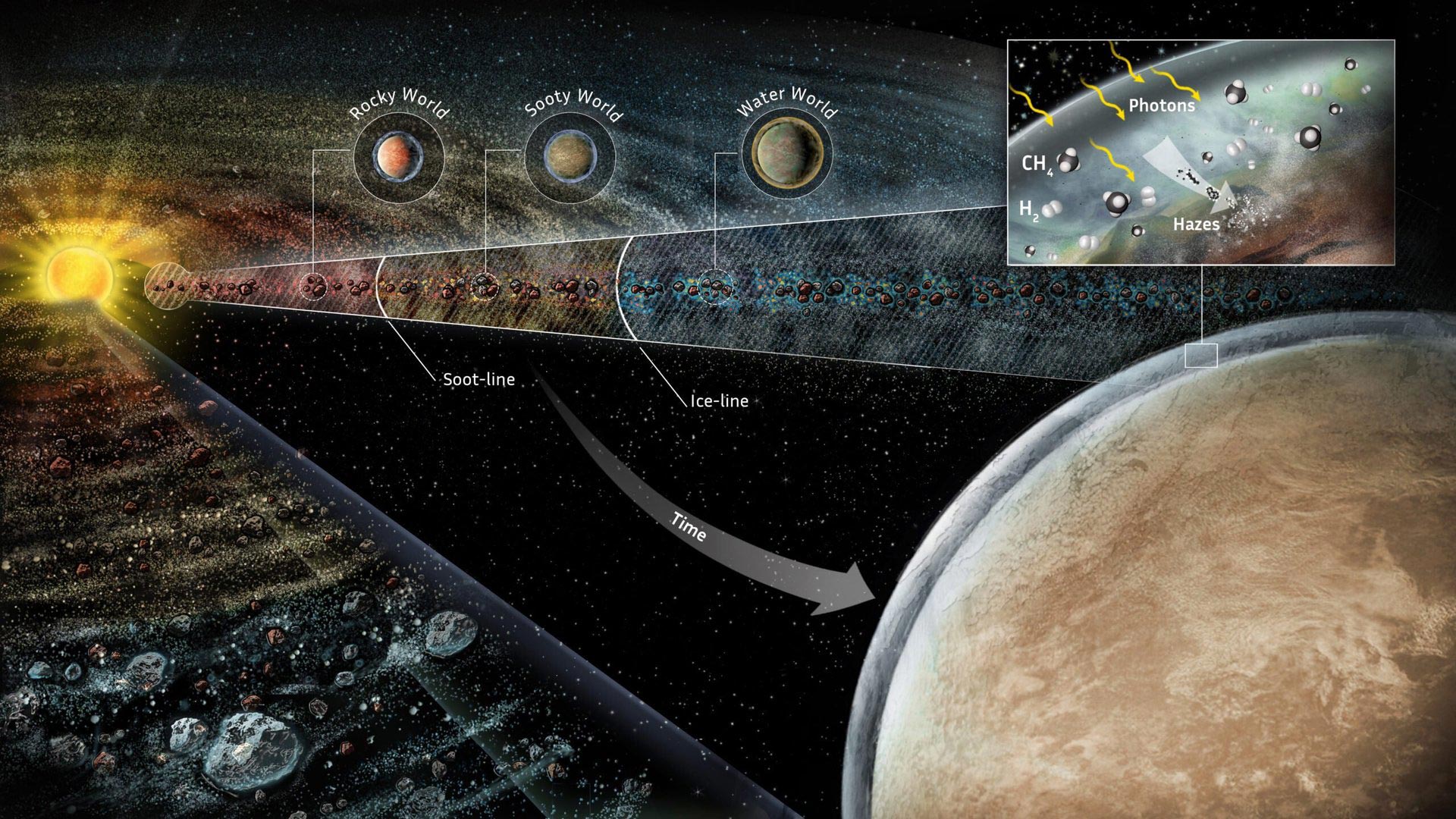
Some planets may be soot-rich rather than water-based. Atmosphere studies will be key to understanding their true nature.
Here's one of the sources for this article: See here

Thursday, September 11, 2025

Rendezvous Robotics Raises Funding To Develop Technology For Self-assembling Space Structures...

Image
WASHINGTON — A startup has raised an initial round of funding to commercialize a technology that could create large structures in orbit.
You can find out even more here: Check here

Webb Telescope Studies Hopeful Hint Of Earthlike Atmosphere On Trappist-1e Planet - The New York...

Image
But after thorough analysis of one of these worlds, Trappist-1e, astronomers have not been able to rule out the presence of a nitrogen-gas-rich ...
Other references and insights: Check here

Wednesday, September 10, 2025

Short-duration Space Station Missions Not Part Of NASA's Long-term Plans

Image
WASHINGTON — The inclusion of a 30-day demonstration mission in revised plans by NASA to support development of commercial space stations does not ...
Looking to read more like this: Visit website

Animation Of NASA's ESCAPADE Launched To Mars Atop Blue Origin's New Glenn Rocket

Image
A pair of NASA spacecraft know as the Escape and Plasma Acceleration and Dynamics Explorers (ESCAPADE)
Looking to read more like this: Visit website

NASA To Reveal New Perseverance Mars Rover Discovery On Sept. 10: How To Watch Live

Image
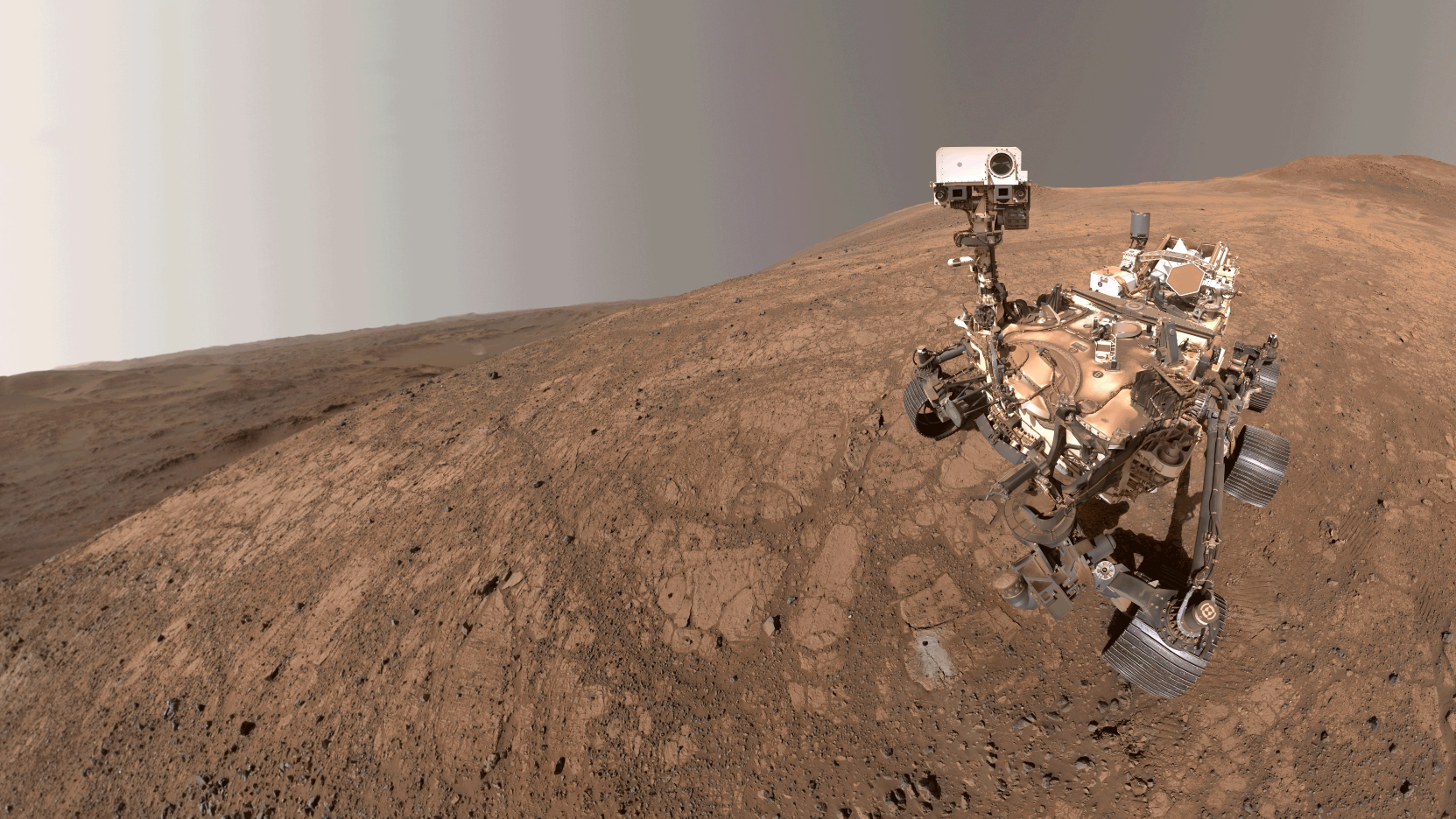
On Wednesday (Sept. 10), NASA officials will share details about a new finding connected to a unique sample the Perseverance rover found on Mars.
Here's one of the sources for this article: Visit website

Tuesday, September 9, 2025

SpaceX's Lesson From Last Starship Flight? “We Need To Seal The Tiles.”

Image
It has been two weeks since SpaceX's last Starship test flight, and engineers have diagnosed issues with its heat shield, identified improvements, ...
Looking to read more like this: See here

Hit The Wrong Spot And An Asteroid Returns On A Collision Course

Image
Selecting the right spot to smash a spacecraft into the surface of a hazardous asteroid to deflect it must be done with great care, according to new...
You can find out even more here: Visit website

Space Travel May Accelerate The Aging Of Stem Cells As Much As Tenfold

Image
NASA's pioneering study of the identical twin astronauts Mark and Scott Kelly tracked signals of aging in both men while Mark remained on Earth and ...
You can find out even more here: See here