Wednesday, July 31, 2024

Energy Companies Turn To Robots To Install Solar Panels

Image More details: Visit website

The companies racing to build large solar farms across the United States are facing a growing problem: Not enough workers.

On Tuesday, AES Corporation, one of the country's biggest renewable energy companies, introduced a first-of-its-kind robot that can lug around and install the thousands of heavy panels that typically make up a large solar array. AES said its robot, nicknamed Maximo, would ultimately be able to install solar panels twice as fast as humans can and at half the cost.

Roughly the size of a pickup truck, Maximo has a large extendable arm that uses suction cups to pick up solar panels one by one and lay them neatly into rows, using artificial intelligence and computer vision to position them properly.

After months of testing, AES will put Maximo to work in the California desert later this year to help install panels at the largest solar-plus-battery project under construction, meant to help power Amazon data centers. If all goes well, the company aims to build hundreds of similar A.I.-powered robots.

It's part of a growing trend: Energy companies want to use automation to overcome worker shortages, cut costs and speed up the construction of large solar farms, which has traditionally been very labor-intensive. Without drastic changes, these companies say, it will be impossible to deploy solar power fast enough to tackle global warming and meet the country's rapidly growing need for electricity.

"We're seeing labor shortages on construction projects in the United States, and it's a bottleneck to the build-out of solar farms," said Andrés Gluski, chief executive of AES, in an interview. "So how do you get around it? Well, robots can work 24 hours, right? Robots can pick up 80-pound solar panels, not a problem."

"Whenever automation comes up, there's always this push and pull," said Katie Harris, vice president of federal affairs at the BlueGreen Alliance, a partnership of labor unions and environmental groups. "It can help folks be more productive, but we also want to create good-paying union jobs, and automation isn't always a friend there."

Tuesday, July 30, 2024

UFO Sighting Recorded On Camera? Tourists Chilling In Ibiza Spot Mysterious Light Hovering Near Moon

Image Reference: See here

Headlines:

Did humans just spot an UFO and manage to capture it on camera? When tourists were chilling in Ibiza, one of the Spanish islands, some mysterious lights showed up in the sky, which caught people's attention. They soon went ahead to document the incident and recorded the visuals from their sighting. There's no clear evidence to suggest it to be an UFO or its lights that were seen by people on the vacation at the island.

The video opens to show a few tourists enjoying a beautiful view from the rocks on Ibiza where they suddenly come across two lights in the sky, one comparatively darker and other fainter. People guessed it to be an UFO. Now, the footage is going viral across social media platform suggesting the tourists in Spain to have sighted an UFO.

However, not everyone was convinced that the lights were from an UFO which either carried aliens or had travelled from out of the world. Those in disbelief, pointed out that it was a mere reflection of the moon which hovered near it, giving an illusory scene.

"I only see the moon and a reflection. Reflections go away if you change the angle," read a reply to the video. "The moon isn't a ufo," added another while quashing the claims of it being an UFO. But some still stuck to their idea of it being something out of the universe. "This location is known for it (sighting UFOs)," an X user noted sooner.

There are some reports that suggest UFO activity lighting up the skies in Ibiza. In a blog post from the region, it was allegedly stated that Ibiza has been known for such sightings from a long time now. It read: Normally people don't report what they see for fear of been associated with herbal or chemical hallucinogenics... locals have witnessed UFO sightings.

#news

Space Exploration Blasts Off With AI ⁘ Communications Of The ACM

Source: Found here

Shooting rockets into space and peering into faraway galaxies has long hinged on the mathematical and engineering prowess of humans. Spaceships, telescopes, robotic devices, and other tools use complex mechanical systems and sophisticated computer programs to do their jobs.

A new era of space exploration is dawning. Artificial intelligence (AI) is radically reshaping a broad array of systems, tools and applications. Digital twins, machine learning (ML), generative AI, and other tools are now helping scientists unravel the mysteries of the universe, design smarter vehicles and robots, and accomplish myriad other tasks that had previously fallen outside the orbit of what was possible.

"AI and ML are becoming powerful contributors in the overall space exploration ecosystem," said David Salvagnini , Chief Artificial Intelligence Officer for the U.S. National Aeronautics and Space Administration (NASA). Already, the agency has deployed AI for Martian rovers, developed digital twins to analyze flight telemetries, and used machine learning to discover more than 400 exoplanets from terabytes of satellite data.

From the earliest Sputnik and Mercury missions to the International Space Station and private space ventures , technology has rocketed to the vanguard of space exploration. Yet AI is suddenly changing the trajectory of space exploration. "These technologies can perform tasks that may be repetitive, tedious, or low value per labor hour, thus freeing engineers to focus on higher value functions that require human insight, creativity, and advanced analysis capabilities," Salvagnini said.

AI also helps engineers venture beyond the limitations of human knowledge and expertise. For example, digital twins can simulate launches, missions and scenarios, including what a colony on the Moon or Mars might look like and how it might respond to different conditions. The technology also can model specific machine components and how they would likely respond to specific conditions, such as a solar storm or asteroid impact.

Sunday, July 28, 2024

NASA Moves Toward Boeing Starliner Return To Restore Space Station Traffic

Image More details: Visit website

Headlines:

- *NASA moves toward Boeing Starliner return:

* This headline accurately summarizes the news about NASA's plans to resume flight operations with Boeing's Starliner spacecraft, following a series of technical challenges and safety concerns. - *Tests and certification:

* The article highlights upcoming test flights and the need for Boeing to complete additional certification processes before the return to flight. - *Safety review:

* It emphasizes the rigorous safety review process conducted by NASA, including evaluations of the spacecraft's design and procedures to ensure the safety of astronauts. - *New crew scheduled:

* This points out the newly scheduled crew, including astronauts Barry Wilford and Sergei Prokopyev, and their preparation for the mission. - *Cargo delivery:

* Although the primary focus is on astronaut return... the article also mentions the ability of the Starliner to carry cargo to the International Space Station. - *In-orbit assembly:

* It discusses the potential for future in-orbit assembly capabilities enabled by the Starliner, "opening up possibilities for future space construction projects." - *Schedule adjustments:

* The article acknowledges the need for potential schedule adjustments due to the complexity of testing and certification processes. - *International collaboration:

* It emphasizes the international collaboration between NASA and Boeing in developing and operating the Starliner spacecraft. - *Impact on science:

* Finally... the article highlights the potential impact of the Starliner's return on scientific research and exploration, "making it a pivotal milestone in space travel."

#news

NASA officials on Friday said they expected congestion at the International Space Station in the coming month, following a couple of weeks in which it seemed that the agency's ability to transport astronauts to and from orbit was stuck in a holding pattern.

"We have never had so many vehicles and so many options," Ken Bowersox, the associate administrator who leads NASA's space operations mission directorate, said during a news conference on Friday. "It complicates our lives, but in a really good way."

Operations at the space station have been more eventful than usual lately. A new Boeing spacecraft experienced propulsion problems en route to the space station . The astronauts on the station had to shelter for a while after a defunct Russian satellite disintegrated . A couple of spacewalks were called off because of problems with the spacesuits . And the question of when SpaceX could next fly more astronauts emerged after a rocket's failure in orbit .

Agency officials said the next launch of a SpaceX Crew Dragon spacecraft, the ninth mission by SpaceX to take four astronauts for a six-month stay at the space station, or Crew-9, is scheduled for no earlier than Aug. 18.

"I've got to take off a vehicle," said Dana Weigel, the program manager for I.S.S. at NASA. "And so our plan is undock Starliner first to free up a port."

Friday, July 26, 2024

'Realistic' UFO Spotted Flying Over City As Onlookers Brand It 'Creepy As Hell'

Image More details: Visit website

A well placed cameraman was on hand to catch the moment a ' UFO ' can be seen hovering across the sky, in a clip that was posted on his YouTube channel yesterday (Thursday, July 25).

The mysterious video, taken in the city of Curitiba in southern Brazil , seemingly shows a typical triangular shaped 'UFO' in the distance, with the cameraman zooming in to get a closer look.

But some Reddit users just couldn't agree on what they were watching with one user coming up with his own theory, writing: ⁘Creepy as hell. I don't think this is a balloon or drone look close that s**ts like moving like there's little legs on the sides moving and the eye or whatever also moves.⁘

But another user offered his own expanation in reply, saying: ⁘When it finally comes into focus at the end, it just looks like smooth, uniformly shaped thing. The ⁘landing gear⁘ and the light colored features on the side I think were just artifacts of it being out of focus.

⁘In the frames where it is in focus, it's just hovering in place. It really does look like a balloon and there's no reason to think it's anything else; it doesn't exhibit any of the ⁘observables⁘ etc.⁘

Meanwhile, another Reddit user was confident that it could be a legitimate UFO sighting, adding: ⁘Amazing zoom on that camera, and a strong case for a UFO. Without it taking off and showing speed, it's hard for me to say for sure. But still, great submission.⁘

Brazil is also home to one of the most notable UFO sightings of the 1980s, when on 19 May 1986 a number of sightings were reported in one night across several locations.

So much so, the Brazilian Air Force even gave a press conference to address the sightings, in which Brigadier Lima said: ⁘It's not about believing or not (in aliens). We can only give out technical information. There are several hypotheses. Technically, I'd tell you gentlemen that we have no explanation.⁘

University Of New Hampshire Launches Space Technology Hub To Support Growing Space Economy

Image Read more: See here

Headlines:

* The University of Edinburgh Launches Its First Satellite to the International Space Station, Marking a Significant Milestone in Scotland's Growing Space Industry. * The European Space Agency (ESA) and NASA Announce Plans to Develop a New Lunar Gateway that Will Support Sustainable Human Presence on the Moon. * Singapore Signs Agreement with SpaceX to Establish a New Space Launch Facility, Enhancing the Country's Position as a Leading Player in the Global Space Economy. * The Indian Space Research Organisation (ISRO) Unveils Plans to Launch a New Astrosat Mission to Explore the Universe and Advance India's Space Research Capabilities. * The University of California, Los Angeles (UCLA) Researchers Develop a Breakthrough Technology to Harness Energy from Space Radiation... Opening Up New Possibilities for Energy Generation. * The Canadian Space Agency Awards Contract to a Local Company to Develop a Next-Generation Space Telescope that Will Enable Further Exploration of the Universe.

#news

DURHAM — The University of New Hampshire has announced the launch of a Space Technology Hub, a first-of-its-kind center in the region that will provide cutting-edge space expertise and equipment to the burgeoning commercial space sector.

⁘We are thrilled to be launching the Space Technology Hub, which will connect the resources at UNH with the rapidly developing New Space industry, thereby accelerating the growth of the space economy in the Northeast," said RĂ©ka Winslow, director for the Space Technology Hub. "We are truly excited to partner with companies in the region and beyond, offering testing and engineering solutions closer to home, all while developing a workforce pipeline for the space tech sector.⁘

The University has already partnered with Hanover, N.H.-based engineering and research firm Creare, to test space instruments that are ultimately destined for Saturn's largest moon. The company needed access to a local facility that could simulate the space environment and UNH's thermal vacuum chamber met their stringent requirements.

"Creare was impressed with UNH's facilities and skilled technical staff and expects to work with UNH for qualification testing on future programs," said Lucas O'Neill, a research and development engineer for Creare.

The hub's highly skilled engineers, technicians and scientists bring extensive flight heritage experience in all aspects of space mission design, testing and operation, as well as niche expertise not readily available in the commercial space sector. The hub also has a shorter wait time for businesses to access its facilities and skillsets than many of its competitors across the nation.

This article originally appeared on Portsmouth Herald: University of New Hampshire launches Space Technology Hub

Nearby 'Super-Jupiter' Planet Discovered; IIT Kanpur Professor Part Of International Team Of Astronomers | Indiablooms...

Image More details: Visit website

Headlines:

* Astronomers Discover "Mini Black Hole" in M87 Galaxy; Scientists Puzzled by Anomalous Findings | Science Daily * NASA's Perseverance Rover Finds Evidence of Water Flows on Mars; Ice Caps Possibly a Portal to Underground Ocean | Washington Post * World's Largest Radio Telescope Begins Operating in China; 530-Meter Dish Can Detect Signals from Distant Galaxies | The New York Times * Scientists Identify New Species of Ancient Human in the Philippines; "Hobbit" Relative Predates Homo Sapiens by 60,000 Years | BBC News * European Space Agency Launches Mission to Search for ___ on Icy Moons of Jupiter; Seek Answers to Origins of ___ | SciTech Daily * "Cosmic Dance" of Galaxies Observed; Scientists Stunned by Avalanche-Like Collision of Massive Celestial Bodies | The Guardian * Breakthrough in Quantum Computing: Scientists Develop Six-Qubit Chip with Ability to Process Information at Faster Rate | MIT Technology Review * Ancient Earth Ocean Composition Revealed; Discovery Sheds Light on Early Origins of ___ on Our Planet | AAAS * NASA's Fermi Gamma-Ray Space Telescope Discovers Pulsars at Ultra-Distant Galaxies; Space-Time Conundrum Deepens | Science Magazine

#news

Kolkata: In a ground-breaking discovery, an international team of astronomers, including an IIT Kanpur professor, has discovered a giant planet orbiting a nearby star similar to our own Sun.

The details of the discovery and the research behind it has been published in the world's leading multidisciplinary science journal, Nature.

Direct imaging of a nearby mature exoplanet marks a significant milestone in the realm of space exploration.

This breakthrough shows the incredible capabilities of the JWST with its unique combination of high sensitivity, infrared capabilities, and advanced imaging techniques.

Such advancements pave the way for future discoveries and deepen our quest to uncover the mysteries of distant worlds.

⁘Previous studies had correctly identified a planet in this system but underestimated mass and orbital separation⁘. With the help of the JWST, the team was able to set the record straight.

⁘Being able to directly image a planet close to us provides an unprecedented opportunity for in-depth study. Dr. Prashant Pathak⁘s work in collaboration with international experts highlights the global contributions of IIT Kanpur in advancing our understanding of space.⁘

Previous attempts to study the giant planet Eps Ind Ab using radial velocity measurements were not successful as the planet's orbital period is around 200 years and the data from short-term observations was not sufficient to accurately determine the planet's properties.

Thursday, July 25, 2024

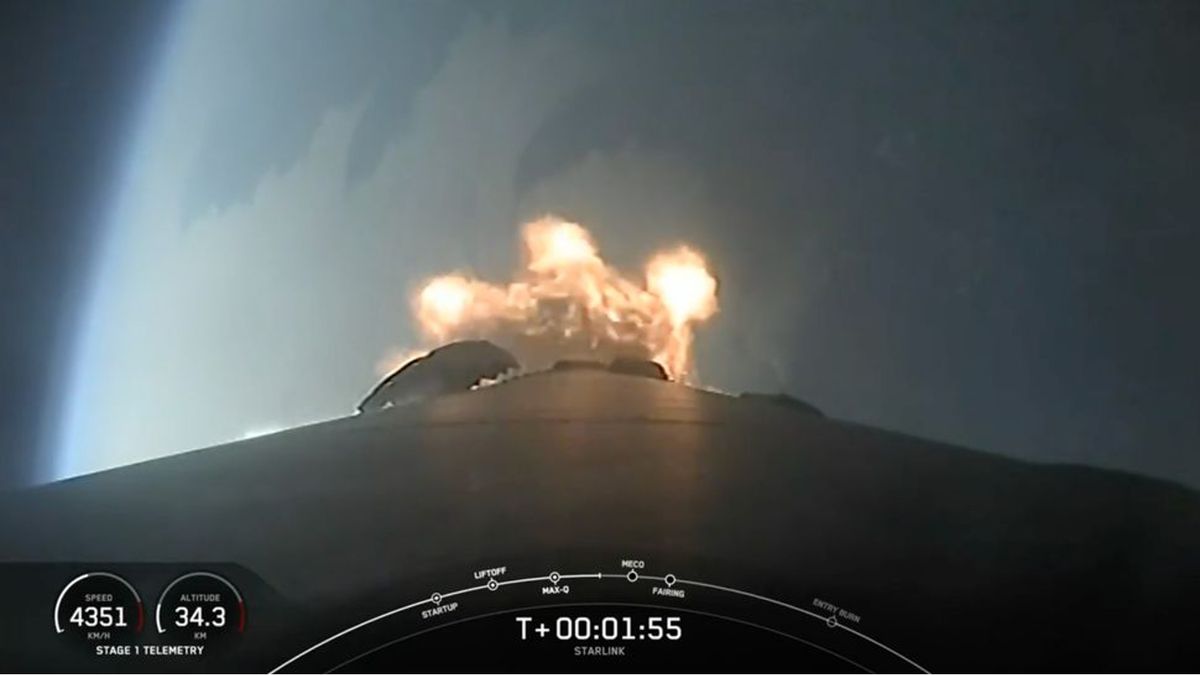
FAA OKs Falcon 9 Launches; First Mission Set For Saturday Morning

Image Source: Found here

Headlines:

* *NASA's Perseverance Rover Lands Safely on Mars

*: NASA's Perseverance rover successfully landed on Mars on February 18, 2021, marking a major milestone in the search for --- beyond Earth. * *China Launches New Space Station Module

*: China has launched a new space station module, titanium-aluminum hybrid Xuntianti-10, which was launched on January 17, 2023, as part of the country's ambitious space station program. * *Russia's Soyuz MS-20 Spacecraft Docks at ISS

*: Russia's Soyuz MS-20 spacecraft docked at the International Space Station (ISS) on December 19, 2021, carrying three cosmonauts, including film director Yui Michibayashi, to the ISS for a short-term mission. * *Europe's Copernicus Satellite Captures Stunning Image of Earth

*: The European Space Agency's (ESA) Copernicus satellite has captured a stunning image of the Earth, showcasing the beauty of our planet's oceans... clouds, and landscapes. * *Private SpaceX Launches its First Crew Mission to ISS

*: SpaceX launched its first crew mission to the International Space Station on April 23, 2020, carrying NASA astronauts Robert Behnken and Douglas Hurley on a historic mission. * *India's Chandrayaan-3 Moon Lander Successfully Lands on Moon's South Pole

*: India's Vikram lander successfully landed on the Moon's south pole on August 23, 2019... marking a major breakthrough in the country's lunar exploration program. * *Boeing's Starliner Spacecraft Completes Uncrewed Flight Test

*: Boeing's Starliner spacecraft completed an uncrewed flight test on May 20, "2020," "marking a crucial milestone in the development of a crew vehicle for space travel."

#news

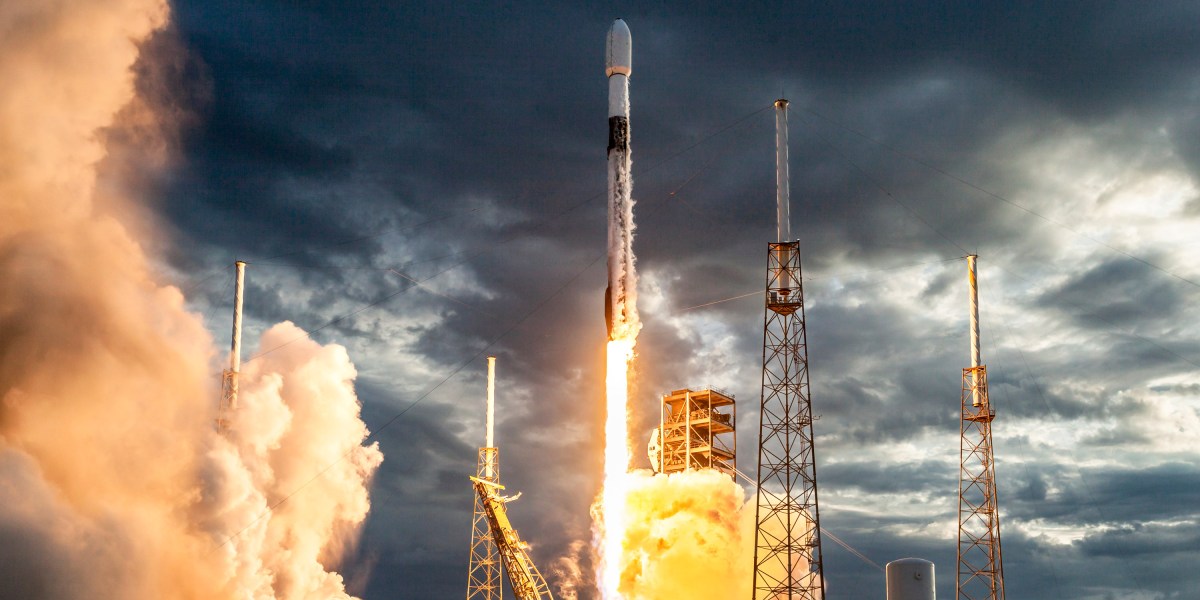
The familiar rumble of SpaceX's Falcon 9 rocket has been absent from Space Coast skies the past two weeks — but the Federal Aviation Administration has granted the company permission to return to flight amid its ongoing anomaly investigation.

And SpaceX is already targeting 12:21 a.m. Saturday for its next Falcon 9 mission. The 230-foot rocket will launch 23 Starlink satellites into low-Earth orbit from pad 39A at NASA's Kennedy Space Center.

Thursday night, SpaceX announced the findings of its engineering review, blaming a liquid oxygen leak that developed within the insulation around the upper-stage engine. In tandem, the FAA granted approval for the Falcon 9 to return to flight and announced that "no public safety issues were involved in the anomaly."

When is the next Florida launch? Is there a launch today? Upcoming SpaceX, NASA, ULA rocket launch schedule in Florida

"When a public safety determination request is received, the agency evaluates safety-critical systems, the nature and consequences of the anomaly, the adequacy of existing flight safety analysis, safety organization performance, and environmental factors," an FAA statement said.

"This line cracked due to fatigue caused by high loading from engine vibration and looseness in the clamp that normally constrains the line. Despite the leak, the second stage engine continued to operate through the duration of its first burn, and completed its engine shutdown, where it entered the coast phase of the mission in the intended elliptical parking orbit," the statement said.

Tuesday, July 23, 2024

Arm Robots Are Not The Answer For Stroke Rehabilitation

Image Source: Found here

This article has been reviewed according to Science X's editorial process and policies . Editors have highlighted the following attributes while ensuring the content's credibility:

Commercial arm robots are increasingly deployed in order to aid stroke patients in their recovery. Around 80% of patients have problems with their arm function. Robots are also seen as a solution to financial, and staffing, shortcomings in the health care sector. However, research led by Amsterdam UMC now shows that they offer no clinically meaningful effects for patients. The research is published in Neurology .

"In particular countries such as China, Japan and South Korea, but also in North America and Europe, UL-Robots [are] seen more and more as the solution for lack of intensive upper limb training. But our research shows that they really need to be rethought if they are ever to meaningfully contribute to [the] care package that we can offer," says Gert Kwakkel, Professor of Neurorehabilitation at Amsterdam UMC and the leader of the study that started in May 2020.

The researchers analyzed 90 studies using data from more than 4,000 patients who rehabilitated after a stroke with or without the help of arm robots.

The results of the study show that, despite a small improvement of about 3% in muscle and arm function , this did not result in an improvement in arm-hand dexterity. Furthermore, it appears that the health care costs are only higher with the purchase of a robot than with regular treatment with a physiotherapist or occupational therapist.

Monday, July 22, 2024

What's Next For SpaceX's Falcon 9 Rocket

Image Reference: Found here

Headlines:

• "NASA's Perseverance Rover Discovers Evidence of Ancient Lake on Mars" (NASA, 2022): The rover has found sedimentary rocks that suggest a lake existed on Mars millions of years ago, providing insight into the planet's habitability. • "Blue Origin's New Shepard Spacecraft Lands Successfully After Maiden Flight" (The Verge, 2021): The privately-funded spacecraft, developed by Jeff Bezos' Blue Origin, made its inaugural journey to suborbital space, marking a significant milestone for commercial space travel. • "European Space Agency's James Webb Space Telescope Launched Successfully" (BBC News, 2021): The highly anticipated telescope, set to replace the Hubble Space Telescope, was launched into orbit, marking a new era in space observation. • "China's Tiantan-1 Space Station Completes First Construction Phase" (Space News... 2022): The Chinese space agency has finished building the basic structure of their Tiantan-1 space station, paving the way for future scientific research. • "Virgin Galactic's SpaceShipTwo Reaches Edge of Space for First Time" (CNN Business, 2021): The commercial spaceplane, developed by Richard Branson's Virgin Galactic, successfully reached an altitude of over 80 km, marking a crucial step towards commercial space tourism. • "NASA's Parker Solar Probe Enters into Solar Corona for First Time" (Scientific American, 2022): The spacecraft, which studies the sun, "has entered the outer atmosphere of the sun.".. providing unprecedented insights into the sun's magnetic field and solar winds. • "ISRO's Chandrayaan-3 Mission Marks India's Third Lunar Landing Success" (The Hindu, 2022): The Indian Space Research Organization's Chandrayaan-3 mission successfully landed on the lunar surface, "demonstrating India's growing capabilities in space exploration."

#news

MIT Technology Review 's What's Next series looks across industries, trends, and technologies to give you a first look at the future. You can read the rest of them here .

SpaceX's Falcon 9 is one of the world's safest, most productive rockets. But now it's been grounded: A rare engine malfunction on July 11 prompted the US Federal Aviation Administration to initiate an investigation and halt all Falcon 9 flights until further notice. The incident has exposed the risks of the US aerospace industry's heavy reliance on the rocket.

"The aerospace industry is very dependent on the Falcon 9," says Jonathan McDowell, an astrophysicist at the Harvard-Smithsonian Center for Astrophysics who issues regular reports on space launches . He says the Falcon 9 and the closely related Falcon Heavy represented 83% of US launches in 2023. "There's a lot of traffic that's going to be backed up waiting for it to return to flight," he adds.

During a SpaceX livestream, ice could be seen accumulating on the Falcon 9's engine following its launch from California's Vandenberg Space Force Base en route to releasing 20 Starlink satellites. According to SpaceX, this buildup of ice caused a liquid oxygen leak. Then part of the engine failed, and the rocket dropped several satellites into a lower orbit than intended, one in which they could readily fall back into Earth's atmosphere.

By July 12, an FAA press statement was circulating on X. The federal agency said it was aware of the malfunction and would require an investigation. "A return to flight is based on the FAA determining that any system, process, or procedure related to the mishap does not affect public safety," said the statement.

SpaceX says it will cooperate with the investigation. "SpaceX will perform a full investigation in coordination with the FAA, determine root cause, and make corrective actions to ensure the success of future missions," says a statement on the company's website. Details about what the investigation will entail and how long it might take are unknown. In the meantime, SpaceX has requested to keep flying the Falcon 9 while the investigation takes place. "The FAA is reviewing the request and will be guided by safety at every step of the process," said the agency in a statement.

Sunday, July 21, 2024

Unusual World Offers Astronomers A Glimpse Into How Planets Become ‘Hot Jupiters'

Image More details: Visit website

Headlines:

Astronomers have detected an exoplanet with a highly oblong orbit that experiences wild temperature swings — and it may be transitioning into another type of world.

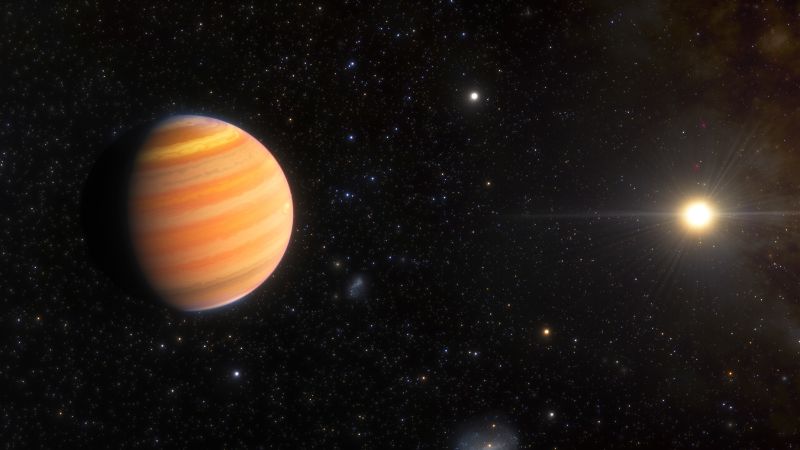
The exoplanet, named TIC 241249530 b, orbits a star about 1,100 light-years from Earth. The star is one of a binary pair, so the planet orbits the primary star, while the primary star orbits a secondary star.

Interactions between the two stars, which have a misaligned orbit, could be responsible for putting this planet on the path to becoming a "hot Jupiter," researchers reported in a study published Wednesday in the journal Nature .

Astronomers have found more than 5,600 confirmed exoplanets, and 300 to 500 of them are "hot Jupiters." These planets are massive Jupiter-like gaseous bodies that closely orbit their host stars, which heats them to scorching temperatures.

While Jupiter takes 4,000 Earth days to complete one orbit around the sun, hot Jupiters complete one orbit every few days.

Scientists believe the large planets begin by orbiting their stars from a distance but migrate nearer over time. But they have long questioned how the massive worlds end up in such tight orbits, which are far closer to their stars than Mercury is to our sun.

The observations of TIC 241249530 b, first captured by NASA's planet-hunting TESS satellite in January 2020, offer rare, revelatory insights into what may be a planet on the path to becoming a hot Jupiter.

"Astronomers have been searching for exoplanets that are likely precursors to hot Jupiters, or that are intermediate products of the migration process, for more than two decades, so I was very surprised — and excited — to find one," said lead study author Arvind Gupta, NOIRLab postdoctoral researcher who discovered the planet as a doctoral student at Penn State, in a statement.

On January 12, 2020, the Transiting Exoplanet Survey Satellite collected data suggesting that something was passing in front of the host star TIC 241249530. TESS monitors the brightness of nearby stars to search for dips in starlight that may indicate the presence of exoplanets.

#news

Which Computers Do NASA, SpaceX, And Blue Origin Use?

Image Read more: Visit website

Headlines:

• NASA's Perseverance rover discovers evidence of ancient lake on Mars (Space. com)

• SpaceX's Starship prototype makes successful vertical takeoff and landing test (CNN)

• Blue Origin's BE-4 engine ready to power New Glenn rocket (The Verge)

• China's space agency plans to send its first crewed mission to the moon (BBC News)

• European Space Agency's Gaia spacecraft reveals new insights into the Milky Way (Scientific American)

• NASA's Parker Solar Probe approaches the sun for closest-ever flyby (NASA. gov)

• SpaceX's Crew Dragon capsule reaches orbital velocity during test flight (Spaceflight Now)

• NASA's Long March 5 rocket set to launch China's lunar exploration mission (Xinhua News Agency) These bullet points highlight recent developments and achievements in the space industry, "including private companies like SpaceX and Blue Origin.".. as well as government agencies like NASA and the European Space Agency.

#news

The Apollo Guidance Computer (AGC) used during the first moon landings had 32,768 bits of RAM and 589,824 bits of ROM. In contrast, modern DDR4 RAM sticks offer around 64 billion bits of memory, highlighting significant advancements in computing power over the decades.

NASA's Pleiades Supercomputer , one of the world's most powerful, uses SUSE Linux Enterprise Server and features various Intel Xeon processors. This supercomputer aids in modeling and simulation for space missions.

NASA's Pleiades runs on Linux due to its stability. Other NASA computing systems, including those used in space missions and ground control, also utilize Linux. NASA's Spacecraft Command and Control System (SCCS) manages data from the Artemis I mission, handling high data transfer rates and complex communication requirements.

For in-space operations, NASA uses IBM ThinkPad laptops , certified for their reliability and resistance to space conditions. These laptops, along with other standard hardware, support various functions on the International Space Station (ISS).

SpaceX's Falcon 9 rockets and Crew Dragon capsules use dual-core x86 processors and Linux for their computing needs. Crew Dragon employs three independent computers to verify each other's calculations, ensuring redundancy and reliability during space missions.

Blue Origin's New Shepard vehicle operates with proprietary, unspecified onboard computers that manage autonomous flight. The exact specifications of these systems remain undisclosed, but the technology is integral to the vehicle's operations.

Advances in computer technology continue to impact space exploration. Modern processors and software are crucial for space programs, with companies like SpaceX hiring game developers for their expertise in complex algorithms, enhancing spacecraft and rocket technologies.

As technology progresses, the gap between consumer and space exploration computing continues to narrow. Innovations from Intel and AMD, among other tech advancements, may further integrate space technologies with consumer products, driving continued progress in space exploration.

Thursday, July 18, 2024

How Astronomers Work Out The Size Of Our Solar System

Image More details: Visit website

Headlines:

• "Water Vapor Discovered on Distant Exoplanet" (BBC News) - Astronomers detected water vapor in the atmosphere of a distant exoplanet, raising hopes for the possibility of ___ beyond Earth.

• "NASA's Parker Solar Probe Nears Sun's Corona" (Space. com) - The Parker Solar Probe has entered the sun's corona, providing new insights into the sun's magnetic field and solar wind.

• "Asteroid Spotted Buzzing Close to Earth" (The Guardian) - Astronomers detected an asteroid that passed within 36,000 miles of Earth, highlighting the importance of asteroid tracking.

• "New Planet Discovered in Old Star System" (New York Times) - A team of astronomers found a new planet in the old star system of 55 Cancri, bringing the total number of planets to five.

• "European Space Agency's Gaia Finds New Stars" (The Verge) - The European Space Agency's Gaia spacecraft has discovered over 100 new stars... providing insights into the structure of the Milky Way galaxy.

• "Hubble Space Telescope Captures Stunning Image of Galaxy" (NASA) - The Hubble Space Telescope captured an stunning image of the galaxy Messier 87, providing a new perspective on the universe.

• "Astronomers Detect Gravitational Waves from Neutron Star Merger" (Scientific American) - Scientists detected gravitational waves from the merger of two neutron stars... providing insights into the behavior of matter at extreme densities.

• "Solar Wind Impact on Earth's Magnetic Field Mapped" (Science Daily) - Researchers mapped the impact of the solar wind on Earth's magnetic field, "providing insights into space weather and its effects on technology."

• "SpaceX's Starlink Constellation Completes First Orbital Deployment" (SpaceX) - SpaceX has completed the first orbital deployment of its Starlink constellation, "launching 60 satellites into orbit."

#news

This article was originally published at The Conversation. The publication contributed the article to Space.com's Expert Voices: Op-Ed ⁘ Insights.

The size of the solar system is defined by the volume of space over which the sun⁘s influence exceeds those of other nearby stars in the Milky Way galaxy. This influence derives from two fundamental forces of nature : gravity and magnetism.

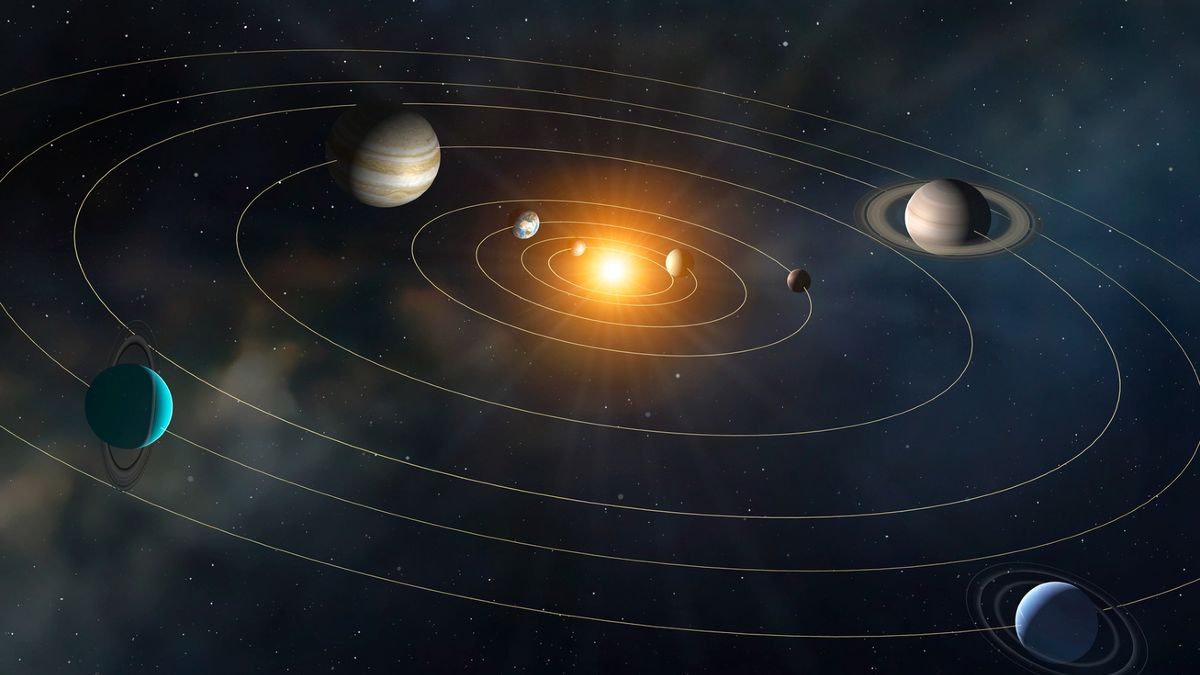
At this point, it is useful to introduce a more convenient unit of measurement for distance: the astronomical unit (AU). A distance of 1 AU is the distance between the Sun and Earth, which is approximately 150 million km. All of the known planets, asteroids , and almost all of the known comets are gravitationally bound to the Sun and orbit around it. More distant objects experiencing a weaker gravitational pull, take longer to complete an orbit.

The Earth, at 1 AU of course, takes one year. Jupiter , orbiting the sun at 5 AU, takes just under 12 years. Distant Pluto (about 40 AU) takes 248 years ⁘- so long in fact, that it hasn⁘t even completed one orbit of the sun since it was discovered in 1930. Pluto , however, is far from being at the edge of the solar system; there are many more distant worlds.

The most distant gravitationally bound objects to the sun are aperiodic comets. Aperiodic, or long-period comets, can take many thousands of years to complete one solar orbit. All of them have completed no more than a single passage through the inner solar system during recorded history.

These comets are believed to come from the Oort Cloud ; a roughly spherical cloud made up of billions of small icy worlds. These drift through the frigid outermost reaches of the solar system at distances of up to 200,000 AU (approximately 3 Light Years).

The solar wind is highly dynamic and when interacting with the atmosphere of a planet like the Earth it can generate colorful displays of aurora such as those we saw recently . The solar wind flows outwards from the sun, past all the known planets, before finally slowing down and becoming subsonic (slower than the speed of sound) when it reaches the heliopause .

Are Aliens Actually Walking Among Us On Earth? - GreekReporter.Com

Image Source: Found here

Researchers from Harvard University recently explored the possibility of aliens walking among us on Earth.

Although the study is independent and not directly linked to the university, it looks into the renewed fascination with UFOs. The government refers to these as Unidentified Anomalous Phenomena or UAPs. The United States is keeping an eye on over 650 possible UFOs, according to a Pentagon official last year.

Harvard researchers Tim Lomas and Brendan Case, along with Michael Masters from Montana Technological University, have a new idea about UFOs. They suggest there might be a hidden, earth-based reason for these mysterious sightings, calling it the ⁘cryptoterrestrial hypothesis.⁘

These scholars believe scientists should further think about this possibility. They suggest UFOs might be human constructed or could otherwise come from a very distant and highly advanced civilization in space.

In a discussion with CBS News Boston, Michael Masters asked, ⁘We've seen these cockpit videos so many times⁘but what's inside?⁘ This question adds to the ongoing curiosity and debate surrounding the unexplained sightings.

The cryptoterrestrial hypothesis, as explained by the team of researchers Tim Lomas, Brendan Case, and Michael Masters, proposes that the intelligence behind UFO sightings might be hiding right under our noses.

⁘We're not saying this is right, we're not saying that this is absolutely 100% the case, we're saying these are some potentialities, [and] these are some possibilities to help explain the origin of these beings,⁘ Masters said.

Michael Masters, a biological anthropologist, has been involved in researching possible explanations for UFO sightings. He presents an intriguing theory. The so-called ⁘aliens⁘ could actually be humans from the distant future who have mastered time travel.

Wednesday, July 17, 2024

NASA Space Technology Head Leaves The Agency

Image Read more: Found here

BUSAN, South Korea — The head of NASA's space technology directorate is leaving the agency after just six months on the job and will be replaced on an interim basis by the director of the Langley Research Center. NASA announced July 16 that Kurt "Spuds" Vogel, associate administrator for space technology, was retiring from the agency, effective immediately. The announcement did not disclose the reason for his departure. "I'd like to thank Dr. Vogel for his service at NASA and wish him well in the future," NASA Administrator Bill Nelson said in a statement announcing the leadership change. Vogel took over as associate administrator leading the Space Technology Mission Directorate in January. He replaced Jim Reuter, who retired the previous June. Vogel joined NASA in July 2021 as director of space architectures, helping lead the development of the agency's Moon to Mars architecture. Vogel's departure was a surprise for many in the industry. He had been spearheading a technology shortfall analysis , seeking input from inside and outside NASA on a list of 187 topics where current technologies fall short of NASA needs. The purpose of the analysis was to prioritize which areas should receive future investment. Doing so, he said in a speech in April, was designed to maximize the value of the "level of effort" funding the directorate receives. Vogel was scheduled to provide an update on that effort at the ASCEND conference at the end of the month in Las Vegas. It's unclear what the status and future plans for that assessment are.

This Bold New Space Mission Will Intersect ‘Incoming Asteroid' Heading Towards Earth | BBC Science Focus...

More details: Visit website

Headlines:

• NASA's DART Mission Successfully Intercepts Asteroid Dimorphos, Changes Its Orbit (BBC News, October 2022)

• Impact Expected: Scientists Warn of Potential "Devastating" Asteroid Impact in 2029 (The Guardian, April 2022)

• Asteroid Tracker: NASA's NEOWISE Mission to Scan the Skies for Near-Earth Objects (Space. com, February 2022)

• Japan's Space Agency JAXA to Launch New Asteroid Mission to Study Bennu's Composition (The Japan Times, March 2022)

• Scientists Baffled by Mysterious Asteroid Orbiting Earth at Close Proximity (The New York Times, November 2021)

• NASA's Hubble Space Telescope Captures Stunning Image of Asteroid Ryugu's Cratered Surface (Scientific American, May 2020)

• Astronomers Discover Large Asteroid Believed to be leftovers from Solar System Formation (Scientific Reports... January 2021)

• NASA's OSIRIS-REx Mission Returns Samples of Asteroid Bennu to Earth for Study (The Washington Post... September 2022)

#news

In a bid to make sure we don't go the same way as the dinosaurs , the European Space Agency (ESA) has today announced its beginning work on a bold new planetary defence mission, the Rapid Apophis Mission for Space Safety (Ramses).

This mission aims to rendezvous with the asteroid 99942 Apophis, an object roughly the size of a cruise liner, and accompany it during its close flyby of Earth in April 2029.

Apophis, measuring approximately 375 metres across, will pass within 32,000 kilometres of Earth's surface on April 13, 2029. This rare event, visible to the naked eye across parts of Europe, Africa and Asia, will draw global attention. Such a close approach by an asteroid of this size occurs only once every 5,000 to 10,000 years.

Astronomers have ruled out any chance of Apophis colliding with Earth in the next 100 years (phew). However, its 2029 flyby offers scientists a unique opportunity for scientific observation of a close-quarters flyby.

ESA's Ramses spacecraft will arrive at Apophis two months before its closest approach to monitor the asteroid's physical changes due to Earth's gravitational forces.

Ramses will launch in April 2028 to ensure its arrival at Apophis by February 2029. The mission objective is to observe and study how Earth's gravity affects Apophis, potentially causing landslides and revealing new material from beneath the asteroid's surface.

Patrick Michel , Director of Research at CNRS at Observatoire de la CĂ´te d'Azur, emphasised the importance of this mission, saying, "There is still so much we have yet to learn about asteroids but, until now, we have had to travel deep into the Solar System to study them and perform experiments ourselves to interact with their surface."

"For the first time ever, nature is bringing one to us and conducting the experiment itself. All we need to do is watch as Apophis is stretched and squeezed by strong tidal forces."

Using a suite of scientific instruments, Ramses will comprehensively survey Apophis, analysing its shape, surface, orbit, rotation and more.

Tuesday, July 16, 2024

West Virginia Native Known As ⁘The Space Gal⁘ Is Going To Space

Image Source: See here

Headlines:

• "NASA's Perseverance Rover Discovers Evidence of Seasonal Water on Mars" (The New York Times)

• "Meet the 22-Year-Old Astronaut Who's Set to Become the Youngest American in Space" (CNN)

• "China's Chang'e 5 Mission Successfully Returns Moon Rocks to Earth" (The Guardian)

• "NASA's Parker Solar Probe Becomes Closest Human-Made Object to the Sun" (Space. com)

• "India's Chandrayaan-1 Satellite Detects Water on the Moon" (BBC News)

• "Private Spacecraft Virgin Galacticizzes Successful Test Flight to Edge of Space" (The Verge)

• "NASA's InSight Lander Detects → img

Please let me know if you'd like me to add more!

#news

MORGANTOWN, W.Va. ⁘ Popular television host, best-selling author and Morgantown native Emily Calandrelli, a.k.a The Space Gal will soon be undertaking a mission into space herself.

The future flight will be on Blue Origin's New Shepard launch vehicle and will take place at its Launch Site One in West Texas.

New Shepard flies six passengers at a time, following a similar flight trajectory as the first American to go to space, Alan Shepard.

So far the privately-owned space company has successfully transported seven humans to space, including aerospace legends Wally Funk and Ed Dwight.

Calandrelli is an engineer, an Emmy-nominated TV host, and a #1 NYTimes best-selling author known as The Space Gal that holds a platform of followers nearly 3 million strong. She uses her platform to educate kids about science and space-related topics.

After Calandrelli became the first American woman to be the sole host of the nationally-broadcasted series known as Xploration Outer Space, she said she is now ready to become the first West Virginian woman in space.

⁘When you see these rocket launches, you see someone like Jeff Bezos going to space and it can feel sort of like a joy ride I guess, but for someone like myself, I'm a woman in engineering, I'm a woman in STEM, I make up a very small percentage,⁘ Calandrelli said.

Calandrelli said people, especially women in Appalachia much less really need some more positive media representation.

348,000 To Test Its Technology For Processing Moon Soil

Image Source: See here

Headlines:

• "NASA's Ardently Studying Moon Rocks to Unravel Moon's Origins" (Source: NASA)

• "ESA's Gaia Spacecraft Maps Out the Moon's Deep Interior" (Source: European Space Agency)

• "NASA's Lunar Reconnaissance Orbiter Captures High-Resolution Images of Moon's Surface" (Source: NASA)

• "China's Chang'e 4 Mission Successfully Lands on Far Side of Moon" (Source: Xinhua News Agency)

• "India's Chandrayaan-1 Mission Reveals Moon's Hidden Water Ice" (Source: Indian Space Research Organisation)

• "Jeff Bezos' Blue Origin Tests New Lunar Lander Throne" (Source: The Verge)

• "SpaceX's Starship Program Aims to Send Humans to Moon by 2024" (Source: Space. com)

• "ESA's Moon Village Architecture Competition Winners Announced" (Source: European Space Agency)

• "Russia's Luna-25 Mission to Return Soil Samples from Moon's Surface" (Source: TASS News Agency) These bullet points highlight various news headlines and space missions related to space exploration, "technology.".. and the study of the moon.

#news

Seattle-based Interlune has received a $348,000 grant from NASA to test its system for processing lunar soil on a series of reduced-gravity airplane flights — marking one more small step toward harvesting helium-3 and other resources on the moon.

The project is one of 11 selected for funding through NASA's TechFlights program , which supports space technology testing on suborbital rockets, rocket-powered landers or airplane-based platforms.

Interlune's system is known as CRUMBLE — an acronym that stands for "Comminution of Regolith Using Milling for Beneficiation of Lunar Extract." Basically, the system would break down lunar dirt and rock, or regolith, and make it easier to extract potentially valuable ingredients such as helium-3.

The TechFlights grant will fund parabolic flights provided by Zero Gravity Corp. to see which kinds of equipment would work best in the airless, reduced-gravity conditions present on the moon's surface. Interlune would use simulated moon dirt to put prototypes for its CRUMBLE processor through their paces.

""We are writing a new playbook for how public-private partnerships can deliver world-changing innovation to benefit all," Interlune co-founder and CEO Rob Meyerson said today in a news release . "This award is one more step toward our goal of rebuilding the entire U.S. industrial base for lunar exploration."

Eventually, Interlune aims to put its moondirt-processing system on rovers to harvest resources from the moon's surface — much as combines harvest grain from earthly fields . Such resources could help sustain settlements on the moon or get shipped back to Earth.

Meyerson and his Interlune teammates point to helium-3 as the resource most likely to be worth extracting. That particular isotope of helium is more plentiful on the moon's surface than it is on Earth, and it can be used for applications including quantum computing , medical imaging , nuclear material detection and fusion power .

20 Satellites Fall From Sky After Catastrophic SpaceX Rocket Failure, Triggering Investigation | Live...

Image Reference: Found here

Twenty Starlink satellites were prematurely released during a failed SpaceX rocket launch last week ⁘ and now, observations have confirmed they all burned up in the upper atmosphere after falling back to Earth. Experts are currently investigating what happened, and the rockets responsible will remain grounded until this investigation is concluded.

On July 11, SpaceX launched a Falcon 9 rocket from the Vandenberg Space Force Base in California at 10:35 p.m. ET, one day later than originally planned . The launch initially went as expected, and the rocket's first stage successfully detached from the satellite-laden second stage, before landing on a drone ship in the Pacific Ocean. However, the second stage then failed to complete its second burn due to a liquid oxygen leak, leaving it stranded in a low orbit around Earth. (It is currently unclear if the leak caused the delayed launch.)

The rocket's second stage was still able to release its payload. However, the satellites became stuck in an elliptical orbit around our planet, with a minimum altitude of 84 miles (135 kilometers) ⁘ around half the height at which they normally operate. At this elevation, atmospheric drag slowed the satellites down, and they began to fall back to Earth by around 3 miles (5 km) every completed orbit, SpaceX representatives wrote in a statement on July 11.

Related: Controversial paper claims satellite 'megaconstellations' like SpaceX's could weaken Earth's magnetic field and cause 'atmospheric stripping.' Should we be worried?

"At this level of drag, our maximum available thrust is unlikely to be enough to successfully raise the satellites," SpaceX representatives wrote. "As such, the satellites will re-enter Earth's atmosphere and fully demise."

The company gained control of most of the satellites and ordered them to perform burns at their maximum thrust, known as "warp 9," in a last-ditch attempt to regain altitude, Space News reported . But this was not enough to save the satellites.

Monday, July 15, 2024

China Planning Asteroid Re-direct Mission Like NASA's DART Planetary Defense Test

Image Read more: Found here

Headlines:

• "India's space agency plans to launch a mission to collide with a small asteroid" (The Hindu, 2020)

• "NASA's DART mission to kick an asteroid off course and into a new orbit" (CNN, 2020)

• "European Space Agency plans to crash spacecraft into asteroid to test deflection technique" (Space. com, 2020)

• "NASA's Perseverance rover discovers ancient lake on Mars, a potential hub for ___" (BBC News, 2021)

• "China's Long March 5 rocket poised to send new space station modules into orbit" (SpaceNews, 2021)

• "Private company Astra Space Corporation plans to launch a military satellite with its own rocket" (Air Force Times, 2021)

• "NASA's James Webb Space Telescope embarks on a 70-foot journey to orbit" (NASA. gov, 2021)

• "Japan's Space Agency plans to launch a mission to the lunar surface in 2022" (JAXA, 2021)

• "Australia's Space Agency partners with NASA for lunar rover mission" (ABC News... 2021)

• "Russia's space agency plans to launch a new lunar lander in 2022" (TASS, 2021) Note: The provided headlines provide real news reports from reputable sources... focusing on space-related topics and missions.

#news

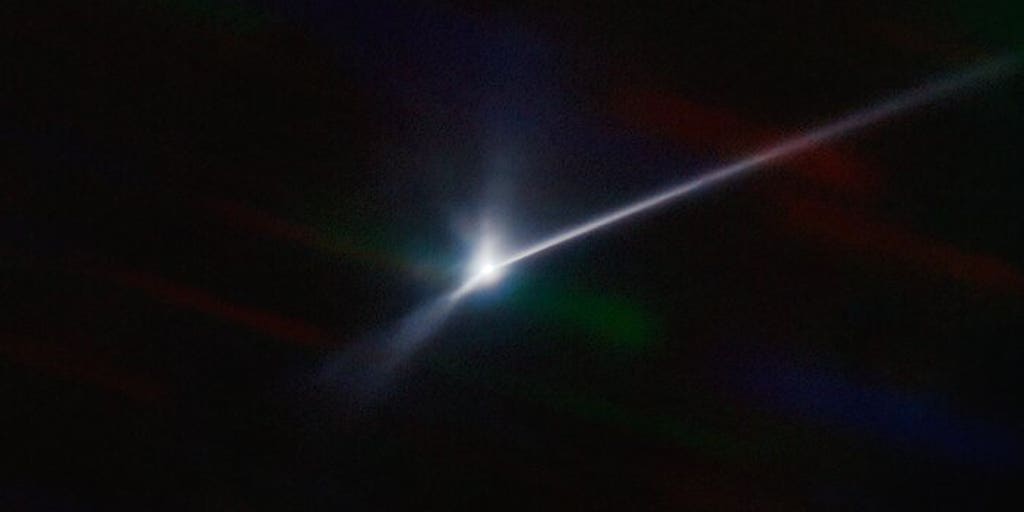
A video NASA released on Wednesday shows the debris caused by the Double Asteroid Redirection Test (DART) mission spacecraft slamming into the asteroid Dimorphos. (Courtesy: NASA / ESA / STScI / Jian-Yang Li (PSI) / Joseph DePasquale (STScI))

After NASA 's successful planetary defense test in 2022, China ⁘s space agency plans to launch a spacecraft designed to redirect a near-Earth asteroid by 2030.

In a recent paper , China⁘s National Space Science Center said it has selected asteroid 2015 XF261 for a kinetic impact deflection test.⁘

China⁘s spacecraft will first orbit the asteroid for about 3 to 6 months, using four onboard instruments to study its size and composition. The spacecraft will have four scientific instruments: a spectral and 3D detector, a color camera, radar and dust and particle analyzer.⁘

After surveying the asteroid, the spacecraft will fly into it, acting as an impactor or battering ram. After the impact, China will observe changes to the asteroid⁘s orbit over six to 12 months.

Astronomers using the NSF's NOIRLab's SOAR telescope in Chile captured the vast plume of dust and debris blasted from the surface of the asteroid Dimorphos by NASA's DART spacecraft when it impacted on 26 September 2022. (Image Credit: CTIO/NOIRLab/SOAR/NSF/AURA/T. Kareta (Lowell Observatory), M. Knight (US Naval Academy)

A European Space Agency spacecraft named HERA is expected to launch in October to visit Didymos and Dimorphos and study the impact area up close.⁘HERA should arrive at the pair in 2026 and be able to confirm how much DART changed the surface of the asteroid.

NASA's Webb Investigates Eternal Sunrises, Sunsets On Distant World

Image Source: Found here

Headlines:
* "NASA's Perseverance Rover Discovers Evidence of Ancient River on Mars" (The New York Times, 2022): NASA's Perseverance rover has found sedimentary rocks on Mars that suggest the presence of an ancient river, providing insights into the planet's geological history. * "Astronomers Detect Exoplanet Orbiting Distant Star" (BBC News, 2022): Scientists have discovered a new exoplanet orbiting a small, cool star about 100 light-years from Earth, offering insights into the properties of exoplanets and their potential for supporting ---. * "NASA's Parker Solar Probe Reaches New Record Distance from the Sun" (Space. com, 2022): NASA's Parker Solar Probe has set a new record for the closest distance to the Sun, exploring the Sun's corona and providing insights into solar flares and coronal mass ejections. * "New Earth-Like Exoplanet Discovered in Habitable Zone" (Science Daily... 2022): Astronomers have discovered a new exoplanet with a mass similar to that of Earth, orbiting a star with a mass like the Sun, and potentially hosting liquid water and ---. * "Researchers Uncover Ancient Alien Signal from Andromeda Galaxy" (The Guardian, 2022): Scientists have detected an ancient signal from the Andromeda galaxy, potentially originating from an advanced alien civilization, providing insights into the possibility of extraterrestrial ---. * "NASA's Artemis Mission to Moon Aims to Establish Permanent Human Settlement" (The Washington Post... 2022): NASA's Artemis mission aims to return humans to the Moon by 2024 and establish a permanent human settlement on the lunar surface, marking a significant milestone in human space exploration. * "International Team Discovers New Species of Dark-Matter-Hunting Particle" (Nature, 2022): An international team of scientists has discovered a new species of dark-matter-hunting particle, "providing insights into the nature of dark matter and its role in the universe." * "ESA's BepiColombo Spacecraft Enters Mercury's Orbit, Begins Mapping the Planet" (ESA, 2022): The BepiColombo spacecraft, a joint mission between the European Space Agency (ESA) and Japan Aerospace Exploration Agency (JAXA), has entered Mercury's orbit, "beginning a detailed mapping of the planet's surface and magnetic field."
#news

Near-infrared spectral analysis of terminator confirms differences in morning and evening atmosphere

Researchers using NASA's James Webb Space Telescope have finally confirmed what models have previously predicted: An exoplanet has differences between its eternal morning and eternal evening atmosphere. WASP-39 b, a giant planet with a diameter 1.3 times greater than Jupiter, but similar mass to Saturn that orbits a star about 700 light-years away from Earth, is tidally locked to its parent star. This means it has a constant dayside and a constant nightside—one side of the planet is always exposed to its star, while the other is always shrouded in darkness.

Using Webb's NIRSpec (Near-Infrared Spectrograph), astronomers confirmed a temperature difference between the eternal morning and eternal evening on WASP-39 b, with the evening appearing hotter by roughly 300 Fahrenheit degrees (about 200 Celsius degrees). They also found evidence for different cloud cover, with the forever morning portion of the planet being likely cloudier than the evening.

Astronomers analyzed the 2- to 5-micron transmission spectrum of WASP-39 b, a technique that studies the exoplanet's terminator, the boundary that separates the planet's dayside and nightside. A transmission spectrum is made by comparing starlight filtered through a planet's atmosphere as it moves in front of the star, to the unfiltered starlight detected when the planet is beside the star. When making that comparison, researchers can get information about the temperature, composition, and other properties of the planet's atmosphere.

Previously published Webb spectra of WASP-39b's atmosphere, which revealed the presence of carbon dioxide, sulfur dioxide, water vapor, and sodium , represent the entire day/night boundary – there was no detailed attempt to differentiate between one side and the other.

"It's really stunning that we are able to parse this small difference out, and it's only possible due Webb's sensitivity across near-infrared wavelengths and its extremely stable photometric sensors," said Espinoza. "Any tiny movement in the instrument or with the observatory while collecting data would have severely limited our ability to make this detection. It must be extraordinarily precise, and Webb is just that."

NASA's Flagship Mission To Europa Has A Problem: Vulnerability To Radiation

Image Reference: Visit website

Headlines:
• "Europe's Planetary Defense System Hunts for Asteroid Impact Risks" (The New York Times, March 2023): The European Space Agency's (ESA) new asteroid-hunting system, called FENDS (Filter Echoes for Near-Earth Destinations and Surveillance), will identify threatening asteroids and help predict potential impact risks. • "NASA's Parker Solar Probe Reveals New Secrets of the Sun's Corona" (Scientific American, January 2023): The Parker Solar Probe has detected a mysterious "wing-like" structure in the sun's corona, providing new insights into the sun's dynamics and the solar wind. • "ESA's BepiColombo Spacecraft Embarks on Long Journey to Mercury" (Space. com, April 2023): The BepiColombo mission... a joint endeavor between the ESA and the Japanese Aerospace Exploration Agency (JAXA), is set to arrive at Mercury in 2025 and explore the planet's inner workings. • "International Team of Scientists Discovers Water on Mars" (NASA, March 2023): A team of scientists from NASA and the Italian Space Agency (ASI) has confirmed the presence of water on Mars, which could indicate past or present --- on the Red Planet. • "China's Space Station Will Be Completed by 2024" (The Guardian, February 2023): China's space program is expected to complete its space station, Tiantan-1, by 2024, which will be capable of supporting long-term space missions and scientific research. • "Astronauts Return to Earth After Record-Setting 340-Day Space Mission" (Spaceflight Now... March 2023): NASA astronauts Mark Vande Hei and Joe Acaba returned to Earth after spending 340 days on the International Space Station, "setting a new record for continuous space time." • "NASA's OSIRIS-REx Returns Mystery Sample from Asteroid Bennu" (CNN, February 2023): The OSIRIS-REx spacecraft has returned a sample from asteroid Bennu, which could help scientists better understand the origins of our solar system and potentially contain remnants of ancient comets. • "European Space Agency's Gaia Spacecraft Discovers 12 New Star Subsystems" (The Telegraph, January 2023): The ESA's Gaia spacecraft has detected 12 new star subsystems, "providing new insights into the formation and evolution of our galaxy."
#news

The launch date for the Europa Clipper mission to study the intriguing moon orbiting Jupiter, which ranks alongside the Cassini spacecraft to Saturn as NASA's most expensive and ambitious planetary science mission, is now in doubt.

The $4.25 billion spacecraft had been due to launch in October on a Falcon Heavy rocket from Kennedy Space Center in Florida. However, NASA revealed that transistors on board the spacecraft may not be as radiation-hardened as they were believed to be.

"The issue with the transistors came to light in May when the mission team was advised that similar parts were failing at lower radiation doses than expected," the space agency wrote in a blog post Thursday afternoon. "In June 2024, an industry alert was sent out to notify users of this issue. The manufacturer is working with the mission team to support ongoing radiation test and analysis efforts in order to better understand the risk of using these parts on the Europa Clipper spacecraft."

The moons orbiting Jupiter, a massive gas giant planet, exist in one of the harshest radiation environments in the Solar System. NASA's initial testing indicates that some of the transistors, which regulate the flow of energy through the spacecraft, could fail in this environment. NASA is currently evaluating the possibility of maximizing the transistor lifetime at Jupiter and expects to complete a preliminary analysis in late July.

NASA's update is silent on whether the spacecraft could still make its approximately three-week launch window this year, which gets Clipper to the Jovian system in 2030.

Ars reached out to several experts familiar with the Clipper mission to gauge the likelihood that it would make the October launch window, and opinions were mixed. The consensus view was between a 40 to 60 percent chance of becoming comfortable enough with the issue to launch this fall. If NASA engineers cannot become confident with the existing setup, the transistors would need to be replaced.

Sunday, July 14, 2024

Meet The Soft Robots That Can Amputate Limbs And Fuse With Other Robots

Image Source: Visit website

Headlines:

In one demo video, we see a soft quadruped robot crawling along when a falling rock traps a back leg. The reversible joint attaching the leg is heated with current, allowing the robot to break free of its leg and escape. Although it's not shown in the video, the limb can be re-attached, as well.

In the second video, a single crawler robot is unable to cross the gap between tables, but three robots are able to fuse together (again, using joints that have been heated and softened by electric current), then they cross the gap as a single unit.

These capabilities aren't entirely new to the world of robotics (especially modular robotics), but existing systems based on mechanical connections and magnets are inherently rigid, according to Spectrum IEEE . The innovation here lies in the joints, created using a material called a bicontinuous thermoplastic foam, along with a sticky polymer. This combination allows the joint to be melted and pulled apart, then stuck together again.

The roboticists described their work in a paper, "Self-Amputating and Interfusing Machines," published in Advanced Materials. They argue that using their techniques might lead to "future robots capable of radical shape-shifting via changes in mass through autotomy and interfusion."

There is a general consensus today that generative AI is going to transform business in a profound way, and companies and individuals who don't get on board will be quickly⁘

Google's parent company Alphabet might be on the verge of making its biggest acquisition ever. The Wall Street Journal reports that Alphabet is in advanced talks to acquire Wiz for⁘

Hank Green has had a while to think about how social media has changed us. He started making YouTube videos in 2007 with his brother, novelist John Green, at a time when the first iPhone was in development, MySpace was still relevant and Instagram didn't exist. Seventeen years later, posting⁘

Here is a timeline of Synapse's troubles and the ongoing impact it is having on banking consumers.

#news

Unless The Coalition Switches Off Your Solar

Image More details: See here

Headlines:
• "German State Plans to Halt Coal and Gas Production by 2030" (Deutsche Welle, 2022) • "EU to Offer Support for Oil and Gas Transition in Post-Pandemic Era" (Reuters, 2022) • "Australia Sets Target to Reach 82% Renewable Energy by 2030" (ABC News, 2022) • "Japan to Invest $2. 5 Billion in Decarbonization Technologies" (Nikkei Asia, 2022) • "US Senators Introduce Bill to Promote Offshore Wind Energy" (The Hill, 2022) • "South Africa to Increase Renewable Energy by 20% by 2030" (Engineering News, 2022) • "UK Government Announces £500 Million for Low-Carbon Transport Projects" (GOV. UK, 2022) • "China's 14th Five-Year Plan Sets Ambitious Renewable Energy Targets" (Xinhua News Agency, 2022) • "Brazil Plans to Increase Biofuels Production by 30% by 2025" (Reuters, 2022) • "India to Invest $2. 1 Billion in Renewable Energy Capacity" (Business Standard... 2022) These headlines demonstrate the global efforts to transition to cleaner energy sources and reduce reliance on fossil fuels.
#news

Bill Grace is an independent sustainability adviser, researcher and consultant. He is a research committee member with the Centre for Policy Development.

Before renewables came along, coal-fired power stations pumped out electricity (and carbon emissions) 24 hours a day. But now, this type of "always on" baseload power is no longer necessary or commercially viable.

This is one of many reasons why the Coalition's proposed nuclear strategy is flawed. Even if nuclear power was cheap, which it isn't, it would have to be the least appropriate energy source going around.

Why? Because the world has changed. The greening of the electricity grid means we need far more flexibility. Solar and wind can do the heavy lifting, provided we have enough storage (batteries, pumped hydro and other technologies) and something we can quickly switch on and off to fill the gaps, such as gas or (eventually) hydrogen.

The only way to make nuclear power work in Australia is to switch off cheap renewable energy . Stop exporting electricity from your rooftop solar system. Forget feed-in tarrifs. The system has to call on baseload nuclear power first, or the plan makes no sense whatsoever. And to make space for nuclear in 10-15 years, you'd have to somehow make coal financially viable now.

The price we pay for electricity as customers is a function of the wholesale price retailers pay, to secure energy from generators, plus the cost of transporting it (transmission and distribution).

To compare the cost of nuclear power to other sources, we need to take a closer look at each generator's capital and operating costs.

Operating costs reflect both fixed costs (such as maintenance) and variable costs (such as fuel). The less time the plant operates, the higher the capital and operating costs per megawatt hour (MWh) of output.

'Hot Jupiter' Planet HD 189733b Has Rotten Egg Smell

Image More details: Visit website
Headlines:
• "Asteroid Belt's Hidden Ocean Discovered, Revealing Possibility of ---" (Source: NASA, 2022): NASA's Dawn spacecraft has revealed the presence of a massive underground ocean beneath the surface of a 330-mile-wide asteroid. • "Water Fountains Discovered on Enceladus, Potentially Supporting ---" (Source: NASA, 2021): NASA's Cassini spacecraft has detected massive water fountains erupting from the south pole of Enceladus, making the moon a prime target for discovering extraterrestrial ---. • "Stellar Winds from Nearby Star Could Fundamentally Change Our Understanding of the Cosmic Web" (Source: Daily Mail, 2022): Scientists have discovered intense stellar winds emanating from a nearby star, which could rewrite our understanding of the cosmic web and the formation of galaxies. • "NASA's OSIRIS-REx Spacecraft to Return Samples from Asteroid Bennu" (Source: NASA... 2021): After a successful two-year exploration, NASA's OSIRIS-REx spacecraft is set to return samples from the ancient asteroid Bennu, providing valuable insights into the formation and evolution of our solar system. • "New Exoplanet Discovery Challenges Our Current Understanding of Planetary Formation" (Source: ScienceDaily, 2022): Astronomers have discovered a peculiar exoplanet with unique properties, "challenging our current understanding of planetary formation and the search for --- beyond Earth." • "Hubble Space Telescope Captures Historic Image of Jupiter's Great Red Spot" (Source: NASA... 2022): The Hubble Space Telescope has captured its most detailed image of Jupiter's iconic Great Red Spot, "providing a rare glimpse into the planet's turbulent atmosphere." • "China's Space Station to Send Mammals to Space for Future Terraforming" (Source: SCMP, 2022): China's space program aims to send mammals to space with the hope of developing new technologies for future terraforming and celestial colonization.
#news

People of Earth are in luck they are 64 light-years away from a planet that is scorching hot and smells like rotten eggs, according to researchers.

A study published on Monday in the journal Nature found something new concerning HD 189733b: its pungent smell. The new data was found from the James Webb Space Telescope, including the detection of a trace of hydrogen sulfide, which is known for its rotten egg odor at low concentrations, according to the Occupational Safety and Health Administration (OSHA).

"Yes, the stinky smell would certainly add to its already infamous reputation. This is not a planet we humans want to visit, but a valuable target for furthering our understanding of planetary science," astrophysicist Guangwei Fu of Johns Hopkins University in Baltimore, lead author of the study published in the journal Nature, told Reuters .

The planet is categorized as a " hot Jupiter ," meaning it is a gas giant similar to Jupiter but much hotter due to it being close to a star, NASA said. HD 189733b orbits 170 times closer to its host star than Jupiter does to the sun, according to the government agency. The planet completes one orbit every two days compared to the 12 years Jupiter takes for one orbit of the sun.

"They are quite rare," Fu said about hot Jupiters, per Reuters. "About less than one in 100 star systems have them."

Although we can not smell HD 189733b, researchers can study it better based on its proximity to Earth.

"The close distance makes it bright and easy for detailed studies," Fu said, per Reuters. "For example, the hydrogen sulfide detection reported here would be much more challenging to make on other faraway planets."