 Reference: Found here
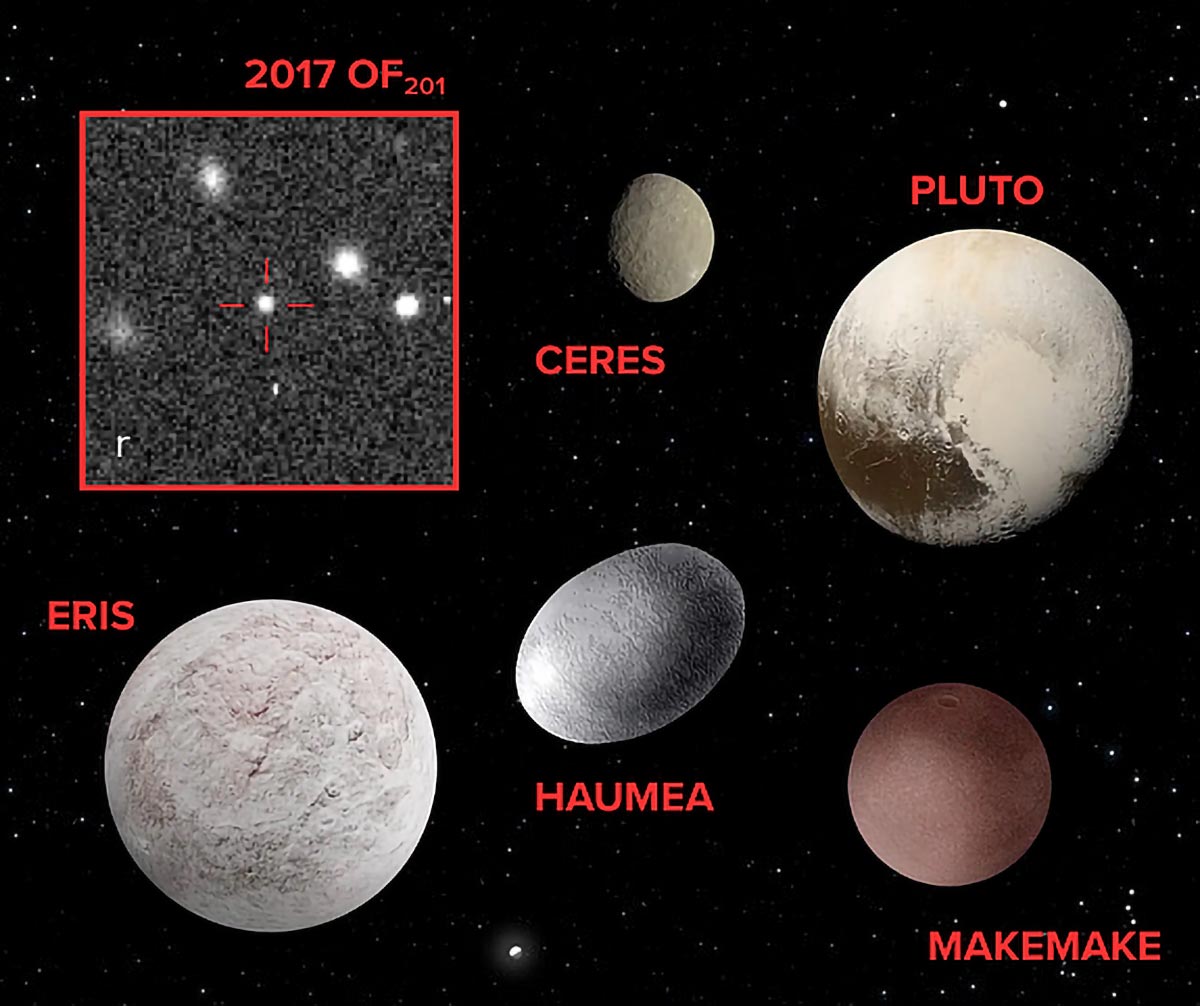
 Based on its estimated size, 2017 OF 201 could meet the criteria for classification as a dwarf planet, placing it in the same category as Pluto . It is among the most distant objects ever observed in the solar system and indicates that the region beyond Neptune in the Kuiper Belt , long assumed to be nearly empty, may in fact harbor more bodies than expected.
Cheng, working with Princeton University collaborators Jiaxuan Li and Eritas Yang, detected the object using advanced computational techniques designed to reveal distinctive orbital patterns across the sky. The discovery was confirmed by the International Astronomical Union⁘s Minor Planet Center on May 21, 2025, and was also described in a preprint released on arXiv.
⁘The object⁘s aphelion⁘the farthest point on the orbit from the Sun⁘is more than 1600 times that of the Earth⁘s orbit,⁘ explains Cheng. ⁘Meanwhile, its perihelion⁘the closest point on its orbit to the Sun⁘is 44.5 times that of the Earth⁘s orbit, similar to Pluto⁘s orbit.⁘
This extreme orbit, which takes the object approximately 25,000 years to complete, suggests a complex history of gravitational interactions.
⁘It must have experienced close encounters with a giant planet, causing it to be ejected to a wide orbit,⁘ says Yang. ⁘There may have been more than one step in its migration. It⁘s possible that this object was first ejected to the Oort cloud, the most distant region in our solar system, which is home to many comets, and then sent back,⁘ Cheng adds.
Cheng and his team estimate that 2017 OF 201 is about 700 km in diameter, which would make it the second largest object discovered with such an extended orbit. For comparison, Pluto⁘s diameter is 2,377 km. The researchers note that further observations, possibly with radio telescopes, will be required to measure the object⁘s true size more precisely.

No comments:
Post a Comment