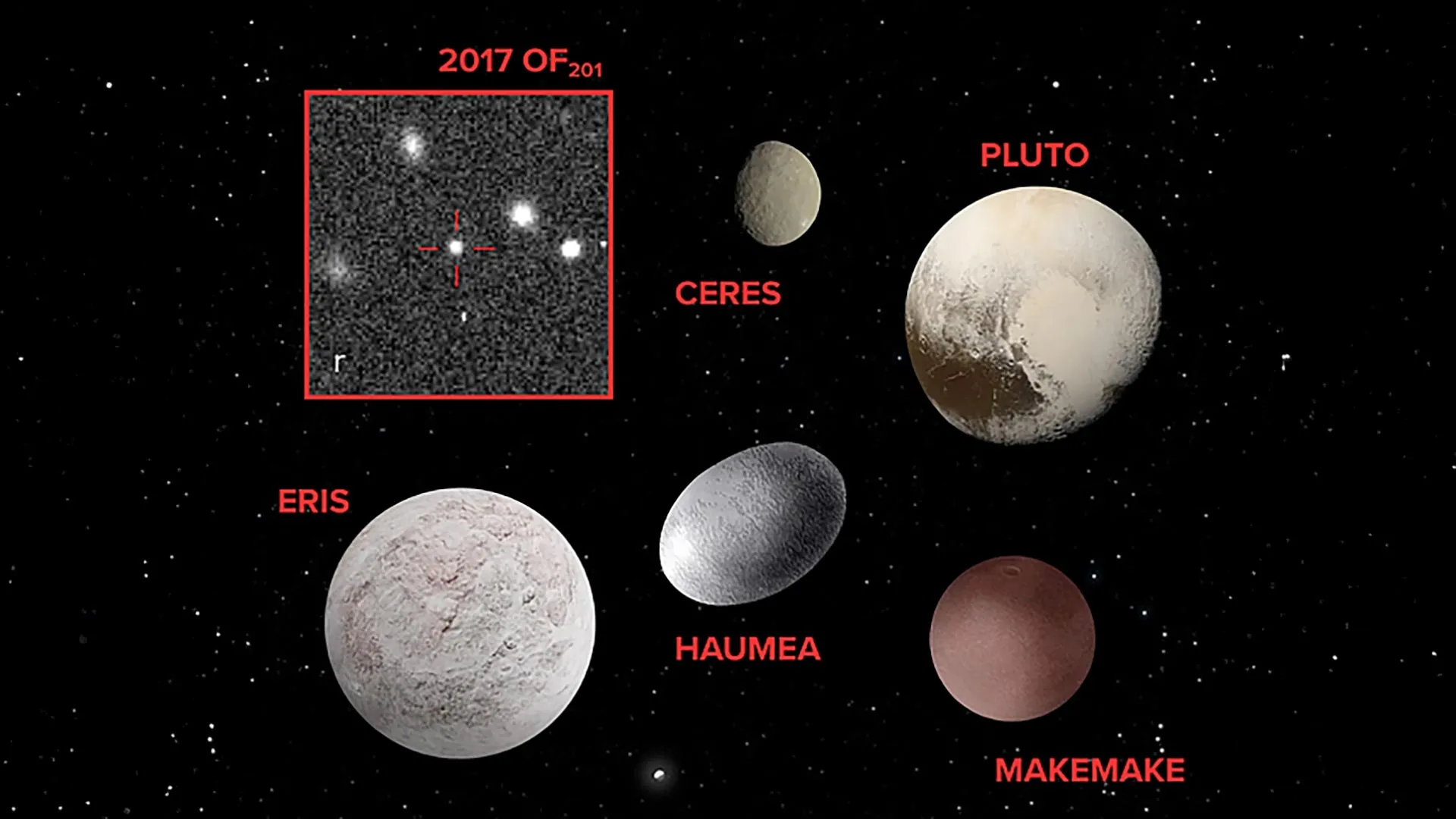
The TNO is potentially large enough to qualify as a dwarf planet, the same category as the much more well-known Pluto. The new object is one of the most distant visible objects in our solar system and, significantly, suggests that the empty section of space thought to exist beyond Neptune in the Kuiper Belt is not, in fact, empty at all.
Cheng made the discovery alongside colleagues Jiaxuan Li and Eritas Yang from Princeton University, using advanced computational methods to identify the object's distinctive trajectory pattern on the sky. The new object was officially announced by the International Astronomical Union's Minor Planet Center and in an arXiv pre-print.
⁘The object's aphelion -- the farthest point on the orbit from the Sun -- is more than 1600 times that of the Earth's orbit,⁘ explains Cheng. ⁘Meanwhile, its perihelion -- the closest point on its orbit to the Sun -- is 44.5 times that of the Earth's orbit, similar to Pluto's orbit.⁘
This extreme orbit, which takes the object approximately 25,000 years to complete, suggests a complex history of gravitational interactions.
⁘It must have experienced close encounters with a giant planet, causing it to be ejected to a wide orbit,⁘ says Yang. ⁘There may have been more than one step in its migration. It's possible that this object was first ejected to the Oort cloud, the most distant region in our solar system, which is home to many comets, and then sent back,⁘ Cheng adds.
Cheng discovered the object as part of an ongoing research project to identify TNOs and possible new planets in the outer solar system. The object was identified by pinpointing bright spots in an astronomical image database from the Victor M. Blanco Telescope and Canada France Hawaii Telescope (CFHT), and trying to connect all possible groups of such spots that appeared to move across the sky in the way a single TNO might.
This search was carried out using a computationally efficient algorithm produced by Cheng. Ultimately, they identified 2017 OF 201 in 19 different exposures, captured over 7 years.

No comments:
Post a Comment