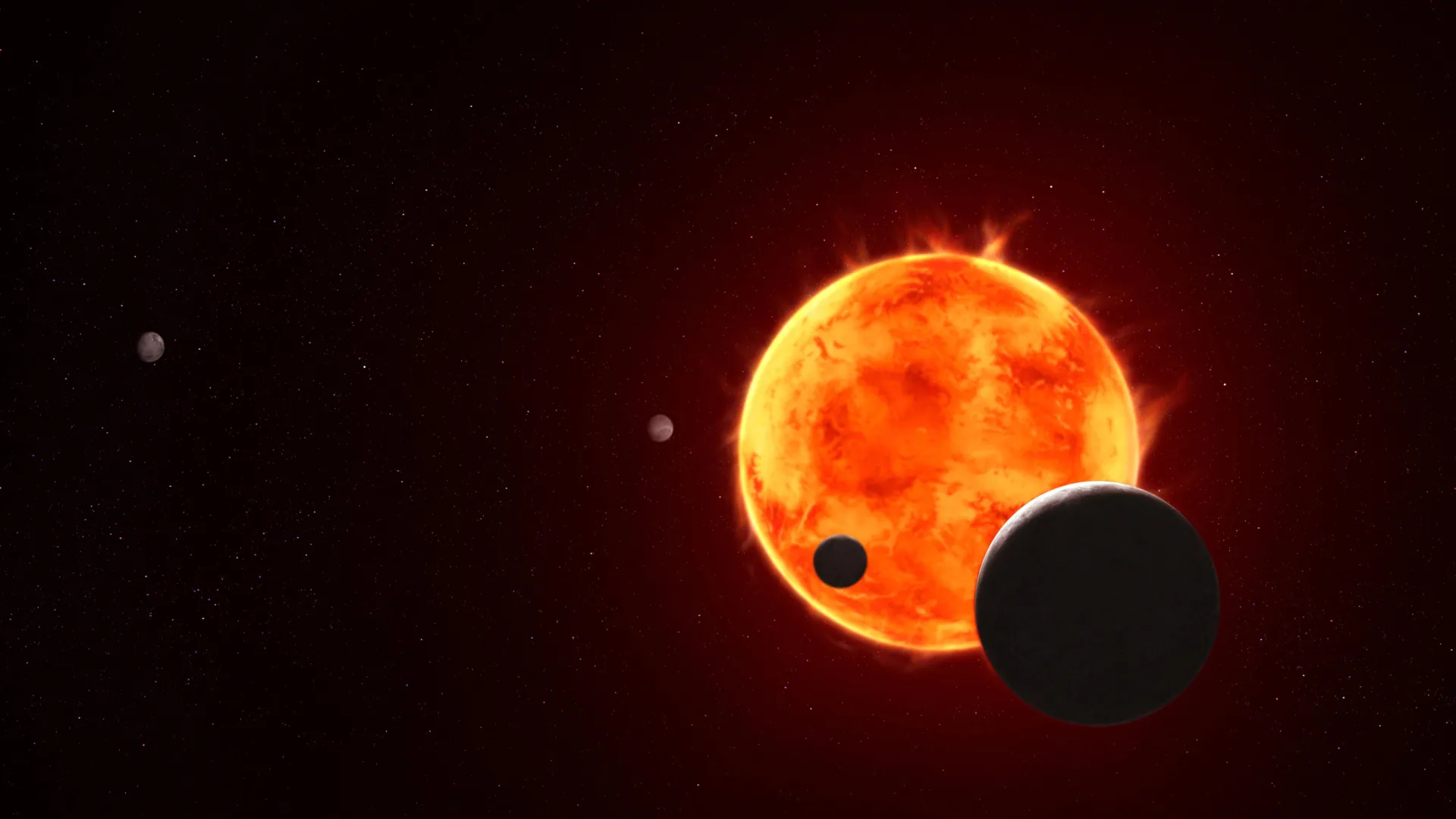
The TRAPPIST-1 system, a collection of seven planets orbiting a small, cool star, has long fascinated astronomers due to its striking resemblance to our own solar system, albeit in a scaled-down version. Located approximately 39 light-years from Earth, this planetary family has been the subject of intense study, particularly with the recent deployment of NASA's James Webb Space Telescope. Sukrit Ranjan, an assistant professor at the University of Arizona's Lunar and Planetary Laboratory, and his research team have made groundbreaking observations of the TRAPPIST-1 system using the James Webb Space Telescope. Their findings, published in the Astrophysical Journal Letters, offer a nuanced glimpse into the possible atmospheric composition and surface characteristics of TRAPPIST-1e, one of the system's Earth-size planets. According to Ranjan, "The basic thesis for TRAPPIST-1e is this: If it has an atmosphere, it's habitable." However, he cautions that the first-order question must be, "Does an atmosphere even exist?" This query underscores the complexity and uncertainty surrounding the planet's properties. The research team employed the James Webb Space Telescope's powerful Near-Infrared Spectrograph (NIRSpec) to investigate the presence of an ← →
Two recent scientific papers report the first detailed observations of the TRAPPIST-1 system made with NASA's James Webb Space Telescope.Related materials: Visit website

No comments:
Post a Comment