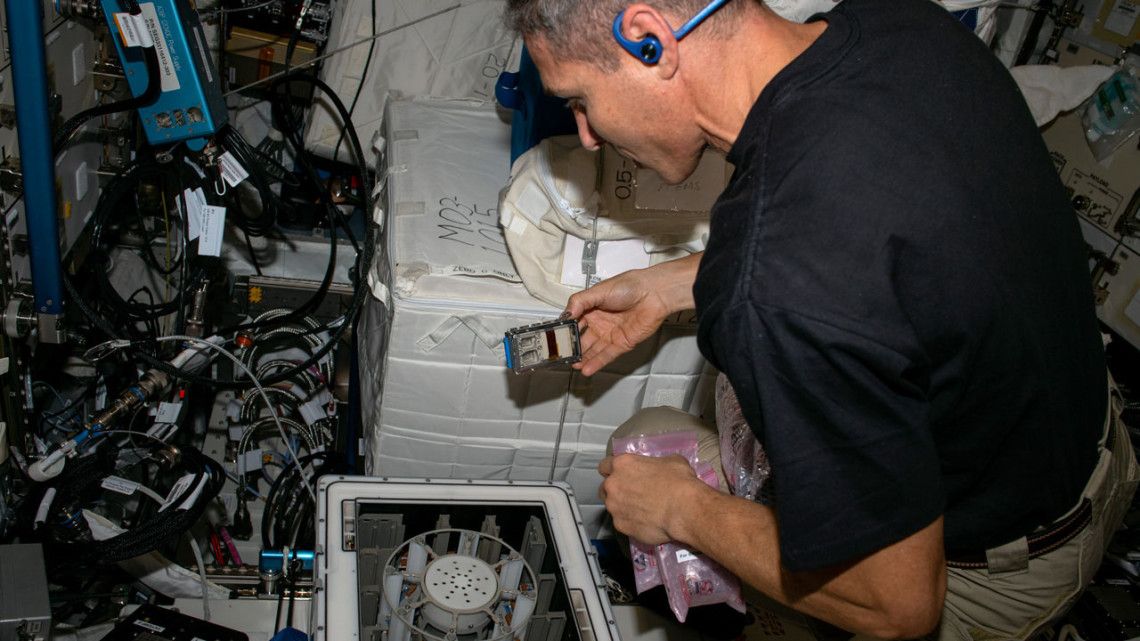
The darkness of space had long been a barrier to extracting precious metals from meteorites, but a breakthrough experiment on the International Space Station has shed light on a novel approach. Scientists have successfully used microorganisms to mine meteorites, a method that could potentially support space exploration. The experiment, conducted by NASA astronaut Michael Scott Hopkins, utilized two distinct microorganisms: the bacterium Sphingomonas desiccabilis and the fungus Penicillium simplicissimum. These microbes "mined" the meteorite specimens by producing carboxylic acids, which attached themselves to minerals and released them into a liquid solution. The researchers, including Cornell professor Rosa Santomartino, sought to understand how the extraction method worked in space compared to Earth. And it was in the vastness of space that the fungus' microbial metabolism changed, allowing it to increase molecule production, including carboxylic acids. But what does this mean for the future of space exploration? The enhanced release of palladium, platinum, and other elements could be crucial in sustaining long-term space missions. Space provided details on this topic, highlighting the significance of this experiment in the context of space exploration. The fact that the method worked similarly in both space and Earth environments is a significant finding

No comments:
Post a Comment